
This guide breaks down MMA odds explained for readers who want a clear path into fight betting. It covers UFC odds and other promotions, explains moneyline odds, and shows how to read odds so you can judge probability and payout.
MMA betting is volatile and matchup-driven. With one-on-one fights, stylistic edges and quick finishes create micro-markets that bettors at Bet365, William Hill, and offshore books often target. This article highlights how sportsbooks translate assessments into prices and where value appears.
You will learn the basics of American moneyline odds and implied probability, common bet types like method of victory and round betting, and practical concepts such as bookmaker vig, closing line value, and finding positive expected value. The goal is to make fight betting less mysterious and more systematic.
MMA Odds Explained

Understanding fight lines starts with American odds. This moneyline explained format uses a plus or minus sign to show who is favored and how payouts work. A negative figure like -196 means the fighter is the favorite and you must risk $196 to win $100. A positive figure such as +152 marks the underdog and pays $152 on a $100 stake.
Convert American odds to implied probability to see how likely a sportsbook thinks an outcome is. For negative odds, use the absolute value divided by that value plus 100. Example: -150 becomes 150 / 250 = 60%. For positive lines, divide 100 by the odds plus 100, so +150 gives 100 / 250 = 40%.
Switching through formats helps, since many bettors use decimal odds or fractional odds depending on the site. Decimal odds show total return including stake, so 2.0 equals 50% implied probability. Fractional odds, common in the UK, express profit relative to stake, such as 3/1 for three units won per one staked.
Bookmakers add a margin known as betting vig or juice to ensure profit over time. A fair 50/50 matchup would be decimal 2.0 on both sides. Books might post 1.91 on each side instead, which embeds the vig and skews implied probability upward. That is why posted lines rarely reflect a true, fair market percentage.
Practical conversions clarify things: 3/1 equals 4.0 decimal and converts to +300 American. A 1/2 fractional becomes 1.5 decimal and shows as -200 in American odds. Learning these conversions makes comparing lines across Caesars, DraftKings, BetMGM, and international exchanges easier.
Use implied probability to spot value and to compare your own assessment with published lines. When you account for betting vig, you get a clearer picture of where an edge might exist and why two books can show different prices for the same matchup.
Core MMA Betting Markets and What the Numbers Mean
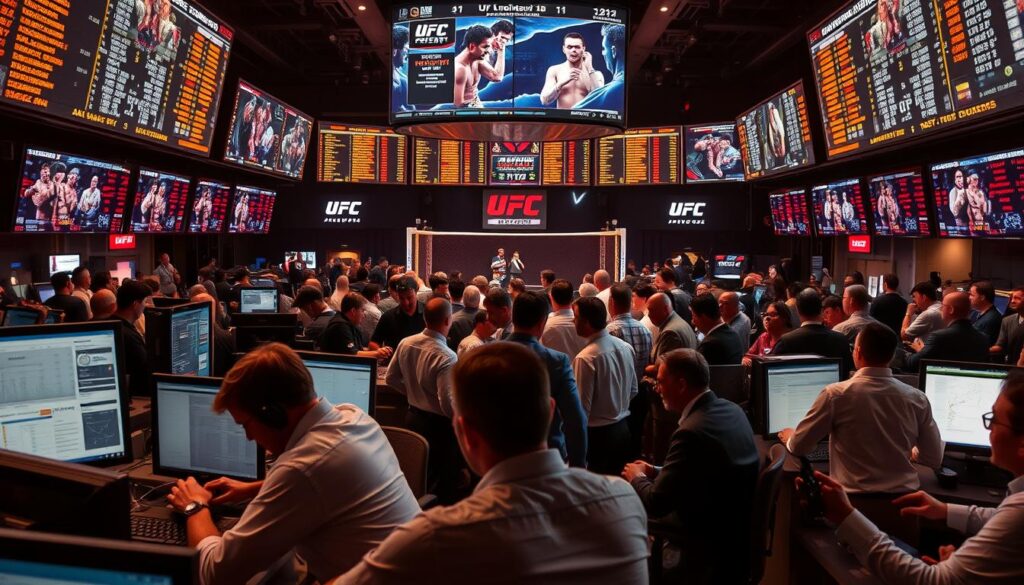
Betting on mixed martial arts centers on a handful of primary markets that every bettor should know. The simplest option is the fight winner market, often presented as a moneyline. This market covers all official win conditions a sportsbook recognizes. Payouts follow decimal conversions: stake × decimal odds equals return. For example, a £20 stake at 1.91 returns £38.20, giving a £18.20 profit.
Fight winner lines are staples on books like Bet365 and William Hill. Favorites show negative American odds while underdogs appear with positive numbers. These markets are ideal for straightforward wagers but can hide value when one fighter has an underrated style edge.
Method of victory markets let bettors predict how a bout ends. Options commonly include KO/TKO, submission, and decision. Books may bundle similar outcomes, such as KO/TKO/DQ or Submission versus Decision. Method markets tend to carry longer odds because they require a specific finish rather than any win.
Picking a method of victory suits bettors who trust matchup nuance. A grappler with a high submission rate facing weak submission defense will often offer attractive submission pricing. Outright finish props can reward research into fighter tendencies and historical finishing rates.
Totals rounds, presented as over/under lines, create a two-way market by using half-round increments like 2.5. Betting UNDER 2.5 means the fight ends in Rounds 1–2. Choosing OVER 2.5 means the bout continues into Round 3 or later. Totals reflect fighters’ durability, finish rates, and tempo.
Totals markets are useful when styles hint at either early pressure or long-term control. A heavy hitter versus an evenly matched technician might push the totals lower, while two grinders with low finish rates push totals higher.
Round betting raises variance by asking bettors to predict the exact round of a finish. Odds jump because specificity increases difficulty. A wager on a fighter to win in Round 2 pays far more than a simple moneyline bet.
Round + method markets combine round prediction with a finish type, creating some of the longest prices available. Examples include a fighter by submission in Round 3 or a KO in Round 1. These markets reward precise reads on pacing, cardio, and historical round trends.
Availability of these markets varies by event. Major UFC cards receive deep market coverage across fight winner, method of victory, totals rounds, and round betting. Smaller regional cards often list only the moneyline and basic totals.
How Bookmakers Set MMA Odds and Where Value Appears
Bookmakers set odds by first estimating each fighter’s true chance to win. Those estimates become the baseline for set odds. Sportsbooks then shorten the fair price to include a bookmaker margin so they earn regardless of the result.
Estimating probability vs. posted price
Bettors build models from tape, stats and camp news to estimate a fighter’s win likelihood. Compare your projection to the posted price to spot gaps. If your model says a fighter has a 55% chance but the market implies 41.7%, that difference signals opportunity.
Bookmaker margin, early lines, and line movement
Books create profit by compressing fair odds. An even market near 2.0 might appear as 1.9 once the bookmaker margin is applied. Early lines often show up on offshore or crypto books. Those releases can differ from later domestic numbers.
Line movement follows money flow and news. Public bets on a popular fighter push their price down. Sharp bettors trigger fast steam moves that books respect and mirror. Injuries, weight issues or late scratches produce sudden shifts in the market.
Finding positive EV and closing line value
Positive EV exists when your estimated chance exceeds the implied probability of a price. Use line shopping and timing to capture that edge. Taking early sharp lines or waiting for public overreaction are common tactics.
Closing line value measures how your bet compares to the final market. Consistently beating the closing line is a reliable indicator that your process finds value, independent of short-term results.
Public bias, sharp money, and market flow
Public bias often inflates favorites and star fighters. That bias creates exploitable discrepancies between true probability and the market price. Sharp money from professional syndicates can reverse those gaps quickly.
Monitoring steam, observing line movement, and following sharp money signals help identify where the market misprices outcomes. Use odds comparison tools to track shifts and to find the best available price before books correct liability.
Fight Analysis That Informs Odds Interpretation
Good fight analysis starts with a clear read of how two styles will interact. Stylistic matchups shape the pace and likely pathways to victory. A striker who lands heavy power shots forces different odds than a high-volume boxer who aims to outpoint opponents.
Stylistic matchups: striker vs. grappler, southpaw effects, volume vs. power
When a wrestler meets a knockout artist, anticipate a tug-of-war between takedown attempts and heavy counters. Southpaw stances can create angles that disrupt orthodox timing and raise the chance of head-kick opportunities.
Volume fighters can win on output even against one-punch finishers if they avoid getting clipped early. A single power shot changes the math for method markets and round totals more than cumulative output does.
Key metrics to check: takedown rates, finishing rate, strikes absorbed, cardio
Track takedown rates and takedown defense to estimate control time and late-round risk. Finishing rate reveals how often a fighter turns success into a stoppage. Compare strikes landed and strikes absorbed to gauge vulnerability under sustained pressure.
Cardio indicators like late-round pace and previous cardio-related losses tell you if a fighter is prone to fade. Use official databases such as UFC Stats for consistent numbers when translating metrics into betting angles.
Short-notice replacements, injuries, and weigh-in indicators that shift probability
Short-notice replacements often alter posted lines because preparation time changes both strategy and conditioning. A late add can create soft lines worth exploring for value, depending on matchup fit.
Weigh-in behavior and visible injuries matter. Missing weight or showing severe dehydration at the weigh-in can reduce power and stamina, shifting implied probability toward the opponent. Watch corner reactions and medical callouts for live-market cues.
| Factor | What to Check | How It Changes Odds |
|---|---|---|
| Stylistic matchups | Striker vs. grappler, southpaw angles, range control | Alters method markets and round total lines; impacts pre-fight favorite selection |
| Takedown rates | Successful takedowns per 15 min, takedown defense | Predicts control time and late-round scoring; lowers finishing rate for controlled fighters |
| Finishing rate | KO/TKO and submission percentage across career and recent fights | Increases odds for early finishes and boosts payouts on first-round markets |
| Strikes absorbed & cardio | Significant strikes absorbed, late-round output, past cardio issues | Raises probability of late stoppages or decision losses; affects live betting strategies |
| Weigh-in indicators | Missed weight, dehydration signs, visible injuries | Creates line movement; can create value when public ignores physical red flags |
| Short-notice changes | Replacement fighter record, camp readiness, stylistic fit | Often produces soft lines and volatility in pre-fight markets |
Advanced Markets and Live Betting Dynamics
Advanced markets give experienced bettors tools beyond the main moneyline. Prop markets cover first-round finish, total takedowns, knockdowns, first submission attempt, and niche stats. These lines move more than basic odds. Sharp players find value when public attention is low.
Live betting updates continuously during a fight. Lag-free streaming from UFC Fight Pass, ESPN+, or book-embedded feeds matters for timing. Spotting a fighter fading, visible damage, or corner urgency creates live edge triggers that a quick interface can exploit.
Offshore sportsbooks often post earlier and list deeper prop menus. They can show three-way markets and alternate lines not found at regulated U.S. sites. Crypto betting speeds deposits and withdrawals, but bettors must check licensing and payout reputation before staking funds.
Prop markets and specialized lines
Props include micro-markets such as first-round finishes, total takedowns, and knockdowns. Payouts vary widely between books, so odds shopping is essential. Film study and matchup nuance help identify mispriced props.
Live/in-play mechanics and streaming
Live markets let you bet updated totals, live methods, and round lines. Use reliable streams and fast platforms to act on momentum swings. Know how each book defines official actions to avoid disputes on close calls.
Futures, parlays, and round-robin strategies
Futures lock in long-term views on champions or contenders. Monitor injuries and matchmaking to adjust positions. Parlays boost payout potential while raising variance. Round-robin tickets split risk across multiple parlays to smooth returns.
Offshore and crypto book considerations
Offshore sites may show earlier lines and expanded MMA menus. Crypto betting offers privacy and speed, with Bitcoin and Ethereum common. Regulatory and security trade-offs exist; verify Curaçao or Panama licensing and read payout histories.
| Market | Typical Use | Pros | Cons |
|---|---|---|---|
| First-round finish prop | High-variance bets on fast fights | Large payouts, clear outcomes | High variance, sharp line movement |
| Total takedowns | Matchup-driven statistical play | Exploitable with film study | Scoring definitions vary by book |
| Live moneyline | React to in-fight momentum | Capture immediate value swings | Requires speed and low latency |
| Futures | Season-long or title bets | Big upside on early lines | Injury and layoff risk |
| Parlays / round-robins | Combine multiple legs for payout | Enhanced ROI if legs have EV | Compound variance, lower hit rate |
| Offshore / crypto books | Early access and broad menus | Expanded props, faster crypto deposits | Regulatory and payout risk |
For a deeper dive into advanced prop strategies and metrics like striking efficiency and round-by-round micro-props, see this advanced MMA prop betting guide. Use that context when mixing MMA props with live betting, futures, parlays, offshore sportsbooks, or crypto betting to build a coherent approach.
Responsible Strategy, Bankroll Management, and Common Mistakes
Good wagering starts with rules that protect your money and your mindset. Use a clear plan to avoid impulse moves and keep betting sustainable across big UFC cards and quieter fight nights.
Stake a fixed percentage of your bankroll on each wager. Many successful bettors use 1–3% depending on risk tolerance. For high-variance markets like prop bets or round markets, drop your stake toward the lower end of that range.
Set daily or weekly deposit caps. Predefine maximum exposure per card and expect variance on cards with 10–15 fights. Adjust percent-per-bet when variance rises to protect capital.
Avoiding rookie errors
Do not bet every fight. Sharp bettors often pick 2–4 strong spots per card. Over-betting the card erodes edge and increases volatility.
Skip blind parlays that rely on hype. Only combine legs where each selection has standalone value. Chasing losses and betting on tilt are quick ways to lose discipline and funds.
Watch weigh-ins, short-notice replacements, and late scratches. Ignoring these events ranks among the most common mistakes and can turn a routine wager into a bad one.
Odds shopping and tools
Use odds shopping across regulated books to find the best price. A small difference in odds compounds across a season and impacts ROI.
Track closing line value, steam moves, and early lines with simple tools or spreadsheets. Combine statistical databases for takedown rates and finishing percentages with tape study to refine bets.
Redeem promos and boosted odds selectively. Read rollover terms and market limits before using bonuses to ensure they truly add value.
| Area | Practical Rule | Why it Matters |
|---|---|---|
| Percent-per-bet | 1–3% of bankroll; reduce on high-variance markets | Preserves capital and smooths variance over time |
| Bet selection | 2–4 quality bets per card | Focus increases research depth and improves edge |
| Deposit limits | Set daily/weekly caps | Controls losses and supports responsible betting |
| Odds shopping | Compare multiple regulated books before placing | Small price differences boost long-term ROI |
| Tools & tracking | Monitor CLV, line moves, and fighter metrics | Helps identify profitable patterns and common mistakes |
| Promo use | Read terms; avoid forced bets | Prevents surprises that reduce expected value |
Follow these practices to maintain discipline and reduce risk. Treat betting as a long-term activity, prioritize bankroll management, embrace responsible betting, use odds shopping to your advantage, and learn from common mistakes to improve over time.
Conclusion
This MMA betting summary wraps up the essentials: MMA Odds Explained starts with American moneyline odds, converting them to implied probability, and remembering the bookmaker vig. Core markets — fight winner, method of victory, totals, and round bets — all require clear interpretation before staking money. Understanding how lines move and where sportsbooks add margin is part of basic market literacy.
For a practical betting strategy overview, combine metrics like takedown rates, finishing percentages, and strikes absorbed with stylistic matchup analysis. Build your own probability projections and compare them to posted odds to hunt for positive expected value. Odds shopping and tracking closing line value help measure whether your model is producing an edge over time.
On execution, manage bankroll with percent-per-bet rules and avoid emotional chasing or over-betting the card. When you know a matchup well, explore prop markets and use live betting with a reliable stream to exploit in-play inefficiencies. Offshore and crypto books can offer earlier lines, but treat them cautiously and account for counterparty risk.
Ultimately, how to bet MMA successfully is about process over hype: consistent projection quality, disciplined bankroll management, and timely market engagement—early or live—are the factors that deliver long-term results.