
American bettors put more than 70% of public tickets on favorites in many marquee matches, but the dollars often tell a different story — and that split is where sharp money soccer signals hide.
This section explains how betting splits reveal who really moves lines in soccer betting markets. Tickets show the crowd’s sentiment; handle shows where larger, professional stakes sit. Together, these metrics help U.S. bettors read public vs sharp flows and spot soccer betting trends worth watching.
Key Takeaways
- Betting splits separate percent of bets (tickets) from percent of money (handle) to show public vs sharp influence.
- Large gaps — e.g., low ticket share but high money share — often indicate sharp money soccer involvement.
- Follow live feeds and public reports from books like DraftKings and Circa; update cadence matters for interpretation.
- Use splits alongside line movement, injury news, and closing-line checks; splits are signals, not guarantees.
- For practical guidance and live examples of public-money reports and betting splits, review resources such as public money reports.
Understanding bet splits and how they explain soccer betting markets
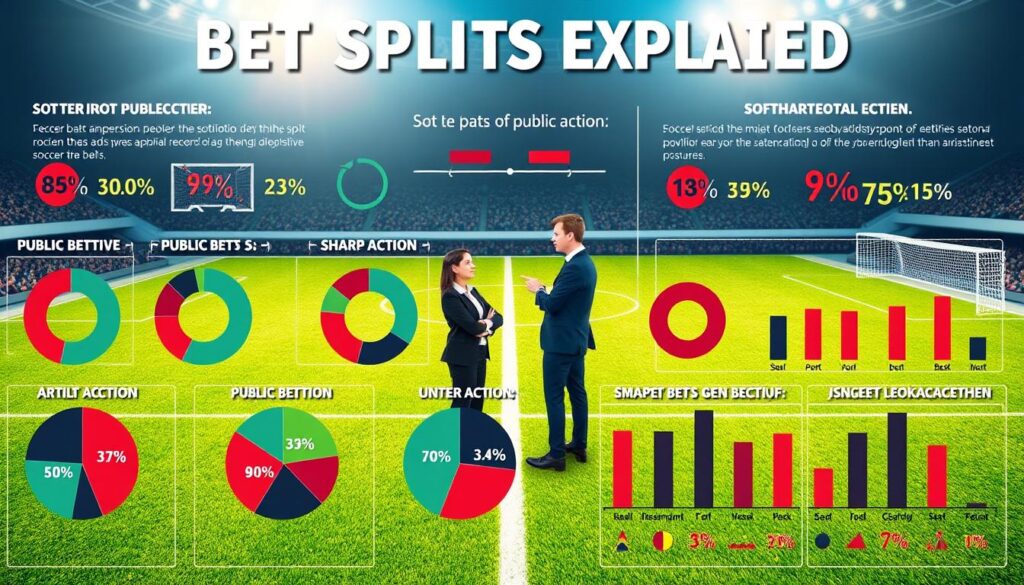
Bet splits explained: these charts show two core metrics that help decode market behavior. One metric counts individual wagers—soccer bet tickets—expressed as a percent of bets. The other measures money on each side, shown as percent of money or handle. Watching tickets vs handle reveals whether casual fans or larger bettors dominate a market.
What bet splits show: tickets (percent of bets) vs dollars (percent of money)
Tickets reflect how many people back a side. A high ticket share often signals public betting trends tied to narratives, recent form, or star names. Dollars capture where the real cash lands and can signal professional interest when handle indicates pros more than ticket counts suggest.
Why tickets often reflect public sentiment and handle often signals larger wagers
Recreational bettors usually create lopsided soccer bet tickets. Pros use larger stakes, shifting percent of money without raising ticket totals. That gap creates smart money signals when money significantly exceeds ticket share. Look for “low bets, higher dollars” patterns as a sign to investigate further.
How spread, moneyline and totals each tell different stories in soccer markets
Soccer spread betting (including Asian handicaps and goal lines) often shows different behavior than soccer moneyline or totals betting. Fans may favor favorites on spreads, while pros sometimes exploit moneyline value on underdogs. Totals and over/under soccer markets attract sharps who focus on pace and defensive metrics, producing split patterns unique from match-winner markets.
Key data caveats: sportsbook source, update frequency, and market coverage
Bet split reliability depends on which books feed the chart and how often data refreshes. DraftKings vs Circa represents two distinct customer bases; DraftKings often mirrors broad retail sentiment while Circa can show higher-limit, pro action. Data update frequency matters: some services push updates every five minutes, others every 30 minutes, changing how fast smart money signals appear.
Not all splits cover every sportsbook. Verify whether a provider aggregates multiple operators or shows a single-book view. For a practical primer on these concepts, see a clear guide to betting splits at betting splits explained.
- Check tickets vs handle to separate public bias from larger wagers.
- Compare spread, moneyline, and totals betting for different market dynamics.
- Account for sportsbook data caveats and data update frequency before drawing conclusions.
Spotting public bias and contrarian value in soccer betting
Public money often shapes markets more than it should. When ticket splits skew, sharp bettors look for value on the less popular side. This short guide shows how to read lopsided tickets, apply a contrarian betting approach, and use a simple betting workflow to mark plays worth investigating.

Reading lopsided ticket percentages to identify public leans (65% public threshold)
Use the 65 percent rule as a quick filter. If 65 percent or more of tickets sit on one side, the market shows a strong public lean. Lopsided tickets at that level often create mispricing, especially in large markets like Premier League and MLS matches.
Using the contrarian rule: when 35% or fewer tickets points to the unpopular side
Tag the side with 35 percent or fewer tickets as your contrarian candidate. The 35 percent contrarian mark highlights when crowds have heavily favored one team. Contrarian betting means you may bet against the public when analytics suggest the unpopular side offers better value.
Real-world soccer examples: when star players, recent form, or home crowds drive public tickets
Soccer public drivers include star player betting, recent form bias, and the home crowd effect. A high-profile striker returning from injury will draw tickets fast. A string of wins can create recent form bias that inflates prices. Home crowds prompt many casual bettors to back the host, even when data says otherwise.
Practical checklist: scan slates, mark lopsided games, verify context, and track results
- Scan slates soccer early to find games with heavy ticket splits.
- Apply a bet splits checklist: mark games with 65%+ public and identify the ≤35% contrarian side.
- Check money-minus-ticket gaps and shop lines before committing.
- Verify context for injuries, late lineups, weather, or travel that affect value.
- Decide based on your ratings and bankroll rules, not headlines alone.
- Track betting results and closing-line behavior to refine which signals work for you.
Detecting sharp action: money vs ticket discrepancies and professional indicators
Sharp bettors move markets in ways ticket counts do not always show. Watch the split between money and tickets to spot sharp money indicators that hint at pro involvement. A focused scan of money vs tickets helps separate retail noise from informed wagers.
Low bets, higher dollars is a common pattern. Use the 10 percent rule as a threshold: a money-minus-ticket gap of 10% or more often flags value. For example, tickets 40% and dollars 65% suggest large wagers on the less-bet side.
- H3: “Low bets, higher dollars” — interpreting a 10%+ money-minus-ticket gap
In practice, an underdog with 33% tickets and 55% dollars shows sharp interest. Totals where the public favors the over in tickets while the handle leans under deserve a closer look. These signals are clues, not proof; verify timing and context before acting.
- H3: How reverse line movement and line freezes can signal pro money in soccer
Reverse line movement happens when the line shifts opposite ticket direction. That pattern is often a sharp reverse. A line freeze, where heavy tickets produce little movement, can mean sportsbooks are protecting liability or waiting on action from high-limit books. Both events are key sharp money indicators for market movement soccer.
- H3: Why comparing multiple books (DraftKings vs Circa style examples) strengthens the signal
Compare sportsbooks to strengthen your read. DraftKings Circa differences are common: DraftKings often shows retail lean while Circa can show larger dollars. If DraftKings posts 75% tickets one way and Circa shows big dollars the other way, sharps vs public divergence becomes clearer. Multi-book analysis reduces single-book bias.
- H3: Examples of sharp indicators in matchups: moneyline, spread and total scenarios for soccer
Moneyline sharp examples soccer: an underdog with 30% tickets and 60% dollars signals belief in an upset. Spread sharp spots include sides with ≤35% tickets but +10% dollars and late movement back to that side. Totals sharp signs show heavy over tickets but the handle favoring the under; check injuries, lineups, and weather for reasons sharps might pivot.
Track coordinated reverse line movement across operators and look for consistent money-minus-ticket gaps. That pattern, paired with timing around line freezes and late bets, offers a practical path to spotting pro money in soccer markets.
Applying a responsible, data-driven workflow to soccer wagering decisions
Start with a clear soccer betting workflow: scan bet splits across moneyline, spread/goal line, and totals for multiple books. Mark games where tickets show public lopsides (≥65%) and isolate contrarian sides with 35% or fewer tickets. Treat each market separately because totals, spreads, and moneylines often tell different stories.
Next, hunt for money-minus-ticket gaps of 10% or more and compare lines across DraftKings, Circa, and other trusted books. Use data feeds like VSiN that report frequent updates so late sharp action is visible. Verify injuries, lineup timing, and news that could explain abrupt splits or reverse line movement before committing funds.
Decide stakes based on your ratings and bankroll rules, then line-shop to secure the best price. Record every wager, closing-line data, and ROI to test which bet splits strategy patterns translate into long-term edge. Avoid treating splits as guarantees or chasing extreme numbers without context.
Practice responsible sports betting: set limits, wager within means, and contact the National Council on Problem Gambling if you need help. When combined with line movement, multi-book checks, and matchup analysis, a disciplined, data-driven wagering approach improves decision quality—while remembering splits are signals, not certainties.

