
League tracking shows the Los Angeles Lakers’ bench is producing just 24.5 points per game—the fewest in the NBA—while starters deliver a league-high 93.9 points, the second-most since 1996-97. That split spotlights how bench scoring, bench net rating and reserve players now swing game outcomes more than ever.
The central thesis is simple: NBA depth matters. A dominant starting five can hide structural problems, but weak bench units turn late-game margins into lasting losses. The Lakers’ reserves attempt only 18.9 field goals per game, 6.3 fewer than the next-closest team, and are being outscored by opposing second units by 12.5 points nightly—a staggering drop-off that costs possessions and momentum. For further context on Los Angeles’ transition defense and bench rotation, see this Lakers notebook on transition and bench trends: Lakers bench and transition analysis.
Contrast that with teams that invest in a balanced bench unit or nurture a reliable sixth man. Reserve players who supply scoring, defense and pace give coaches flexibility and preserve starter energy. Examples range from college pipelines that deliver prepared pros to front-office moves that convert depth into wins. This article argues that optimizing bench scoring and bench net rating is the most efficient lever for improving overall team performance.
Key Takeaways
- Bench scoring and bench net rating are increasingly decisive for modern NBA outcomes.
- Over-reliance on starters, as with the Lakers, exposes teams to second-unit collapses and transition vulnerabilities.
- Well-constructed reserve players and a true sixth man can sustain pace and defensive intensity.
- Roster construction should balance offensive firepower with bench versatility to protect leads and close games.
- Small investments in bench depth often yield outsized returns in wins and lineup flexibility.
How nba bench impact is reshaping modern rosters
The rise of bench valuation has pushed teams to study reserve production with the same rigor they use on starters. Front offices lean on NBA analytics to measure bench scoring trends, bench minutes and bench net rating per 100 possessions. Those metrics feed decisions in roster construction and rotation design, guiding where to spend minutes and who to trust in high-leverage moments.
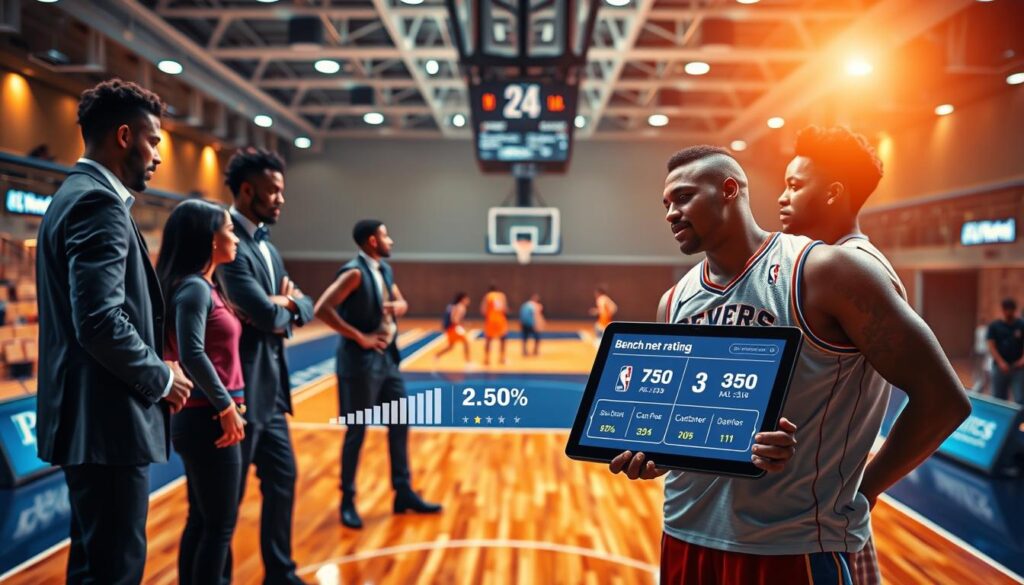
Statisticians and coaches now track bench differential across games to spot weaknesses. Bench pace and bench minutes affect how a team manages load management and depth strategy. A short drop in bench scoring trends can signal a need for fresh role players or a tweak in rotation design.
Teams monitor reserve production through per-36 and per-100 metrics, then compare bench net rating to starters. This practice highlights gaps where starters vs bench mismatches emerge and where defensive speed or reserve athleticism must improve.
Statistical shifts: scoring, minutes and net rating from reserves
Analytics reveal how fewer attempts from the second unit changes outcomes. When bench scoring trends drop, the bench net rating often follows. That effect shows up in bench differential charts and forces adjustments in bench minutes to re-balance offense and defense.
Per-minute outputs from reserves can paint a different picture than raw points. Coaches use these numbers to value players who provide consistent reserve production even with limited minutes. This approach reshapes rotation design and the emphasis on sustainable bench minutes.
Bench contributions to transition opportunities and pace
Reserve athleticism drives how teams attack and defend in transition. Faster benches boost bench pace and generate transition points allowed advantages for the offense. Teams with slower reserves suffer in transition defense and see opponents score on quick possessions.
Transition defense hinges on defensive speed and sprinting off stops. When the bench sustains tempo, starters can rest without a drop in pressure. That dynamic changes load management choices and how coaches structure late-game minutes.
Roster construction trade-offs: starters vs. bench balance
Front-loaded talent can yield a dominant starting five but create a thin second unit. That trade-off affects both short-term wins and long-term resilience. Roster construction must weigh elite starter production against the risk of bench inefficiency and transition vulnerabilities.
Investing in trustworthy reserves reduces the strain on starters and supports flexible rotation design. A deliberate depth strategy allows teams to maintain pace, protect against fatigue and respond to in-game swings without sacrificing defense or offensive flow.
Real-world examples of bench units changing outcomes

The modern bench can flip a game in minutes. Below are three team-level stories that show how rotation choices, player development and roster balance shape results on the court.
New York Knicks: depth and tactical adjustments
The Knicks leaned into a deeper rotation after Leon Rose and the front office made targeted moves. Mike Brown rotation choices mirrored the Pacers blueprint: speed, physicality and sprinting off stops.
That philosophy helped the Knicks win the Emirates NBA Cup. Tyler Kolek emerged as a defensive-minded backup point guard, while Jordan Clarkson supplied instant offense off the bench. Mitchell Robinson bench move gave New York fresh energy; his offensive rebounding numbers spiked and he produced key boards in the Cup final.
Trusting reserves changed outcomes. Knicks depth allowed starters to rest without a collapse. The blend of role players and top-end talent converted minutes into tangible wins.
Arizona State and college-to-pro pipeline impact
Arizona State shows how program-level bench building pays off. After depth struggles, the Arizona State bench became a core strength early in the season.
Players like Anthony “Pig” Johnson and Allen Mukeba carved defined roles, while Noah Meeusen handled backup playmaking duties. This college bench development balanced inside and outside scoring and tightened defense game to game.
Such sixth man development can feed the pipeline to NBA teams. Mid-major recruitment and non-traditional scouting often uncover players who translate reserve roles into pro minutes.
Contrast: Lakers’ bench struggles and consequences
The Lakers serve as a cautionary tale. A thin second unit has driven clear problems in transition and scoring.
Lakers bench struggles show up in the numbers. The club ranks poorly in Lakers transition defense and generates limited Lakers bench scoring. Star-heavy minutes, including extended LeBron minutes, mask rotation flaws but raise fatigue risks.
Persistent Lakers rotation issues force coaches into short-term fixes. Teams that fail to fix bench gaps leave themselves exposed in close games and long playoff series.
Coaching, strategy and practical steps to maximize bench value
Coaches and front offices can turn reserves into decisive assets by adopting clear coaching bench strategy and deliberate rotation design. Start with an 8–11 player rotation and assign distinct bench roles: change-of-pace big, scoring spark, defensive stopper, and backup point guard. Trusting players in those roles, as seen when a coach shifted a starting center to the second unit, often creates immediate momentum swings.
Use data-driven bench tactics to identify weaknesses and opportunities. Track bench net rating, transition points allowed with the second unit, offensive rebound rates per minute, and usage for bench shot attempts. Early-season in-game adjustments and lineup experiments reveal pairings that hold pace without sacrificing defense. This process supports smarter minutes management and reduces starter fatigue over the long haul.
Invest in player development and scouting to widen the talent pool. Target mid-major standouts, NAIA standouts, and versatile role players who fit specific bench needs. Build development programs that create a reliable sixth-man pipeline and pair athletic wing defenders with veteran scorers—following the Jordan Clarkson model—to stabilize second-unit offense while preserving transition defense.
When coaching bench strategy, prioritize athleticism, mobility, and quick recovery to limit opponent transition points. Combine that with rotation design that redistributes minutes to keep starters fresh. These practical steps—scouting, targeted acquisitions, metrics tracking, and agile in-game adjustments—raise the odds of consistent margins, better transition defense, and deeper postseason resilience.

