
Referees who average more than 4.5 yellow cards per game now tilt live betting markets and fan conversations before kickoff. On December 3, 2025, Abongile Tom’s second-yellow dismissal of Teboho Mokoena in the 81st minute of Mamelodi Sundowns vs. Sekhukhune United reignited a referee controversy that cost Sundowns two points and fueled calls for clearer officiating standards.
Across Europe, Xabi Alonso’s public criticism of Alejandro Quintero Gonzalez after Real Madrid’s 2–0 loss to Celta Vigo amplified the narrative that inconsistent enforcement and permissive timekeeping change match rhythms and outcomes. That game featured multiple dismissals and debates over discipline, showing how refereeing can reshape standings and managerial pressure.
For U.S. bettors and analysts, these incidents matter beyond headlines: referee card rates feed directly into predictive tools such as a Second-Half Goals Model and influence in-play betting behavior. A known high card referee can push bookmakers’ lines, prompt rapid live betting reaction, and alter perceived value in corner and card markets.
To understand how to exploit this edge responsibly, bettors should track match-by-match referee histories and compare individual metrics to league averages. Detailed referee analytics, like those summarized in this referee-style breakdown, help frame betting integrity questions and reveal when markets may be mispriced.
Key Takeaways
- High card referees can shift in-play betting and second-half goal probabilities before a ball is kicked.
- Recent cases—Abongile Tom in South Africa and Alejandro Quintero Gonzalez in La Liga—illustrate how decisions influence results and sentiment.
- Referee card rates are best used relative to league averages when adjusting predictive models.
- Live betting reaction often creates short-term value when bookmakers ignore referee history.
- Maintaining betting integrity requires verified match-by-match referee data and cautious bankroll management.
- For a primer on referee styles and metrics, see this referee-style resource: referee card strategy guide.
How a High Card-Rate Referee Changes Live Betting and Fan Sentiment
When a match features a known card-heavy referee, the atmosphere shifts before kickoff. Bettors, broadcasters, and fans note the referee assignment and expect more stoppages, bookings, and stricter enforcement. That expectation feeds social media reaction and alters how people approach live betting once the whistle blows.

Immediate social media reaction and punditry
High-profile incidents draw fast, emotional responses on Twitter and in broadcast commentary. Clips of late red cards and debatable second yellows trend quickly. SuperSport TV replayed contentious moments while pundits parsed the criteria for dismissals. Coaches speak carefully in post-match interviews, yet criticism from figures like Xabi Alonso intensifies the debate about consistency and fairness.
Impact on in-play markets and bettor behavior
Sendings-off change match math. A late red reduces attacking options and raises the chance a team concedes, so markets for second-half goals and handicaps swing toward the under. Sharp bettors shift stakes into card props and low-goal outcomes. Model-driven traders update probabilities for stoppages, added time, and tactical changes that follow a dismissal.
Bookmaker reaction and line movement
Bookmakers watch referee histories and tweak betting lines before kickoff when a card-heavy referee appears. After controversial calls, operators may suspend markets or widen spreads to manage liability. Odds movement often favors lower goal totals when a team loses a player, while liquidity shifts into cards and next-goal markets as cash-out activity rises.
These dynamics link fan sentiment, media narratives, and market mechanics. Understanding how referee behavior shapes in-play markets helps bettors and bookmakers navigate rapid odds movement during volatile moments.
Second-Half Goals Model: Integrating Referee Card Rates into Predictive Betting
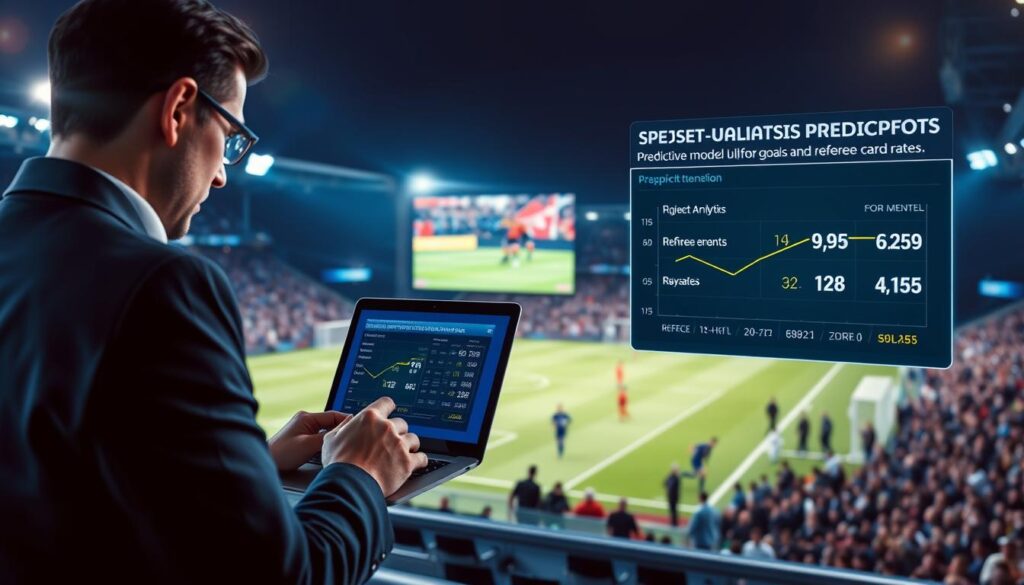
The Second-Half Goals Model updates live forecasts when referee behavior shifts game dynamics. This short primer shows why referee card rates matter, what model inputs to include, and how bettors can convert updated probabilities into an actionable betting strategy. The approach blends event-level evidence with a practical in-play prediction model that reacts to bookings and dismissals.
Why referee behavior matters for second-half goal probabilities
Referees who hand out many cards change match flow. A red or second yellow often reduces the sanctioned team’s attacking output and increases the opponent’s chance to score. Historical episodes, from late dismissals in major club fixtures to international tournaments, show large shifts in expected goals and stoppage patterns.
High card-rate officials raise the prior probability of a sending-off, more stoppages, and longer added time. Those factors shift timing and volume of second-half chances, which a predictive betting framework must capture to produce reliable live odds.
Data inputs and model adjustments
Core model inputs include team-level xG by half, xG conceded, current scoreline and time, substitutions, plus player discipline records. Referee card metrics should appear as explicit covariates: cards per 90, cards per match, second-yellow propensity, and late-card frequency.
Supplementary inputs cover referee appointment profile and historical referee-team interactions. Context variables such as tournament stage and fixture congestion help refine the baseline. Event datasets, including major-league incidents and tournament matches, support calibration.
The modeling mechanics mix Bayesian updating and hazard-rate timing. Pre-match goal-rate forecasts receive statistical adjustment when a high card-rate referee is assigned or when bookings occur. Hazard modeling handles sequencing of goals while Poisson or negative-binomial processes capture count uncertainty. Reduce expected-goal parameters for a team down to ten men and increase variance for chaotic late-game scenarios.
Practical betting strategies using the model
Pre-match tactics: when a high card-rate referee is named, favor card props and lean toward lower second-half goal expectations. Market edges often appear on under goals or team-specific unders, especially when a defensively disciplined side faces a card-prone official.
In-play tactics: after a late booking or sending-off, apply the in-play prediction model to recalibrate probabilities. Cut exposure on the team with a sending-off for scoring markets and consider backing the opponent in next-goal or short-window handicap markets. The Bayesian-updated model highlights lines where bookmakers lag the rapid shift.
Event-specific signals: watch managerial response and club history. Measured containment by a coach suggests reduced risk taking after a red card, while teams that erupt into dissent can produce volatile scoring and larger variance in outcomes. Use those signals to widen or tighten stake sizes.
For readers who want empirical grounding, a focused econometric study of referee effects and timing can be found at this article, which offers event-level methods and referee covariates suitable for calibrating model inputs.
Wider Sporting Context: Officiating Controversies, Accountability, and Betting Integrity
High-profile incidents—from the Abongile Tom–Teboho Mokoena moment in the Betway Premiership to the Real Madrid–Celta Vigo clashes—have sharpened public focus on officiating controversies. Media scrutiny and manager criticism, such as Xabi Alonso’s comments about Alejandro Quintero Gonzalez, show how repeated disciplinary disputes and perceived inconsistency can amplify debate about referee accountability. Fans and clubs demand clearer standards and league explanations after contentious decisions.
Those controversies ripple into betting integrity. Perceived referee inconsistency or visible dissent can shift in-play markets as bettors react emotionally or speculatively. Bookmakers and regulators must watch for match manipulation risk and unusual wagers tied to contentious calls. Clear protocols that flag abnormal market movement help protect punters and preserve fair pricing when officiating issues ignite controversy.
Practical governance steps can reduce friction. Leagues should publish referee transparency measures like post-match reports, card-rate statistics, and appointment rationales. Wider use of VAR explanations, consistent enforcement training, and independent review panels for dismissals would strengthen referee accountability and lower uncertainty for modelers and bettors.
Stronger liaison between integrity units and betting operators is also vital. Requiring bookmakers to disclose monitoring protocols and trigger suspicious activity reports around controversial matches helps limit match manipulation risk. Better data, clearer regulation, and open communication make predictive models more reliable and improve the overall integrity of sport and wagering markets.

