
Betting dollars told the story: BetMGM reported Texas as its single largest liability in the national-championship market, accounting for 20.4% of dollars, after early lines for Texas vs Ohio State opened with Ohio State -3 and total 50.5 and then shifted toward Texas and a lower total.
The Week 1 Texas–Ohio State market became a clear case of public money betting moving lines. Caesars, Fanatics, Prime Sports, Westgate and BetMGM all showed the bulk of bets and stakes on Texas. Circa even reported a single $550,000 wager on Texas +1 that forced a meaningful adjustment to a pick’em. Oddsmakers such as Joey Feazel at Caesars and Jon Richards at Prime Sports described the motion as driven by public narratives — Arch Manning’s Heisman buzz, coaching changes at Ohio State, and freshman quarterback uncertainty — rather than concentrated sharp action.
That contrast — visible market noise from public money alongside isolated sharp probes on the total — highlights the larger dynamic between sharp money vs public money. In modern sports betting markets, algorithmic pricing and human traders coexist, and books will sometimes shade or lag lines to manage liability. These behaviors create friction points where sharp action and public money diverge, producing a rare betting opportunity for disciplined bettors who can read structure, schedule effects, and real betting flow.
Key Takeaways
- Public money betting can move lines quickly, often on narratives rather than objective edges.
- Sharp action targets measurable edges — schedule, fatigue, pace, and efficiency — not headline stories.
- When books lag or react to volume rather than value, mispricings appear.
- Watch for large-dollar wagers and books’ reported liabilities as signals of market stress.
- Combining line movement, context metrics, and timing reveals the best betting opportunity.
How Public Money Moves Lines: Case Study of Texas vs Ohio State
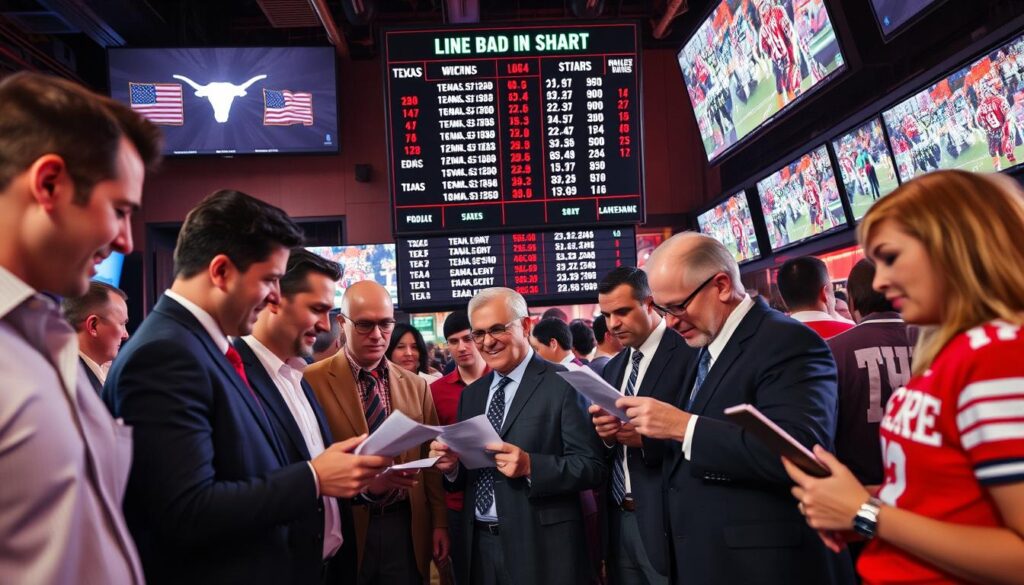
The market for Texas vs Ohio State betting shows how steady public action can reshape a game’s price before kickoff. Early odds listed Ohio State as a 3-point favorite with a 50.5 total. Weeks of one-way public tickets and dollars pushed that spread toward Texas, with several books trimming the number to pick’em and the total sliding to 47.5.
Market snapshot and timeline
Across multiple sportsbooks the pattern was clear: heavier money on Texas shifted both spread and total. Fanatics reported over 60% of dollars on the Texas moneyline and roughly 70% of cash on Texas overall, while bet counts sat near 55-45 favoring Texas. Westgate showed about five times as much money and twice as many bets on Texas, and Circa noted a single $550,000 wager that nudged its line to make Texas a one‑point favorite.
Books’ liability and popular narratives
Oddsmakers flagged sportsbook liability as a core driver of adjustments. BetMGM listed Texas as the largest liability in its national title market, with 11.9% of wagers and 20.4% of the dollars backing the Longhorns. Traders pointed to Arch Manning’s Heisman chatter and Texas program hype, plus questions about Ohio State’s new coordinators and freshman quarterbacks, as public narratives fueling bets.
Examples of public-driven line movement
Several books—Caesars, Prime Sports, Fanatics and Westgate—reported sustained, one-way traffic toward Texas that cumulatively moved the market. Prime Sports’ Jon Richards noted sharps largely steered clear of the spread and moneyline while some pros targeted the total. The Texas surge shows how many small public wagers can match or exceed the impact of a single large ticket and create unusual outcomes, such as a top-ranked team closing as an underdog.
For readers tracking line behavior, compare movement patterns and betting splits across books and use independent analysis to diagnose whether a move stems from public-driven line movement, sharp money, or breaking news. See a practical primer on what line moves can reveal at what line moves can tell us.
sharp money vs public money
The market divides into two clear streams: one driven by informed, high-stakes bettors and one driven by casual fans backing popular teams. Understanding the difference helps with betting market interpretation and spotting edges before lines settle.

Characteristics of sharp action
Sharp bettors stake fewer tickets and place larger wagers. Their approach rests on model-driven factors like rest, pace, efficiency, injury impact, and late-game tendencies. Those factors create repeatable edges that lead to quick, sizable money movement early in a market.
Syndicates and professional bettors use disciplined sizing methods such as fractional Kelly to control risk. When sharps move a line, it often signals new information or a hidden value point for traders to consider.
Characteristics of public money
Public money traits include many small bets concentrated on marquee names and narratives. Fans chase storylines like a star player or a high-profile team, producing heavy bet counts but fewer large stakes per ticket.
Public flows tend to nudge lines gradually as more bettors pile in toward kickoff. That slow drift can create visible liability at major books such as BetMGM or Caesars before any sharp response arrives.
How sportsbooks interpret and react to each
Books separate behavioral public flows from informational sharp flows when managing risk. Traders at Circa, Westgate, and other operators watch money distribution and adjust lines for both liability and strategic positioning.
- When sharps show up, books often move quickly to limit exposure or probe the size of the edge.
- When the public dominates, books may shade lines to discourage chasing or lean on markets where copycat feeds create lagging books.
- Traders may also move against public sentiment to trap bettors or balance books if they have sufficient contrarian money.
Reading the mix of sharp money characteristics and public money traits gives bettors a clearer picture of how sportsbooks react. That insight improves betting market interpretation and helps identify when a line change is information-driven versus crowd-driven.
Where Rare Betting Opportunities Appear When Public and Sharp Diverge
When public money and sharp action move in different directions, market cracks open. These gaps create rare betting opportunities for bettors who track lines across multiple books and read context, not noise.
Watch for lagging books that copy major feeds slowly. A single slow-moving line can offer value after a sharp-driven adjustment has already been priced elsewhere. Sharps exploit latency by hitting books before the copycat updates. This is most common in live markets where milliseconds matter and stale numbers linger.
Lagging books and copycat lines
Many sportsbooks mirror odds providers like Betradar or Kambi. If one feed updates first, others may follow with a delay. That delay creates isolated spots to lock favorable prices.
Monitor several accounts at once and note which brands consistently lag. Those patterns often repeat across seasons and sports. Quick reaction wins small edges repeatedly.
False steam and contrarian plays
Not every surge is genuine. Syndicates sometimes push false steam to bait copycat moves and harvest value on the opposite side. Treat sudden movement as a signal, not proof.
Look for contrarian plays where a book moves against public narratives or where sharp interest concentrates on different markets, like totals instead of the spread. Those divergences point toward where real information resides.
Schedule, fatigue and structural edges from other sports
Objective factors such as travel, back-to-backs, and rest cycles produce predictable effects. The NBA shows how schedule edges shift expected points by one to three. Those margins translate to other leagues when usage or compressed calendars matter.
Exploitable patterns emerge in props and live lines when fatigue alters fourth-quarter efficiency or a starter sees reduced minutes. Public bettors often miss these subtle, repeatable edges.
Behavioral traps books exploit
Sportsbooks build markets around common biases: favorite bias, key numbers, and chasing narratives. They nudge lines to extract an emotional tax from casual bettors.
Phantom injury chatter and social-media hype can trigger reversible moves. Sharp bettors who ignore the noise and target true informational discrepancies avoid those traps and profit from the resulting mispricings.
Practical Approach: How to Spot and Act on the Opportunity
Start by tracking both bet count and dollar-weighted percentages across multiple books. When the public floods one market while sharp action moves another — as with Texas–Ohio State where public bets pushed the spread but sharps chased the over — that split can reveal value. Learn how to spot sharp vs public by watching timing: quick, large moves with thin bet counts usually signal sharp money; slow, heavy bet counts point to public-driven pressure.
Line shopping is essential. Maintain accounts at several sportsbooks and scan lines in real time to find lagging books or copycat patterns. Use a live betting strategy to exploit latency and watch totals and props where sharps often migrate. Verify steam sources before you act: a single large wager reported from Circa or DraftKings differs from thousands of small bets tied to social narratives.
Apply objective edges from schedule and performance science rather than headlines. Rest differentials, travel, pace, and fourth-quarter efficiency are repeatable inputs that help you exploit betting divergences. Combine those metrics with sharp signals on totals and player props to form a contrarian betting plan when markets look skewed by public emotion.
Manage bankroll and timing tightly. Size stakes with flat units or a fractional Kelly (1–3% of bankroll), avoid opening-line noise, and wait for confirmation of sharp flow. Use a simple checklist before wagering: confirm bet-versus-dollar distribution, identify sharp versus public movement, check schedule metrics, compare totals/props across books, and shop lines immediately. This approach makes contrarian betting sustainable and raises the odds of turning momentary market splits into long-term profit.

