
Nearly half of Week 15 handle showed a clear split: DraftKings and Circa data flagged low-ticket, high-dollar action that moved lines in the opposite direction of the public. Bookmakers from BetMGM to Caesars reported contrasting behavior — heavy ticket volume on games like Bills -1.5 and Chargers +6, while big dollars flowed into Texans -10, Eagles -12.5 and Rams -6.
That divergence between ticket percentage and money percentage is the hallmark of smart money versus one-way public action. VSiN and shop reports showed classic reverse-line movement in games such as Vikings-Cowboys and Packers-Broncos, where a majority of tickets favored one side but professional bettors placed larger wagers on the other side, forcing books to adjust.
Sharp reporting from Caesars’ Joey Feazel and Borgata’s Thomas Gable highlighted shop-level moves: Bills opened -1.5 and slid toward pick’em in some outlets even as ticket counts stayed high on Buffalo. Caesars also logged a six-figure wager on the Rams, illustrating how betting splits and money percentage can mask true market risk for sportsbooks.
This Week 15 pattern matters because it reveals where smart money is concentrated and when reverse-line movement signals value. Understanding the interplay of public vs sharp bets, smart money, betting splits, reverse-line movement, money percentage and ticket percentage equips bettors to read market signals before moving their stake.
Key Takeaways
- Week 15 showed clear betting splits: many tickets versus fewer, larger-dollar wagers.
- Money percentage and ticket percentage together reveal where smart money is active.
- Reverse-line movement is a strong indicator of sharp backing even when the public dominates tickets.
- Shop-level quotes from BetMGM, Caesars and Borgata confirmed real adjustments across books.
- Tracking both betting splits and sharp lists will help bettors spot value earlier in the market.
Public vs sharp bets: identifying the split in Week 15 markets
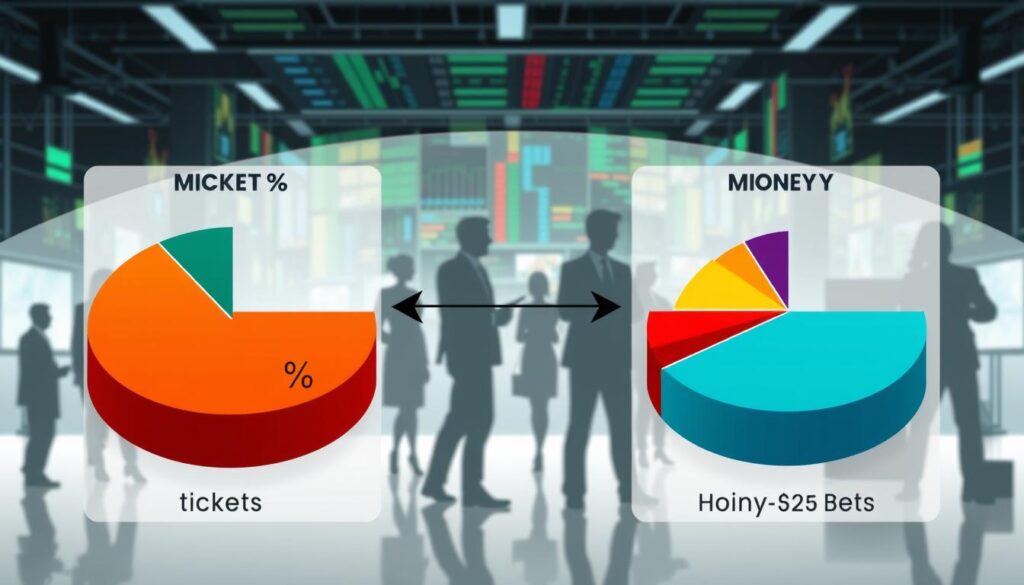
Understanding where the public stops and sharp bettors start matters for anyone staking money. Week 15 showed clear examples of market friction. Ticket counts and dollar handles often told two different stories at the same time.
Ticket percentage vs money percentage explained
Ticket percentage counts how many wagers land on each side. Money percentage sums the dollars risked. That split reveals whether casual bettors or big-stake pros control the market.
DraftKings splits and Circa splits publish both metrics for spreads, moneylines, and totals. A team with high ticket percentage but low money percentage is driven by small, popular bets. The opposite — low tickets with high dollars — flags low-bets high-dollars action from sharps.
A quick diagnostic is simple: subtract ticket % from money %. A positive result suggests larger bets backing that side. A negative result points to bigger dollars on the opponent. Pair that read with line movement and shop-level quotes for context.
Real-world Week 15 examples of market split
The Broncos-Packers line showed a classic low-bets high-dollars pattern. Circa splits listed Denver with 58% of spread tickets but 82% of spread dollars. The market opened Green Bay -1.5, ticked to -2.5, then sharp buyback pushed Denver to +1.5. That reverse-line movement followed heavy pro backing.
Vikings-Cowboys provided a DraftKings splits contrast. The public piled on Dallas with about 75% of spread tickets. Circa reported Minnesota holding 35% of tickets but 77% of spread dollars. The market moved from Cowboys -7.5 to -5.5 as sharps pushed the road dog.
Panthers-Saints offered a line-freeze example. DraftKings showed roughly 80% of spread tickets on Carolina while the spread stayed near -2.5. That freeze signaled smart money on New Orleans and created teaser value and shop-level edges.
- BetMGM ticket leaders that week included Buffalo, Los Angeles Chargers, Panthers, Broncos, and Lions by count.
- Handle leaders were Texans, Bills, Eagles, and Jets on some books, showing divergent public and sharp flows.
- Totals like Ravens-Bengals unders tightened after concentrated sharp tickets, trimming posted numbers from 52.5 to 51.5 in places.
Why identifying public vs sharp bets matters for bettors
Finding value often means following sharp money when it signals mispricing. Reverse-line movement and low-bets high-dollars splits can point to profitable contrarian plays such as taking the Broncos at plus points after a sharp buyback.
Timing and shop lines matter. Smart money tends to arrive late and in larger units. Shopping across Caesars, DraftKings, Circa, BetMGM and other books can capture better numbers and increase expected value.
Risk management improves with context. Public trends can push a line to inefficient levels. Fading lopsided ticket percentages might work when sharps are absent. When heavy smart-money signals align with injuries, home-field edge, or same-game-parlay spikes, respecting those moves reduces downside.
How books respond to one-way public action and sharp money
The market often splits when public tickets push one direction and sharp tickets drive another. Bookmakers must perform quick bookmaker adjustments to protect margins and limit risk. Shops watch ticket counts and money percentages, then apply shop-level line movement or maximum limits to keep liability in check.

Bookmaker quotes shift first at shops that move fast, like Circa and DraftKings, then cascade to peers such as Caesars and Borgata. Lines opened by sharp-friendly books can signal where risk concentrates, prompting other books to trim totals or nudge spreads. Real-time feeds from DraftKings and Circa help operations detect early sharp tickets and guide liability management choices.
Bookmaker quotes and shop-level adjustments
Shops log early traffic and tweak quotes if one side draws outsized action. Caesars reported one-way Bills traffic that forced moves from -1.5 to closer to pick’em at some books. Borgata trimmed totals after heavy early interest. Those micro moves reflect a mixture of public bets, sharp tickets, and news like injuries.
Lines will sometimes reverse when sharps sell back a side. A sharp buyback on the Broncos moved a spread from -2.5 toward +1.5 at certain books. That reverse line movement signals to traders that liability management needs to pivot away from public flow and toward pro bettors’ stakes.
Totals and same-game parlay impacts observed in Week 15
Same-game parlay impact was visible in several Week 15 matchups. Joe Burrow’s return spurred heavy SGP action, which raised ticket counts and forced total trims at shops tracking money per ticket. Borgata cut a Ravens-Bengals total from 52.5 to 51.5 after sharp unders hit the market.
SGPs amplify apparent public demand while shrinking average stake. Books monitor SGP volume because it can mask true money weight. When multiple customers build similar parlays, shops may adjust pricing or juice to distribute exposure more evenly across totals and props.
High-dollar wagers and liability management
Large single bets trigger immediate liability management moves. Caesars recorded a six-figure wager on the Rams that led to hedging and line tweaks. Heavy bets like that cause shops to lower limits, lay off risk with other books, or change pricing to attract offsetting action.
Operators use transaction tracking to spot abnormal splits between tickets and handle. When a small percentage of tickets carries a large share of handle, liability management steps include moving lines, setting caps for certain customers, or freezing markets until the picture clears. Those controls keep losses predictable and markets orderly.
For more on how sportsbooks set lines and respond to market forces, consult this primer on wagering mechanics and line setting explained.
Practical betting strategies using market-split signals
Start by treating market splits as one tool in your betting strategy toolbox. Check ticket and money splits on DraftKings and Circa to spot low-ticket/high-dollar divergences. When you see examples like Panthers-Saints where DraftKings shows heavy ticket lean but other shops offer Saints +3, line shopping can turn a half-point into a long-term edge.
Use a reverse-line movement strategy to read sharp timing. If a side has few tickets but heavy dollars — think Broncos 58% tickets/82% dollars at Circa — assume professional support. Consider following that money, especially if the market later moves back toward the sharp side. Early access to numbers before gameday nudges can let you capture extra value.
Teasers and the Wong Teaser strategy matter too. Turning Denver +1.5 into +7.5 or Saints +2.5 into +8.5 passes key numbers and can mask sharp intent. Watch how teaser flow influences the open and move sequence and adjust size accordingly. Pair teaser thinking with injury monitoring; a report like Justin Herbert’s hand issue should change how you weigh totals and spreads.
Finally, manage risk with simple rules. Don’t blindly follow one side — combine shop lines, injury updates, SGP volumes, and observed reverse-line movement strategy cues before sizing bets. Start small on contrarian lines, scale as other books confirm movement, and keep a checklist: check DraftKings/Circa splits, line shopping across shops, review injury reports, note same-game-parlay effects, and watch for late sharp timing.

