
This short introduction explains what bettors in the United States need to know about fractional odds and how to convert them for practical use. This fractional odds guide will help you read prices, convert odds to decimal, and learn the basics of implied probability without confusing jargon.
Fractional odds appear often in horse racing and traditional betting markets, but many U.S. sportsbooks show decimal or American moneyline formats. Knowing how to convert odds to decimal and interpret a price like 4/11 or 11/4 makes it easier to compare markets and spot value. This piece draws on clear operator explanations from sources such as Betway Insider and publisher breakdowns to keep the math simple and relevant.
Throughout the full article you will find step-by-step conversions, implied probability formulas, and practical staking advice tailored for American bettors. The goal is straightforward: get comfortable with betting odds explained in fractional form, use implied probability to judge value, and make better choices when you place a bet.
What fractional odds mean and how to read them
Fractional odds are a classic format used in UK betting to show profit relative to stake. The left number represents potential profit, the right number the stake. This simple ratio makes it easy to compare prices across markets and to see at a glance whether a selection is odds-on or odds-against.
Definition of fractional odds
The fractional odds definition is straightforward: a fraction like 10/1 means you win $10 for every $1 staked. A fraction such as 1/2 shows an odds-on result where a larger stake is required to win a smaller profit. Bookmakers display fractions to emphasize the profit-to-stake relationship rather than the total return alone.
How to read a fraction like 11/4 and relate to other common examples
To understand how to read fractional odds, convert the fraction to decimal or think in terms of units. The 11/4 meaning is $11 profit for every $4 staked. In decimal form that equals 3.75, giving a total return of $3.75 per $1 staked, which corresponds to +275 in American odds.
Other common examples clarify the pattern. 10/1 equals a big payout for a small stake. 5/2 shows moderate risk and return. 4/11 is odds-on and returns less than stake profit. 2/1 sits between these extremes and is one of the clearest odds-against offers.
Why bookmakers use fractional odds
Bookmakers prefer fractional odds because they fit long-standing markets like horse racing and horse racing exchanges run by firms such as Betfair. Fractions let firms balance liabilities while showing whether a selection is odds-on vs odds-against. Non-round figures like 11/4 or 13/8 can reflect market movement and the actual money backing each outcome.
| Fraction | Profit per $1 stake | Decimal | American | Type |
|---|---|---|---|---|
| 11/4 | $2.75 | 3.75 | +275 | Odds-against |
| 10/1 | $10.00 | 11.00 | +1000 | Odds-against |
| 5/2 | $2.50 | 3.50 | +250 | Odds-against |
| 4/11 | $0.36 | 1.36 | -275 | Odds-on |
| 1/2 | $0.50 | 1.50 | -200 | Odds-on |
Converting fractional odds to decimal and American formats
Understanding how to convert fractional odds to decimal and American formats makes betting clearer for U.S. players. The process is simple. You can check prices on Betway or DraftKings and then run a quick manual conversion to confirm what a bookmaker shows.
Step-by-step conversion method to decimal odds
To convert fractional to decimal, divide the numerator by the denominator and add one. For example, 11/4 → 11 ÷ 4 = 2.75; 2.75 + 1 = 3.75 decimal. That same method gives 6/1 → 7.00, 6/4 → 2.50, and 2/5 → 1.40.
Converting to American (moneyline) odds
Start with the decimal result, subtract one, then scale to a $100 stake. Using the 11/4 example: decimal 3.75 → 3.75 − 1 = 2.75. That equates to a +275 conversion, meaning a $100 stake returns $275 profit if the bet wins.
Why conversions matter for U.S. bettors
Fractional to American odds conversions let bettors compare lines across operators and spot value quickly. Many U.S. sportsbooks display moneyline, so knowing how to convert fractional odds to decimal and fractional to American odds helps when evaluating cash-out offers and cross-book opportunities.
| Fraction | Decimal | American |
|---|---|---|
| 11/4 | 3.75 | +275 |
| 6/1 | 7.00 | +600 |
| 6/4 | 2.50 | +150 |
| 2/5 | 1.40 | -250 |
Implied probability and calculating value from odds
Understanding implied probability from fractional odds helps you read a bookmaker’s view of an event. The figure shows the bookmaker’s converted chance, not a guaranteed truth. Use implied probability as one input when you seek value betting opportunities.
How the conversion works
To calculate implied probability from fractional odds, divide the right-hand number by the sum of both numbers. For example, 11/4 becomes 4 ÷ (11 + 4) = 4 ÷ 15 ≈ 0.2667 or 26.7%. You can reach the same result by converting fractional odds to decimal and doing 1 ÷ decimal odds.
Using probability in decisions
Interpreting implied probability means comparing it to your own estimated chance. If you estimate an event at 35% but the implied probability from fractional odds is 26.7%, that gap suggests value betting. Build your estimates from stats, form, weather, injuries and public market moves to improve accuracy.
Watch for common traps
Bookmaker margin distorts raw implied probabilities. Bookmakers add an overround so implied probabilities across a market exceed 100%. Adjust for bookmaker margin before calling value.
Another trap is misreading odds-on fractions like 4/11. That format signals a strong favorite and not a profit-of-4-for-11 interpretation. Confusing returns that include stake with pure profit will skew your staking plan.
Each-way terms and place conditions change the effective implied probability for partial payouts. Relying on a single metric without longitudinal tracking or an odds calculator can lead to inconsistent judgment.
Practical checklist
1) Convert fractional odds to implied probability. 2) Adjust for bookmaker margin. 3) Compare to your true-probability estimate. 4) Use value betting only when your estimate exceeds the adjusted implied probability. 5) Track outcomes to refine your model.
4/11 betting odds
This section breaks down the 4/11 price and shows how to think about short odds in real betting. Use the quick math here to check conversions before you stake money. The aim is to make the numbers simple and practical.
Exact meaning and quick math
Fractional odds of 4/11 mean you win $4 profit for every $11 staked. Convert the fraction by dividing 4 by 11 to get 0.3636. Add one to reach the decimal form: 1.3636. To find implied chance, divide the denominator by the sum: 11 ÷ (4+11) = 11 ÷ 15 = 0.7333, or 73.33% implied probability. The American equivalent sits as a negative moneyline, showing the amount you must risk to win $100.
When these prices appear in markets
Odds like 4/11 show up for clear favorites in horse racing and in strong pre-match picks for football and soccer. Bookmakers such as Betway and William Hill set odds-on favorites where the market sees high certainty. Markets with heavy backing or predictable outcomes often produce similar short prices like 1/2 or 1/4.
Is 4/11 a good price and bankroll considerations
4/11 signals heavy favoritism. Profit per stake is low, so you need frequent wins to make long-term gains. Ask whether the true chance you assign exceeds the 73.33% implied probability before placing significant wagers.
For bankroll management, consider conservative staking. Flat staking or a Kelly-style fraction helps protect funds when backing odds-on favorites. Track results and avoid increasing stake size after losses. Each-way terms matter only if you use place bets; plain win bets at 4/11 are about risk control rather than big returns.
Real-world examples: sports and markets where these odds appear
Fractional odds show up across many betting markets. Sports fans and casual punters want clear examples to understand value and context. The examples below show how a price like 11/4 sits in different sports and where you see fractional odds most often.
Horse racing examples
In UK racing, fractional pricing drives the market. You will see 4/11 horse racing when a clear favorite enters a big meeting, such as a short-priced runner at Ascot or Cheltenham. Bookmakers often list a strong favorite at 4/11 when form, trainer statistics, and course suitability point to a near-certain win.
An 11/4 quote commonly appears for second-favorites or well-backed outsiders. That price balances risk and reward and often reflects contenders with consistent returns over similar trips and conditions. For deeper reading on real race examples and market context, consult an odds guide like 11/4 odds explained.
Football and soccer markets
Fractional odds are common in match specials. Correct-score markets, first-goalscorer lines, and half-time/full-time bets often carry prices like 11/4 football odds for plausible outcomes. Examples include Arsenal to win 2-1 or Mohamed Salah to open the scoring in Premier League fixtures.
Heavy favorites in one-sided domestic ties can be quoted 4/11 in the match-winner market. That price signals a strong expectation of victory while keeping payouts modest for bettors backing the favorite.
Other sports applications
Tennis markets use fractional odds for upset potential and modest favorites. You might see Cameron Norrie priced at 11/4 against a higher-ranked opponent in tournament play. Golf markets list players at 11/4 for top-10 or top-20 finishes when course form supports a solid claim.
Cricket and novelty markets also adopt fractional pricing. A batsman like Ben Stokes could be 11/4 to finish as top run-scorer in a Test match, while a golfer such as Shane Lowry might be 11/4 to place in a major. These sports betting examples help bettors weigh probability against payout.
| Market | Typical fractional price | What it implies |
|---|---|---|
| Horse racing (favorite) | 4/11 | Strong favorite, high implied chance, small returns |
| Horse racing (second-favorite) | 11/4 | Likely contender, balanced risk/reward |
| Football correct score / first scorer | 11/4 football odds | Reasonable probability for a concrete outcome |
| Tennis / Golf / Cricket specials | 11/4 | Mid-range value for form-backed selections |
Practical payout examples and quick tables
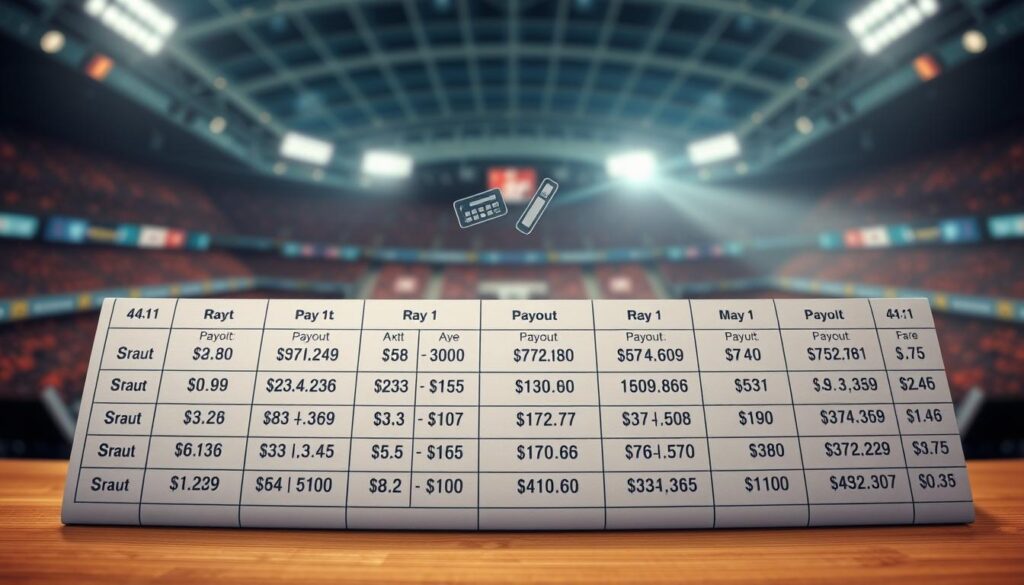
Below are clear methods to calculate returns and use tools that remove guesswork. Read the short steps, then check the quick payout table for common stakes and examples.
How to calculate returns on different stakes
For fractional odds, the profit equals stake × (numerator/denominator). Total return equals stake + profit. For 11/4: a £10 stake gives profit £10 × (11/4) = £27.50 and a total return of £37.50. For 4/11: a simple method is to convert to decimal or use stake × decimal odds to get total return; a £11 stake at 4/11 yields £4 profit and £15 total return.
Using an odds calculator and bet-slip tools
Many operators like Betway, William Hill, and FanDuel include an odds calculator or an in-play bet-slip that will calculate returns instantly. Switch odds display to decimal or American for clarity. An odds calculator will handle singles, accumulators, and each-way splits to deliver exact returns including stake.
Each-way and place terms impact on payouts
An each-way bet splits the stake into win and place halves. Apply the place fraction to the fractional odds to determine the place payout. For example, 11/4 each-way with a 1/4 place term converts the place odds to 11/16 (11/4 × 1/4). That figure determines the place profit and changes the overall each-way payout significantly.
| Odds | Stake | Profit | Total Return | Notes |
|---|---|---|---|---|
| 11/4 | £5 | £13.75 | £18.75 | Standard fractional example for quick payout examples 4/11 comparison |
| 11/4 | £10 | £27.50 | £37.50 | Shows how to calculate returns fractional odds using simple multiplication |
| 11/4 | £100 | £275.00 | £375.00 | Useful for larger bankroll planning and examples |
| 4/11 | £11 | £4.00 | £15.00 | Decimal method: stake × decimal odds = total return |
| 11/4 each-way (1/4) | £10 (total) | Win half profit £27.50; Place half profit £6.875 | Total return if placed: £10 (win lost) + £6.875 + £5 (place stake) = £21.875 | Breakdown shows how each-way payout changes with place fraction |
Use the table to cross-check manual math. When unsure, open a bookmaker’s odds calculator and enter stake plus place terms. That best practice prevents errors and speeds up decisions in busy markets.
Strategies for betting around medium and short fractional prices
Crisp judgment and disciplined staking make the difference when you work around mid-range and short fractional odds. Treat 11/4 as a typical mid-range price and regard 4/11 as a short-price favorite that demands a different approach. Use form, situational factors, and verified tip services to shape each bet.
11/4 converts to roughly a 26.7% implied probability. Look for selections where your assessment is higher than that number. Check recent form, head-to-heads, trainer or coach trends, and conditions such as pitch or track state. Track results at this band with level-stakes to measure if your value betting is real.
Approach for heavy favourites
Short prices like 4/11 imply about a 73.33% chance to win. Ask if that probability matches the evidence. Short-priced markets need a very high strike rate to be profitable. Use conservative staking, lower unit sizes, or percentage-based plans such as Kelly fractions to protect the bankroll. Consider laying on exchanges or using Asian handicaps and spreads when the standard market offers no clear edge under a strategy 4/11 favorites mindset.
Combining selections and bankroll effects
Combining mid-range or short-priced picks into doubles or accumulators increases volatility. Each added leg multiplies the chance of losing the full stake, so apply accumulator risk management rules. Limit the number of legs, size stakes relative to your bankroll, and favor singles or small doubles when value is marginal. Base choices on expected value rather than headline odds.
Practical staking checklist
| Scenario | Recommended action | Staking tip |
|---|---|---|
| 11/4 pick with clear edge | Place single or include in a small double | Level stakes, track separately for this price band |
| 4/11 heavy favorite | Reduce stake, consider exchange lay or handicap | Use small units or Kelly fraction to avoid erosion |
| Multiple mid/short legs | Cap legs to limit downside | Apply accumulator risk management and lower unit size |
| No clear edge | Skip the market or find alternative lines | Preserve bankroll; wait for value betting opportunities |
How bookmakers set and adjust fractional odds
Bookmakers set odds by first estimating the true probability of each outcome and then adding a margin so the book makes a profit. That margin, called the overround, turns fair prices into fractional values like 11/4 or 13/8. The initial board reflects an expert view of chances plus the bookmaker liability they are willing to carry on any single result.
Markets rarely stay static. Odds adjustment happens as money flows in, news breaks, or rival firms change prices. Heavy backing of a favorite will shorten its price to limit bookmaker liability, while lesser-backed selections may lengthen and create overlays. Traders also watch exchanges and flip prices to balance books rather than accept outsized exposure.
For bettors, tracking price movement and understanding how bookmakers set odds reveals where value may hide. Comparing fractional prices across operators and using odds calculators helps spot discrepancies and measure implied probability versus market prices. A useful reference for how decimal prices map to market percentages is available at bookmaker percentages, which illustrates overround effects clearly.
Smart staking reacts to odds adjustment rather than emotion. Monitor market money, factor in injury or news-driven swings, and remember that the overround exists to ensure the house edge. When you see prices diverge across shops or exchanges, that is an opportunity to exploit differences in bookmaker liability and secure long-term value.
FAQ
What do fractional odds represent and how do I read them?
FAQ
What do fractional odds represent and how do I read them?
Fractional odds are a ratio showing potential profit relative to stake. The left number is the profit and the right number is the stake. For example, 10/1 means you win profit for every
FAQ
What do fractional odds represent and how do I read them?
Fractional odds are a ratio showing potential profit relative to stake. The left number is the profit and the right number is the stake. For example, 10/1 means you win $10 profit for every $1 staked; 1/2 means you must stake $2 to win $1 (odds-on). Read 11/4 as $11 profit for every $4 staked. Total return includes your stake: profit + stake.
How do I convert fractional odds like 11/4 into decimal odds?
Convert fractional to decimal by dividing the left number by the right and adding one. For 11/4, divide 11 by 4 = 2.75, then add 1 = 3.75 decimal. That 3.75 is the total return per $1 staked (including stake).
How do I convert 11/4 or 4/11 to American (moneyline) odds?
Convert fractional to decimal first, then to American. 11/4 → 3.75 decimal → American +275 (you profit $275 on a $100 bet). For short odds like 4/11 → 1.3636 decimal → American around -275 (you must stake $275 to win $100). Positive American odds show profit on $100; negative show how much you must stake to win $100.
Why should U.S. bettors learn these conversions?
U.S. sportsbooks and bettors commonly use moneyline odds. Converting fractional odds helps compare prices across bookmakers, understand payout amounts in familiar terms, evaluate cross-market value, and interpret cash-out offers or exchange prices when fractional format appears in international markets.
How do you calculate implied probability from fractional odds?
Use right ÷ (left + right). For 11/4: 4 ÷ (11+4) = 4 ÷ 15 ≈ 0.2667 → 26.67% implied probability. The decimal method is 1 ÷ decimal odds (1 ÷ 3.75 = 26.67%).
How should I interpret implied probability when deciding a bet?
Implied probability is the bookmaker’s expressed chance. If your assessed “true” probability is higher than the implied probability, the bet has theoretical value. For example, if you estimate a 35% chance versus an implied 26.7% for 11/4, that indicates value. Always factor in margin, form, situational factors, and sample size before staking.
What common mistakes do bettors make using implied probability?
Typical errors include ignoring the bookmaker margin (overround), confusing decimal total return with profit, misreading odds-on fractions like 4/11, neglecting place terms for each-way bets, and relying on single metrics instead of tracking performance and value over time.
Exactly what does 4/11 mean and how do I calculate returns?
4/11 means you win $4 profit for every $11 staked. Decimal equivalent: 4 ÷ 11 = 0.3636 + 1 = 1.3636. Implied probability: 11 ÷ (4+11) = 11 ÷ 15 = 73.33%. Example return: stake $11 → profit $4 → total return $15.
In which markets do I typically see 4/11 odds?
4/11 and similar short prices appear for heavy favourites in horse racing, strong pre-match favourites in football (soccer), short-priced tennis players, dominant golf contenders in top-10 markets, and cricket markets for likely outcomes. They show markets where bookmakers see high certainty.
Is 4/11 a good price and how should it affect my bankroll strategy?
4/11 is a heavy favourite; profit per stake is small and requires a high strike rate (about 73.3%) to be profitable. Use conservative staking (smaller units or Kelly fraction), consider alternatives like Asian handicaps or laying on exchanges, and only stake heavily if your assessed probability comfortably exceeds the implied probability.
How are fractional odds used in horse racing and what does 11/4 indicate there?
Fractional odds are traditional in UK racing. 11/4 often appears as a mid-range price for second favourites or credible contenders. It implies about 26.7% chance. Race context—form, trainer/jockey, course and ground—helps determine whether 11/4 is fair value.
How do fractional odds appear in football and soccer markets?
Fractional odds show across match-winner, correct-score, first-goalscorer, and half-time/full-time markets. Examples: a 2–1 correct score at 11/4, a forward priced 11/4 to score first, or a heavy mismatch where the favourite might be quoted 4/11 in domestic league betting.
Are fractional odds used in other sports like tennis, golf, and cricket?
Yes. Fractional prices such as 11/4 can apply to match winners in tennis, place/top-10 markets in golf, and top-scorer or match-winner markets in cricket. Operators like Betway and industry coverage use fractional odds across these sports, especially in UK-facing markets.
How do I calculate payouts at different stakes for 11/4?
Profit = stake × (left ÷ right). For 11/4: profit = stake × (11 ÷ 4). Total return = stake + profit. Examples: $10 at 11/4 → $10 × 11/4 = $27.50 profit → $37.50 return. $100 at 11/4 → $275 profit → $375 return.
When should I use an odds calculator or bet-slip tools?
Use calculators and bet-slip tools to avoid manual mistakes, to convert formats instantly, and to calculate singles, each-way splits, and accumulator returns. Many operators, including Betway, provide built-in calculators and the option to switch display formats between fractional, decimal, and American.
How do each-way and place terms affect payouts with fractional odds like 11/4?
An each-way bet splits stake into win and place halves. Place payouts use a place fraction (e.g., 1/4 or 1/5). For 11/4 with a 1/4 place term, the place portion pays at 11/16 (11/4 × 1/4). Place returns can materially affect total each-way returns, so compute both parts or use an odds calculator.
How do I find value at mid-range odds like 11/4?
Treat 11/4 as mid-range (≈26.7% implied). Seek selections where your analysis—form data, situational factors, statistical models, and trusted tipster records—gives a higher true probability. Use level-stakes or a disciplined staking plan and track bets within this price band to measure edge.
What is the recommended approach for betting heavy favourites priced 4/11?
For short prices, verify that your assessed probability exceeds the implied 73.3% by a comfortable margin. Use conservative stakes, consider alternative markets (spreads, Asian handicaps), or laying on exchanges if suitable. Avoid large stakes unless long-term edge is demonstrable.
How does combining 11/4 and 4/11 selections in multiples affect my bankroll?
Multiples multiply both risk and reward and increase volatility. A single short-priced leg like 4/11 can reduce accumulator value because it offers low uplift. Use caution with multiple legs, limit the number of selections, and evaluate expected value rather than headline returns to protect bankroll.
How do bookmakers set and adjust fractional odds like 11/4 or 4/11?
Bookmakers estimate true probabilities, apply a margin (overround), and then display fractional odds. They adjust prices in response to market money, liability, news (injuries, team changes), and trading from other operators. Heavy backing on a selection shortens its price; balancing liability can produce non-round fractions like 13/8 or 11/4.
What market signals can price movements provide to bettors?
Movement toward shorter odds often signals heavy backing or new information that increases perceived probability. Drift to longer odds may indicate lack of money or negative news. Comparing prices across bookmakers and exchanges helps spot inefficiencies and potential value.
Which tools and resources help apply these concepts practically?
Use odds converters, calculator tools, and bet-slip utilities offered by operators such as Betway. Track prices across multiple sportsbooks and exchanges, maintain a staking log, and use statistical models or trusted publisher analysis to estimate true probabilities and spot value.
How do bookmaker margins affect implied probability and value calculations?
Bookmaker margins inflate implied probabilities so the sum across outcomes exceeds 100%. Always adjust for overround when estimating value. Compare an individual implied probability to your true probability and account for the margin when calculating required edge to be profitable long-term.
staked; 1/2 means you must stake to win
FAQ
What do fractional odds represent and how do I read them?
Fractional odds are a ratio showing potential profit relative to stake. The left number is the profit and the right number is the stake. For example, 10/1 means you win $10 profit for every $1 staked; 1/2 means you must stake $2 to win $1 (odds-on). Read 11/4 as $11 profit for every $4 staked. Total return includes your stake: profit + stake.
How do I convert fractional odds like 11/4 into decimal odds?
Convert fractional to decimal by dividing the left number by the right and adding one. For 11/4, divide 11 by 4 = 2.75, then add 1 = 3.75 decimal. That 3.75 is the total return per $1 staked (including stake).
How do I convert 11/4 or 4/11 to American (moneyline) odds?
Convert fractional to decimal first, then to American. 11/4 → 3.75 decimal → American +275 (you profit $275 on a $100 bet). For short odds like 4/11 → 1.3636 decimal → American around -275 (you must stake $275 to win $100). Positive American odds show profit on $100; negative show how much you must stake to win $100.
Why should U.S. bettors learn these conversions?
U.S. sportsbooks and bettors commonly use moneyline odds. Converting fractional odds helps compare prices across bookmakers, understand payout amounts in familiar terms, evaluate cross-market value, and interpret cash-out offers or exchange prices when fractional format appears in international markets.
How do you calculate implied probability from fractional odds?
Use right ÷ (left + right). For 11/4: 4 ÷ (11+4) = 4 ÷ 15 ≈ 0.2667 → 26.67% implied probability. The decimal method is 1 ÷ decimal odds (1 ÷ 3.75 = 26.67%).
How should I interpret implied probability when deciding a bet?
Implied probability is the bookmaker’s expressed chance. If your assessed “true” probability is higher than the implied probability, the bet has theoretical value. For example, if you estimate a 35% chance versus an implied 26.7% for 11/4, that indicates value. Always factor in margin, form, situational factors, and sample size before staking.
What common mistakes do bettors make using implied probability?
Typical errors include ignoring the bookmaker margin (overround), confusing decimal total return with profit, misreading odds-on fractions like 4/11, neglecting place terms for each-way bets, and relying on single metrics instead of tracking performance and value over time.
Exactly what does 4/11 mean and how do I calculate returns?
4/11 means you win $4 profit for every $11 staked. Decimal equivalent: 4 ÷ 11 = 0.3636 + 1 = 1.3636. Implied probability: 11 ÷ (4+11) = 11 ÷ 15 = 73.33%. Example return: stake $11 → profit $4 → total return $15.
In which markets do I typically see 4/11 odds?
4/11 and similar short prices appear for heavy favourites in horse racing, strong pre-match favourites in football (soccer), short-priced tennis players, dominant golf contenders in top-10 markets, and cricket markets for likely outcomes. They show markets where bookmakers see high certainty.
Is 4/11 a good price and how should it affect my bankroll strategy?
4/11 is a heavy favourite; profit per stake is small and requires a high strike rate (about 73.3%) to be profitable. Use conservative staking (smaller units or Kelly fraction), consider alternatives like Asian handicaps or laying on exchanges, and only stake heavily if your assessed probability comfortably exceeds the implied probability.
How are fractional odds used in horse racing and what does 11/4 indicate there?
Fractional odds are traditional in UK racing. 11/4 often appears as a mid-range price for second favourites or credible contenders. It implies about 26.7% chance. Race context—form, trainer/jockey, course and ground—helps determine whether 11/4 is fair value.
How do fractional odds appear in football and soccer markets?
Fractional odds show across match-winner, correct-score, first-goalscorer, and half-time/full-time markets. Examples: a 2–1 correct score at 11/4, a forward priced 11/4 to score first, or a heavy mismatch where the favourite might be quoted 4/11 in domestic league betting.
Are fractional odds used in other sports like tennis, golf, and cricket?
Yes. Fractional prices such as 11/4 can apply to match winners in tennis, place/top-10 markets in golf, and top-scorer or match-winner markets in cricket. Operators like Betway and industry coverage use fractional odds across these sports, especially in UK-facing markets.
How do I calculate payouts at different stakes for 11/4?
Profit = stake × (left ÷ right). For 11/4: profit = stake × (11 ÷ 4). Total return = stake + profit. Examples: $10 at 11/4 → $10 × 11/4 = $27.50 profit → $37.50 return. $100 at 11/4 → $275 profit → $375 return.
When should I use an odds calculator or bet-slip tools?
Use calculators and bet-slip tools to avoid manual mistakes, to convert formats instantly, and to calculate singles, each-way splits, and accumulator returns. Many operators, including Betway, provide built-in calculators and the option to switch display formats between fractional, decimal, and American.
How do each-way and place terms affect payouts with fractional odds like 11/4?
An each-way bet splits stake into win and place halves. Place payouts use a place fraction (e.g., 1/4 or 1/5). For 11/4 with a 1/4 place term, the place portion pays at 11/16 (11/4 × 1/4). Place returns can materially affect total each-way returns, so compute both parts or use an odds calculator.
How do I find value at mid-range odds like 11/4?
Treat 11/4 as mid-range (≈26.7% implied). Seek selections where your analysis—form data, situational factors, statistical models, and trusted tipster records—gives a higher true probability. Use level-stakes or a disciplined staking plan and track bets within this price band to measure edge.
What is the recommended approach for betting heavy favourites priced 4/11?
For short prices, verify that your assessed probability exceeds the implied 73.3% by a comfortable margin. Use conservative stakes, consider alternative markets (spreads, Asian handicaps), or laying on exchanges if suitable. Avoid large stakes unless long-term edge is demonstrable.
How does combining 11/4 and 4/11 selections in multiples affect my bankroll?
Multiples multiply both risk and reward and increase volatility. A single short-priced leg like 4/11 can reduce accumulator value because it offers low uplift. Use caution with multiple legs, limit the number of selections, and evaluate expected value rather than headline returns to protect bankroll.
How do bookmakers set and adjust fractional odds like 11/4 or 4/11?
Bookmakers estimate true probabilities, apply a margin (overround), and then display fractional odds. They adjust prices in response to market money, liability, news (injuries, team changes), and trading from other operators. Heavy backing on a selection shortens its price; balancing liability can produce non-round fractions like 13/8 or 11/4.
What market signals can price movements provide to bettors?
Movement toward shorter odds often signals heavy backing or new information that increases perceived probability. Drift to longer odds may indicate lack of money or negative news. Comparing prices across bookmakers and exchanges helps spot inefficiencies and potential value.
Which tools and resources help apply these concepts practically?
Use odds converters, calculator tools, and bet-slip utilities offered by operators such as Betway. Track prices across multiple sportsbooks and exchanges, maintain a staking log, and use statistical models or trusted publisher analysis to estimate true probabilities and spot value.
How do bookmaker margins affect implied probability and value calculations?
Bookmaker margins inflate implied probabilities so the sum across outcomes exceeds 100%. Always adjust for overround when estimating value. Compare an individual implied probability to your true probability and account for the margin when calculating required edge to be profitable long-term.
(odds-on). Read 11/4 as profit for every staked. Total return includes your stake: profit + stake.
How do I convert fractional odds like 11/4 into decimal odds?
Convert fractional to decimal by dividing the left number by the right and adding one. For 11/4, divide 11 by 4 = 2.75, then add 1 = 3.75 decimal. That 3.75 is the total return per
FAQ
What do fractional odds represent and how do I read them?
Fractional odds are a ratio showing potential profit relative to stake. The left number is the profit and the right number is the stake. For example, 10/1 means you win $10 profit for every $1 staked; 1/2 means you must stake $2 to win $1 (odds-on). Read 11/4 as $11 profit for every $4 staked. Total return includes your stake: profit + stake.
How do I convert fractional odds like 11/4 into decimal odds?
Convert fractional to decimal by dividing the left number by the right and adding one. For 11/4, divide 11 by 4 = 2.75, then add 1 = 3.75 decimal. That 3.75 is the total return per $1 staked (including stake).
How do I convert 11/4 or 4/11 to American (moneyline) odds?
Convert fractional to decimal first, then to American. 11/4 → 3.75 decimal → American +275 (you profit $275 on a $100 bet). For short odds like 4/11 → 1.3636 decimal → American around -275 (you must stake $275 to win $100). Positive American odds show profit on $100; negative show how much you must stake to win $100.
Why should U.S. bettors learn these conversions?
U.S. sportsbooks and bettors commonly use moneyline odds. Converting fractional odds helps compare prices across bookmakers, understand payout amounts in familiar terms, evaluate cross-market value, and interpret cash-out offers or exchange prices when fractional format appears in international markets.
How do you calculate implied probability from fractional odds?
Use right ÷ (left + right). For 11/4: 4 ÷ (11+4) = 4 ÷ 15 ≈ 0.2667 → 26.67% implied probability. The decimal method is 1 ÷ decimal odds (1 ÷ 3.75 = 26.67%).
How should I interpret implied probability when deciding a bet?
Implied probability is the bookmaker’s expressed chance. If your assessed “true” probability is higher than the implied probability, the bet has theoretical value. For example, if you estimate a 35% chance versus an implied 26.7% for 11/4, that indicates value. Always factor in margin, form, situational factors, and sample size before staking.
What common mistakes do bettors make using implied probability?
Typical errors include ignoring the bookmaker margin (overround), confusing decimal total return with profit, misreading odds-on fractions like 4/11, neglecting place terms for each-way bets, and relying on single metrics instead of tracking performance and value over time.
Exactly what does 4/11 mean and how do I calculate returns?
4/11 means you win $4 profit for every $11 staked. Decimal equivalent: 4 ÷ 11 = 0.3636 + 1 = 1.3636. Implied probability: 11 ÷ (4+11) = 11 ÷ 15 = 73.33%. Example return: stake $11 → profit $4 → total return $15.
In which markets do I typically see 4/11 odds?
4/11 and similar short prices appear for heavy favourites in horse racing, strong pre-match favourites in football (soccer), short-priced tennis players, dominant golf contenders in top-10 markets, and cricket markets for likely outcomes. They show markets where bookmakers see high certainty.
Is 4/11 a good price and how should it affect my bankroll strategy?
4/11 is a heavy favourite; profit per stake is small and requires a high strike rate (about 73.3%) to be profitable. Use conservative staking (smaller units or Kelly fraction), consider alternatives like Asian handicaps or laying on exchanges, and only stake heavily if your assessed probability comfortably exceeds the implied probability.
How are fractional odds used in horse racing and what does 11/4 indicate there?
Fractional odds are traditional in UK racing. 11/4 often appears as a mid-range price for second favourites or credible contenders. It implies about 26.7% chance. Race context—form, trainer/jockey, course and ground—helps determine whether 11/4 is fair value.
How do fractional odds appear in football and soccer markets?
Fractional odds show across match-winner, correct-score, first-goalscorer, and half-time/full-time markets. Examples: a 2–1 correct score at 11/4, a forward priced 11/4 to score first, or a heavy mismatch where the favourite might be quoted 4/11 in domestic league betting.
Are fractional odds used in other sports like tennis, golf, and cricket?
Yes. Fractional prices such as 11/4 can apply to match winners in tennis, place/top-10 markets in golf, and top-scorer or match-winner markets in cricket. Operators like Betway and industry coverage use fractional odds across these sports, especially in UK-facing markets.
How do I calculate payouts at different stakes for 11/4?
Profit = stake × (left ÷ right). For 11/4: profit = stake × (11 ÷ 4). Total return = stake + profit. Examples: $10 at 11/4 → $10 × 11/4 = $27.50 profit → $37.50 return. $100 at 11/4 → $275 profit → $375 return.
When should I use an odds calculator or bet-slip tools?
Use calculators and bet-slip tools to avoid manual mistakes, to convert formats instantly, and to calculate singles, each-way splits, and accumulator returns. Many operators, including Betway, provide built-in calculators and the option to switch display formats between fractional, decimal, and American.
How do each-way and place terms affect payouts with fractional odds like 11/4?
An each-way bet splits stake into win and place halves. Place payouts use a place fraction (e.g., 1/4 or 1/5). For 11/4 with a 1/4 place term, the place portion pays at 11/16 (11/4 × 1/4). Place returns can materially affect total each-way returns, so compute both parts or use an odds calculator.
How do I find value at mid-range odds like 11/4?
Treat 11/4 as mid-range (≈26.7% implied). Seek selections where your analysis—form data, situational factors, statistical models, and trusted tipster records—gives a higher true probability. Use level-stakes or a disciplined staking plan and track bets within this price band to measure edge.
What is the recommended approach for betting heavy favourites priced 4/11?
For short prices, verify that your assessed probability exceeds the implied 73.3% by a comfortable margin. Use conservative stakes, consider alternative markets (spreads, Asian handicaps), or laying on exchanges if suitable. Avoid large stakes unless long-term edge is demonstrable.
How does combining 11/4 and 4/11 selections in multiples affect my bankroll?
Multiples multiply both risk and reward and increase volatility. A single short-priced leg like 4/11 can reduce accumulator value because it offers low uplift. Use caution with multiple legs, limit the number of selections, and evaluate expected value rather than headline returns to protect bankroll.
How do bookmakers set and adjust fractional odds like 11/4 or 4/11?
Bookmakers estimate true probabilities, apply a margin (overround), and then display fractional odds. They adjust prices in response to market money, liability, news (injuries, team changes), and trading from other operators. Heavy backing on a selection shortens its price; balancing liability can produce non-round fractions like 13/8 or 11/4.
What market signals can price movements provide to bettors?
Movement toward shorter odds often signals heavy backing or new information that increases perceived probability. Drift to longer odds may indicate lack of money or negative news. Comparing prices across bookmakers and exchanges helps spot inefficiencies and potential value.
Which tools and resources help apply these concepts practically?
Use odds converters, calculator tools, and bet-slip utilities offered by operators such as Betway. Track prices across multiple sportsbooks and exchanges, maintain a staking log, and use statistical models or trusted publisher analysis to estimate true probabilities and spot value.
How do bookmaker margins affect implied probability and value calculations?
Bookmaker margins inflate implied probabilities so the sum across outcomes exceeds 100%. Always adjust for overround when estimating value. Compare an individual implied probability to your true probability and account for the margin when calculating required edge to be profitable long-term.
staked (including stake).
How do I convert 11/4 or 4/11 to American (moneyline) odds?
Convert fractional to decimal first, then to American. 11/4 → 3.75 decimal → American +275 (you profit 5 on a 0 bet). For short odds like 4/11 → 1.3636 decimal → American around -275 (you must stake 5 to win 0). Positive American odds show profit on 0; negative show how much you must stake to win 0.
Why should U.S. bettors learn these conversions?
U.S. sportsbooks and bettors commonly use moneyline odds. Converting fractional odds helps compare prices across bookmakers, understand payout amounts in familiar terms, evaluate cross-market value, and interpret cash-out offers or exchange prices when fractional format appears in international markets.
How do you calculate implied probability from fractional odds?
Use right ÷ (left + right). For 11/4: 4 ÷ (11+4) = 4 ÷ 15 ≈ 0.2667 → 26.67% implied probability. The decimal method is 1 ÷ decimal odds (1 ÷ 3.75 = 26.67%).
How should I interpret implied probability when deciding a bet?
Implied probability is the bookmaker’s expressed chance. If your assessed “true” probability is higher than the implied probability, the bet has theoretical value. For example, if you estimate a 35% chance versus an implied 26.7% for 11/4, that indicates value. Always factor in margin, form, situational factors, and sample size before staking.
What common mistakes do bettors make using implied probability?
Typical errors include ignoring the bookmaker margin (overround), confusing decimal total return with profit, misreading odds-on fractions like 4/11, neglecting place terms for each-way bets, and relying on single metrics instead of tracking performance and value over time.
Exactly what does 4/11 mean and how do I calculate returns?
4/11 means you win profit for every staked. Decimal equivalent: 4 ÷ 11 = 0.3636 + 1 = 1.3636. Implied probability: 11 ÷ (4+11) = 11 ÷ 15 = 73.33%. Example return: stake → profit → total return .
In which markets do I typically see 4/11 odds?
4/11 and similar short prices appear for heavy favourites in horse racing, strong pre-match favourites in football (soccer), short-priced tennis players, dominant golf contenders in top-10 markets, and cricket markets for likely outcomes. They show markets where bookmakers see high certainty.
Is 4/11 a good price and how should it affect my bankroll strategy?
4/11 is a heavy favourite; profit per stake is small and requires a high strike rate (about 73.3%) to be profitable. Use conservative staking (smaller units or Kelly fraction), consider alternatives like Asian handicaps or laying on exchanges, and only stake heavily if your assessed probability comfortably exceeds the implied probability.
How are fractional odds used in horse racing and what does 11/4 indicate there?
Fractional odds are traditional in UK racing. 11/4 often appears as a mid-range price for second favourites or credible contenders. It implies about 26.7% chance. Race context—form, trainer/jockey, course and ground—helps determine whether 11/4 is fair value.
How do fractional odds appear in football and soccer markets?
Fractional odds show across match-winner, correct-score, first-goalscorer, and half-time/full-time markets. Examples: a 2–1 correct score at 11/4, a forward priced 11/4 to score first, or a heavy mismatch where the favourite might be quoted 4/11 in domestic league betting.
Are fractional odds used in other sports like tennis, golf, and cricket?
Yes. Fractional prices such as 11/4 can apply to match winners in tennis, place/top-10 markets in golf, and top-scorer or match-winner markets in cricket. Operators like Betway and industry coverage use fractional odds across these sports, especially in UK-facing markets.
How do I calculate payouts at different stakes for 11/4?
Profit = stake × (left ÷ right). For 11/4: profit = stake × (11 ÷ 4). Total return = stake + profit. Examples: at 11/4 → × 11/4 = .50 profit → .50 return. 0 at 11/4 → 5 profit → 5 return.
When should I use an odds calculator or bet-slip tools?
Use calculators and bet-slip tools to avoid manual mistakes, to convert formats instantly, and to calculate singles, each-way splits, and accumulator returns. Many operators, including Betway, provide built-in calculators and the option to switch display formats between fractional, decimal, and American.
How do each-way and place terms affect payouts with fractional odds like 11/4?
An each-way bet splits stake into win and place halves. Place payouts use a place fraction (e.g., 1/4 or 1/5). For 11/4 with a 1/4 place term, the place portion pays at 11/16 (11/4 × 1/4). Place returns can materially affect total each-way returns, so compute both parts or use an odds calculator.
How do I find value at mid-range odds like 11/4?
Treat 11/4 as mid-range (≈26.7% implied). Seek selections where your analysis—form data, situational factors, statistical models, and trusted tipster records—gives a higher true probability. Use level-stakes or a disciplined staking plan and track bets within this price band to measure edge.
What is the recommended approach for betting heavy favourites priced 4/11?
For short prices, verify that your assessed probability exceeds the implied 73.3% by a comfortable margin. Use conservative stakes, consider alternative markets (spreads, Asian handicaps), or laying on exchanges if suitable. Avoid large stakes unless long-term edge is demonstrable.
How does combining 11/4 and 4/11 selections in multiples affect my bankroll?
Multiples multiply both risk and reward and increase volatility. A single short-priced leg like 4/11 can reduce accumulator value because it offers low uplift. Use caution with multiple legs, limit the number of selections, and evaluate expected value rather than headline returns to protect bankroll.
How do bookmakers set and adjust fractional odds like 11/4 or 4/11?
Bookmakers estimate true probabilities, apply a margin (overround), and then display fractional odds. They adjust prices in response to market money, liability, news (injuries, team changes), and trading from other operators. Heavy backing on a selection shortens its price; balancing liability can produce non-round fractions like 13/8 or 11/4.
What market signals can price movements provide to bettors?
Movement toward shorter odds often signals heavy backing or new information that increases perceived probability. Drift to longer odds may indicate lack of money or negative news. Comparing prices across bookmakers and exchanges helps spot inefficiencies and potential value.
Which tools and resources help apply these concepts practically?
Use odds converters, calculator tools, and bet-slip utilities offered by operators such as Betway. Track prices across multiple sportsbooks and exchanges, maintain a staking log, and use statistical models or trusted publisher analysis to estimate true probabilities and spot value.
How do bookmaker margins affect implied probability and value calculations?
Bookmaker margins inflate implied probabilities so the sum across outcomes exceeds 100%. Always adjust for overround when estimating value. Compare an individual implied probability to your true probability and account for the margin when calculating required edge to be profitable long-term.
FAQ
What do fractional odds represent and how do I read them?
Fractional odds are a ratio showing potential profit relative to stake. The left number is the profit and the right number is the stake. For example, 10/1 means you win profit for every
FAQ
What do fractional odds represent and how do I read them?
Fractional odds are a ratio showing potential profit relative to stake. The left number is the profit and the right number is the stake. For example, 10/1 means you win $10 profit for every $1 staked; 1/2 means you must stake $2 to win $1 (odds-on). Read 11/4 as $11 profit for every $4 staked. Total return includes your stake: profit + stake.
How do I convert fractional odds like 11/4 into decimal odds?
Convert fractional to decimal by dividing the left number by the right and adding one. For 11/4, divide 11 by 4 = 2.75, then add 1 = 3.75 decimal. That 3.75 is the total return per $1 staked (including stake).
How do I convert 11/4 or 4/11 to American (moneyline) odds?
Convert fractional to decimal first, then to American. 11/4 → 3.75 decimal → American +275 (you profit $275 on a $100 bet). For short odds like 4/11 → 1.3636 decimal → American around -275 (you must stake $275 to win $100). Positive American odds show profit on $100; negative show how much you must stake to win $100.
Why should U.S. bettors learn these conversions?
U.S. sportsbooks and bettors commonly use moneyline odds. Converting fractional odds helps compare prices across bookmakers, understand payout amounts in familiar terms, evaluate cross-market value, and interpret cash-out offers or exchange prices when fractional format appears in international markets.
How do you calculate implied probability from fractional odds?
Use right ÷ (left + right). For 11/4: 4 ÷ (11+4) = 4 ÷ 15 ≈ 0.2667 → 26.67% implied probability. The decimal method is 1 ÷ decimal odds (1 ÷ 3.75 = 26.67%).
How should I interpret implied probability when deciding a bet?
Implied probability is the bookmaker’s expressed chance. If your assessed “true” probability is higher than the implied probability, the bet has theoretical value. For example, if you estimate a 35% chance versus an implied 26.7% for 11/4, that indicates value. Always factor in margin, form, situational factors, and sample size before staking.
What common mistakes do bettors make using implied probability?
Typical errors include ignoring the bookmaker margin (overround), confusing decimal total return with profit, misreading odds-on fractions like 4/11, neglecting place terms for each-way bets, and relying on single metrics instead of tracking performance and value over time.
Exactly what does 4/11 mean and how do I calculate returns?
4/11 means you win $4 profit for every $11 staked. Decimal equivalent: 4 ÷ 11 = 0.3636 + 1 = 1.3636. Implied probability: 11 ÷ (4+11) = 11 ÷ 15 = 73.33%. Example return: stake $11 → profit $4 → total return $15.
In which markets do I typically see 4/11 odds?
4/11 and similar short prices appear for heavy favourites in horse racing, strong pre-match favourites in football (soccer), short-priced tennis players, dominant golf contenders in top-10 markets, and cricket markets for likely outcomes. They show markets where bookmakers see high certainty.
Is 4/11 a good price and how should it affect my bankroll strategy?
4/11 is a heavy favourite; profit per stake is small and requires a high strike rate (about 73.3%) to be profitable. Use conservative staking (smaller units or Kelly fraction), consider alternatives like Asian handicaps or laying on exchanges, and only stake heavily if your assessed probability comfortably exceeds the implied probability.
How are fractional odds used in horse racing and what does 11/4 indicate there?
Fractional odds are traditional in UK racing. 11/4 often appears as a mid-range price for second favourites or credible contenders. It implies about 26.7% chance. Race context—form, trainer/jockey, course and ground—helps determine whether 11/4 is fair value.
How do fractional odds appear in football and soccer markets?
Fractional odds show across match-winner, correct-score, first-goalscorer, and half-time/full-time markets. Examples: a 2–1 correct score at 11/4, a forward priced 11/4 to score first, or a heavy mismatch where the favourite might be quoted 4/11 in domestic league betting.
Are fractional odds used in other sports like tennis, golf, and cricket?
Yes. Fractional prices such as 11/4 can apply to match winners in tennis, place/top-10 markets in golf, and top-scorer or match-winner markets in cricket. Operators like Betway and industry coverage use fractional odds across these sports, especially in UK-facing markets.
How do I calculate payouts at different stakes for 11/4?
Profit = stake × (left ÷ right). For 11/4: profit = stake × (11 ÷ 4). Total return = stake + profit. Examples: $10 at 11/4 → $10 × 11/4 = $27.50 profit → $37.50 return. $100 at 11/4 → $275 profit → $375 return.
When should I use an odds calculator or bet-slip tools?
Use calculators and bet-slip tools to avoid manual mistakes, to convert formats instantly, and to calculate singles, each-way splits, and accumulator returns. Many operators, including Betway, provide built-in calculators and the option to switch display formats between fractional, decimal, and American.
How do each-way and place terms affect payouts with fractional odds like 11/4?
An each-way bet splits stake into win and place halves. Place payouts use a place fraction (e.g., 1/4 or 1/5). For 11/4 with a 1/4 place term, the place portion pays at 11/16 (11/4 × 1/4). Place returns can materially affect total each-way returns, so compute both parts or use an odds calculator.
How do I find value at mid-range odds like 11/4?
Treat 11/4 as mid-range (≈26.7% implied). Seek selections where your analysis—form data, situational factors, statistical models, and trusted tipster records—gives a higher true probability. Use level-stakes or a disciplined staking plan and track bets within this price band to measure edge.
What is the recommended approach for betting heavy favourites priced 4/11?
For short prices, verify that your assessed probability exceeds the implied 73.3% by a comfortable margin. Use conservative stakes, consider alternative markets (spreads, Asian handicaps), or laying on exchanges if suitable. Avoid large stakes unless long-term edge is demonstrable.
How does combining 11/4 and 4/11 selections in multiples affect my bankroll?
Multiples multiply both risk and reward and increase volatility. A single short-priced leg like 4/11 can reduce accumulator value because it offers low uplift. Use caution with multiple legs, limit the number of selections, and evaluate expected value rather than headline returns to protect bankroll.
How do bookmakers set and adjust fractional odds like 11/4 or 4/11?
Bookmakers estimate true probabilities, apply a margin (overround), and then display fractional odds. They adjust prices in response to market money, liability, news (injuries, team changes), and trading from other operators. Heavy backing on a selection shortens its price; balancing liability can produce non-round fractions like 13/8 or 11/4.
What market signals can price movements provide to bettors?
Movement toward shorter odds often signals heavy backing or new information that increases perceived probability. Drift to longer odds may indicate lack of money or negative news. Comparing prices across bookmakers and exchanges helps spot inefficiencies and potential value.
Which tools and resources help apply these concepts practically?
Use odds converters, calculator tools, and bet-slip utilities offered by operators such as Betway. Track prices across multiple sportsbooks and exchanges, maintain a staking log, and use statistical models or trusted publisher analysis to estimate true probabilities and spot value.
How do bookmaker margins affect implied probability and value calculations?
Bookmaker margins inflate implied probabilities so the sum across outcomes exceeds 100%. Always adjust for overround when estimating value. Compare an individual implied probability to your true probability and account for the margin when calculating required edge to be profitable long-term.
staked; 1/2 means you must stake to win
FAQ
What do fractional odds represent and how do I read them?
Fractional odds are a ratio showing potential profit relative to stake. The left number is the profit and the right number is the stake. For example, 10/1 means you win $10 profit for every $1 staked; 1/2 means you must stake $2 to win $1 (odds-on). Read 11/4 as $11 profit for every $4 staked. Total return includes your stake: profit + stake.
How do I convert fractional odds like 11/4 into decimal odds?
Convert fractional to decimal by dividing the left number by the right and adding one. For 11/4, divide 11 by 4 = 2.75, then add 1 = 3.75 decimal. That 3.75 is the total return per $1 staked (including stake).
How do I convert 11/4 or 4/11 to American (moneyline) odds?
Convert fractional to decimal first, then to American. 11/4 → 3.75 decimal → American +275 (you profit $275 on a $100 bet). For short odds like 4/11 → 1.3636 decimal → American around -275 (you must stake $275 to win $100). Positive American odds show profit on $100; negative show how much you must stake to win $100.
Why should U.S. bettors learn these conversions?
U.S. sportsbooks and bettors commonly use moneyline odds. Converting fractional odds helps compare prices across bookmakers, understand payout amounts in familiar terms, evaluate cross-market value, and interpret cash-out offers or exchange prices when fractional format appears in international markets.
How do you calculate implied probability from fractional odds?
Use right ÷ (left + right). For 11/4: 4 ÷ (11+4) = 4 ÷ 15 ≈ 0.2667 → 26.67% implied probability. The decimal method is 1 ÷ decimal odds (1 ÷ 3.75 = 26.67%).
How should I interpret implied probability when deciding a bet?
Implied probability is the bookmaker’s expressed chance. If your assessed “true” probability is higher than the implied probability, the bet has theoretical value. For example, if you estimate a 35% chance versus an implied 26.7% for 11/4, that indicates value. Always factor in margin, form, situational factors, and sample size before staking.
What common mistakes do bettors make using implied probability?
Typical errors include ignoring the bookmaker margin (overround), confusing decimal total return with profit, misreading odds-on fractions like 4/11, neglecting place terms for each-way bets, and relying on single metrics instead of tracking performance and value over time.
Exactly what does 4/11 mean and how do I calculate returns?
4/11 means you win $4 profit for every $11 staked. Decimal equivalent: 4 ÷ 11 = 0.3636 + 1 = 1.3636. Implied probability: 11 ÷ (4+11) = 11 ÷ 15 = 73.33%. Example return: stake $11 → profit $4 → total return $15.
In which markets do I typically see 4/11 odds?
4/11 and similar short prices appear for heavy favourites in horse racing, strong pre-match favourites in football (soccer), short-priced tennis players, dominant golf contenders in top-10 markets, and cricket markets for likely outcomes. They show markets where bookmakers see high certainty.
Is 4/11 a good price and how should it affect my bankroll strategy?
4/11 is a heavy favourite; profit per stake is small and requires a high strike rate (about 73.3%) to be profitable. Use conservative staking (smaller units or Kelly fraction), consider alternatives like Asian handicaps or laying on exchanges, and only stake heavily if your assessed probability comfortably exceeds the implied probability.
How are fractional odds used in horse racing and what does 11/4 indicate there?
Fractional odds are traditional in UK racing. 11/4 often appears as a mid-range price for second favourites or credible contenders. It implies about 26.7% chance. Race context—form, trainer/jockey, course and ground—helps determine whether 11/4 is fair value.
How do fractional odds appear in football and soccer markets?
Fractional odds show across match-winner, correct-score, first-goalscorer, and half-time/full-time markets. Examples: a 2–1 correct score at 11/4, a forward priced 11/4 to score first, or a heavy mismatch where the favourite might be quoted 4/11 in domestic league betting.
Are fractional odds used in other sports like tennis, golf, and cricket?
Yes. Fractional prices such as 11/4 can apply to match winners in tennis, place/top-10 markets in golf, and top-scorer or match-winner markets in cricket. Operators like Betway and industry coverage use fractional odds across these sports, especially in UK-facing markets.
How do I calculate payouts at different stakes for 11/4?
Profit = stake × (left ÷ right). For 11/4: profit = stake × (11 ÷ 4). Total return = stake + profit. Examples: $10 at 11/4 → $10 × 11/4 = $27.50 profit → $37.50 return. $100 at 11/4 → $275 profit → $375 return.
When should I use an odds calculator or bet-slip tools?
Use calculators and bet-slip tools to avoid manual mistakes, to convert formats instantly, and to calculate singles, each-way splits, and accumulator returns. Many operators, including Betway, provide built-in calculators and the option to switch display formats between fractional, decimal, and American.
How do each-way and place terms affect payouts with fractional odds like 11/4?
An each-way bet splits stake into win and place halves. Place payouts use a place fraction (e.g., 1/4 or 1/5). For 11/4 with a 1/4 place term, the place portion pays at 11/16 (11/4 × 1/4). Place returns can materially affect total each-way returns, so compute both parts or use an odds calculator.
How do I find value at mid-range odds like 11/4?
Treat 11/4 as mid-range (≈26.7% implied). Seek selections where your analysis—form data, situational factors, statistical models, and trusted tipster records—gives a higher true probability. Use level-stakes or a disciplined staking plan and track bets within this price band to measure edge.
What is the recommended approach for betting heavy favourites priced 4/11?
For short prices, verify that your assessed probability exceeds the implied 73.3% by a comfortable margin. Use conservative stakes, consider alternative markets (spreads, Asian handicaps), or laying on exchanges if suitable. Avoid large stakes unless long-term edge is demonstrable.
How does combining 11/4 and 4/11 selections in multiples affect my bankroll?
Multiples multiply both risk and reward and increase volatility. A single short-priced leg like 4/11 can reduce accumulator value because it offers low uplift. Use caution with multiple legs, limit the number of selections, and evaluate expected value rather than headline returns to protect bankroll.
How do bookmakers set and adjust fractional odds like 11/4 or 4/11?
Bookmakers estimate true probabilities, apply a margin (overround), and then display fractional odds. They adjust prices in response to market money, liability, news (injuries, team changes), and trading from other operators. Heavy backing on a selection shortens its price; balancing liability can produce non-round fractions like 13/8 or 11/4.
What market signals can price movements provide to bettors?
Movement toward shorter odds often signals heavy backing or new information that increases perceived probability. Drift to longer odds may indicate lack of money or negative news. Comparing prices across bookmakers and exchanges helps spot inefficiencies and potential value.
Which tools and resources help apply these concepts practically?
Use odds converters, calculator tools, and bet-slip utilities offered by operators such as Betway. Track prices across multiple sportsbooks and exchanges, maintain a staking log, and use statistical models or trusted publisher analysis to estimate true probabilities and spot value.
How do bookmaker margins affect implied probability and value calculations?
Bookmaker margins inflate implied probabilities so the sum across outcomes exceeds 100%. Always adjust for overround when estimating value. Compare an individual implied probability to your true probability and account for the margin when calculating required edge to be profitable long-term.
(odds-on). Read 11/4 as profit for every staked. Total return includes your stake: profit + stake.
How do I convert fractional odds like 11/4 into decimal odds?
Convert fractional to decimal by dividing the left number by the right and adding one. For 11/4, divide 11 by 4 = 2.75, then add 1 = 3.75 decimal. That 3.75 is the total return per
FAQ
What do fractional odds represent and how do I read them?
Fractional odds are a ratio showing potential profit relative to stake. The left number is the profit and the right number is the stake. For example, 10/1 means you win $10 profit for every $1 staked; 1/2 means you must stake $2 to win $1 (odds-on). Read 11/4 as $11 profit for every $4 staked. Total return includes your stake: profit + stake.
How do I convert fractional odds like 11/4 into decimal odds?
Convert fractional to decimal by dividing the left number by the right and adding one. For 11/4, divide 11 by 4 = 2.75, then add 1 = 3.75 decimal. That 3.75 is the total return per $1 staked (including stake).
How do I convert 11/4 or 4/11 to American (moneyline) odds?
Convert fractional to decimal first, then to American. 11/4 → 3.75 decimal → American +275 (you profit $275 on a $100 bet). For short odds like 4/11 → 1.3636 decimal → American around -275 (you must stake $275 to win $100). Positive American odds show profit on $100; negative show how much you must stake to win $100.
Why should U.S. bettors learn these conversions?
U.S. sportsbooks and bettors commonly use moneyline odds. Converting fractional odds helps compare prices across bookmakers, understand payout amounts in familiar terms, evaluate cross-market value, and interpret cash-out offers or exchange prices when fractional format appears in international markets.
How do you calculate implied probability from fractional odds?
Use right ÷ (left + right). For 11/4: 4 ÷ (11+4) = 4 ÷ 15 ≈ 0.2667 → 26.67% implied probability. The decimal method is 1 ÷ decimal odds (1 ÷ 3.75 = 26.67%).
How should I interpret implied probability when deciding a bet?
Implied probability is the bookmaker’s expressed chance. If your assessed “true” probability is higher than the implied probability, the bet has theoretical value. For example, if you estimate a 35% chance versus an implied 26.7% for 11/4, that indicates value. Always factor in margin, form, situational factors, and sample size before staking.
What common mistakes do bettors make using implied probability?
Typical errors include ignoring the bookmaker margin (overround), confusing decimal total return with profit, misreading odds-on fractions like 4/11, neglecting place terms for each-way bets, and relying on single metrics instead of tracking performance and value over time.
Exactly what does 4/11 mean and how do I calculate returns?
4/11 means you win $4 profit for every $11 staked. Decimal equivalent: 4 ÷ 11 = 0.3636 + 1 = 1.3636. Implied probability: 11 ÷ (4+11) = 11 ÷ 15 = 73.33%. Example return: stake $11 → profit $4 → total return $15.
In which markets do I typically see 4/11 odds?
4/11 and similar short prices appear for heavy favourites in horse racing, strong pre-match favourites in football (soccer), short-priced tennis players, dominant golf contenders in top-10 markets, and cricket markets for likely outcomes. They show markets where bookmakers see high certainty.
Is 4/11 a good price and how should it affect my bankroll strategy?
4/11 is a heavy favourite; profit per stake is small and requires a high strike rate (about 73.3%) to be profitable. Use conservative staking (smaller units or Kelly fraction), consider alternatives like Asian handicaps or laying on exchanges, and only stake heavily if your assessed probability comfortably exceeds the implied probability.
How are fractional odds used in horse racing and what does 11/4 indicate there?
Fractional odds are traditional in UK racing. 11/4 often appears as a mid-range price for second favourites or credible contenders. It implies about 26.7% chance. Race context—form, trainer/jockey, course and ground—helps determine whether 11/4 is fair value.
How do fractional odds appear in football and soccer markets?
Fractional odds show across match-winner, correct-score, first-goalscorer, and half-time/full-time markets. Examples: a 2–1 correct score at 11/4, a forward priced 11/4 to score first, or a heavy mismatch where the favourite might be quoted 4/11 in domestic league betting.
Are fractional odds used in other sports like tennis, golf, and cricket?
Yes. Fractional prices such as 11/4 can apply to match winners in tennis, place/top-10 markets in golf, and top-scorer or match-winner markets in cricket. Operators like Betway and industry coverage use fractional odds across these sports, especially in UK-facing markets.
How do I calculate payouts at different stakes for 11/4?
Profit = stake × (left ÷ right). For 11/4: profit = stake × (11 ÷ 4). Total return = stake + profit. Examples: $10 at 11/4 → $10 × 11/4 = $27.50 profit → $37.50 return. $100 at 11/4 → $275 profit → $375 return.
When should I use an odds calculator or bet-slip tools?
Use calculators and bet-slip tools to avoid manual mistakes, to convert formats instantly, and to calculate singles, each-way splits, and accumulator returns. Many operators, including Betway, provide built-in calculators and the option to switch display formats between fractional, decimal, and American.
How do each-way and place terms affect payouts with fractional odds like 11/4?
An each-way bet splits stake into win and place halves. Place payouts use a place fraction (e.g., 1/4 or 1/5). For 11/4 with a 1/4 place term, the place portion pays at 11/16 (11/4 × 1/4). Place returns can materially affect total each-way returns, so compute both parts or use an odds calculator.
How do I find value at mid-range odds like 11/4?
Treat 11/4 as mid-range (≈26.7% implied). Seek selections where your analysis—form data, situational factors, statistical models, and trusted tipster records—gives a higher true probability. Use level-stakes or a disciplined staking plan and track bets within this price band to measure edge.
What is the recommended approach for betting heavy favourites priced 4/11?
For short prices, verify that your assessed probability exceeds the implied 73.3% by a comfortable margin. Use conservative stakes, consider alternative markets (spreads, Asian handicaps), or laying on exchanges if suitable. Avoid large stakes unless long-term edge is demonstrable.
How does combining 11/4 and 4/11 selections in multiples affect my bankroll?
Multiples multiply both risk and reward and increase volatility. A single short-priced leg like 4/11 can reduce accumulator value because it offers low uplift. Use caution with multiple legs, limit the number of selections, and evaluate expected value rather than headline returns to protect bankroll.
How do bookmakers set and adjust fractional odds like 11/4 or 4/11?
Bookmakers estimate true probabilities, apply a margin (overround), and then display fractional odds. They adjust prices in response to market money, liability, news (injuries, team changes), and trading from other operators. Heavy backing on a selection shortens its price; balancing liability can produce non-round fractions like 13/8 or 11/4.
What market signals can price movements provide to bettors?
Movement toward shorter odds often signals heavy backing or new information that increases perceived probability. Drift to longer odds may indicate lack of money or negative news. Comparing prices across bookmakers and exchanges helps spot inefficiencies and potential value.
Which tools and resources help apply these concepts practically?
Use odds converters, calculator tools, and bet-slip utilities offered by operators such as Betway. Track prices across multiple sportsbooks and exchanges, maintain a staking log, and use statistical models or trusted publisher analysis to estimate true probabilities and spot value.
How do bookmaker margins affect implied probability and value calculations?
Bookmaker margins inflate implied probabilities so the sum across outcomes exceeds 100%. Always adjust for overround when estimating value. Compare an individual implied probability to your true probability and account for the margin when calculating required edge to be profitable long-term.
staked (including stake).
How do I convert 11/4 or 4/11 to American (moneyline) odds?
Convert fractional to decimal first, then to American. 11/4 → 3.75 decimal → American +275 (you profit 5 on a 0 bet). For short odds like 4/11 → 1.3636 decimal → American around -275 (you must stake 5 to win 0). Positive American odds show profit on 0; negative show how much you must stake to win 0.
Why should U.S. bettors learn these conversions?
U.S. sportsbooks and bettors commonly use moneyline odds. Converting fractional odds helps compare prices across bookmakers, understand payout amounts in familiar terms, evaluate cross-market value, and interpret cash-out offers or exchange prices when fractional format appears in international markets.
How do you calculate implied probability from fractional odds?
Use right ÷ (left + right). For 11/4: 4 ÷ (11+4) = 4 ÷ 15 ≈ 0.2667 → 26.67% implied probability. The decimal method is 1 ÷ decimal odds (1 ÷ 3.75 = 26.67%).
How should I interpret implied probability when deciding a bet?
Implied probability is the bookmaker’s expressed chance. If your assessed “true” probability is higher than the implied probability, the bet has theoretical value. For example, if you estimate a 35% chance versus an implied 26.7% for 11/4, that indicates value. Always factor in margin, form, situational factors, and sample size before staking.
What common mistakes do bettors make using implied probability?
Typical errors include ignoring the bookmaker margin (overround), confusing decimal total return with profit, misreading odds-on fractions like 4/11, neglecting place terms for each-way bets, and relying on single metrics instead of tracking performance and value over time.
Exactly what does 4/11 mean and how do I calculate returns?
4/11 means you win profit for every staked. Decimal equivalent: 4 ÷ 11 = 0.3636 + 1 = 1.3636. Implied probability: 11 ÷ (4+11) = 11 ÷ 15 = 73.33%. Example return: stake → profit → total return .
In which markets do I typically see 4/11 odds?
4/11 and similar short prices appear for heavy favourites in horse racing, strong pre-match favourites in football (soccer), short-priced tennis players, dominant golf contenders in top-10 markets, and cricket markets for likely outcomes. They show markets where bookmakers see high certainty.
Is 4/11 a good price and how should it affect my bankroll strategy?
4/11 is a heavy favourite; profit per stake is small and requires a high strike rate (about 73.3%) to be profitable. Use conservative staking (smaller units or Kelly fraction), consider alternatives like Asian handicaps or laying on exchanges, and only stake heavily if your assessed probability comfortably exceeds the implied probability.
How are fractional odds used in horse racing and what does 11/4 indicate there?
Fractional odds are traditional in UK racing. 11/4 often appears as a mid-range price for second favourites or credible contenders. It implies about 26.7% chance. Race context—form, trainer/jockey, course and ground—helps determine whether 11/4 is fair value.
How do fractional odds appear in football and soccer markets?
Fractional odds show across match-winner, correct-score, first-goalscorer, and half-time/full-time markets. Examples: a 2–1 correct score at 11/4, a forward priced 11/4 to score first, or a heavy mismatch where the favourite might be quoted 4/11 in domestic league betting.
Are fractional odds used in other sports like tennis, golf, and cricket?
Yes. Fractional prices such as 11/4 can apply to match winners in tennis, place/top-10 markets in golf, and top-scorer or match-winner markets in cricket. Operators like Betway and industry coverage use fractional odds across these sports, especially in UK-facing markets.
How do I calculate payouts at different stakes for 11/4?
Profit = stake × (left ÷ right). For 11/4: profit = stake × (11 ÷ 4). Total return = stake + profit. Examples: at 11/4 → × 11/4 = .50 profit → .50 return. 0 at 11/4 → 5 profit → 5 return.
When should I use an odds calculator or bet-slip tools?
Use calculators and bet-slip tools to avoid manual mistakes, to convert formats instantly, and to calculate singles, each-way splits, and accumulator returns. Many operators, including Betway, provide built-in calculators and the option to switch display formats between fractional, decimal, and American.
How do each-way and place terms affect payouts with fractional odds like 11/4?
An each-way bet splits stake into win and place halves. Place payouts use a place fraction (e.g., 1/4 or 1/5). For 11/4 with a 1/4 place term, the place portion pays at 11/16 (11/4 × 1/4). Place returns can materially affect total each-way returns, so compute both parts or use an odds calculator.
How do I find value at mid-range odds like 11/4?
Treat 11/4 as mid-range (≈26.7% implied). Seek selections where your analysis—form data, situational factors, statistical models, and trusted tipster records—gives a higher true probability. Use level-stakes or a disciplined staking plan and track bets within this price band to measure edge.
What is the recommended approach for betting heavy favourites priced 4/11?
For short prices, verify that your assessed probability exceeds the implied 73.3% by a comfortable margin. Use conservative stakes, consider alternative markets (spreads, Asian handicaps), or laying on exchanges if suitable. Avoid large stakes unless long-term edge is demonstrable.
How does combining 11/4 and 4/11 selections in multiples affect my bankroll?
Multiples multiply both risk and reward and increase volatility. A single short-priced leg like 4/11 can reduce accumulator value because it offers low uplift. Use caution with multiple legs, limit the number of selections, and evaluate expected value rather than headline returns to protect bankroll.
How do bookmakers set and adjust fractional odds like 11/4 or 4/11?
Bookmakers estimate true probabilities, apply a margin (overround), and then display fractional odds. They adjust prices in response to market money, liability, news (injuries, team changes), and trading from other operators. Heavy backing on a selection shortens its price; balancing liability can produce non-round fractions like 13/8 or 11/4.
What market signals can price movements provide to bettors?
Movement toward shorter odds often signals heavy backing or new information that increases perceived probability. Drift to longer odds may indicate lack of money or negative news. Comparing prices across bookmakers and exchanges helps spot inefficiencies and potential value.
Which tools and resources help apply these concepts practically?
Use odds converters, calculator tools, and bet-slip utilities offered by operators such as Betway. Track prices across multiple sportsbooks and exchanges, maintain a staking log, and use statistical models or trusted publisher analysis to estimate true probabilities and spot value.
How do bookmaker margins affect implied probability and value calculations?
Bookmaker margins inflate implied probabilities so the sum across outcomes exceeds 100%. Always adjust for overround when estimating value. Compare an individual implied probability to your true probability and account for the margin when calculating required edge to be profitable long-term.
FAQ
What do fractional odds represent and how do I read them?
Fractional odds are a ratio showing potential profit relative to stake. The left number is the profit and the right number is the stake. For example, 10/1 means you win profit for every
FAQ
What do fractional odds represent and how do I read them?
Fractional odds are a ratio showing potential profit relative to stake. The left number is the profit and the right number is the stake. For example, 10/1 means you win $10 profit for every $1 staked; 1/2 means you must stake $2 to win $1 (odds-on). Read 11/4 as $11 profit for every $4 staked. Total return includes your stake: profit + stake.
How do I convert fractional odds like 11/4 into decimal odds?
Convert fractional to decimal by dividing the left number by the right and adding one. For 11/4, divide 11 by 4 = 2.75, then add 1 = 3.75 decimal. That 3.75 is the total return per $1 staked (including stake).
How do I convert 11/4 or 4/11 to American (moneyline) odds?
Convert fractional to decimal first, then to American. 11/4 → 3.75 decimal → American +275 (you profit $275 on a $100 bet). For short odds like 4/11 → 1.3636 decimal → American around -275 (you must stake $275 to win $100). Positive American odds show profit on $100; negative show how much you must stake to win $100.
Why should U.S. bettors learn these conversions?
U.S. sportsbooks and bettors commonly use moneyline odds. Converting fractional odds helps compare prices across bookmakers, understand payout amounts in familiar terms, evaluate cross-market value, and interpret cash-out offers or exchange prices when fractional format appears in international markets.
How do you calculate implied probability from fractional odds?
Use right ÷ (left + right). For 11/4: 4 ÷ (11+4) = 4 ÷ 15 ≈ 0.2667 → 26.67% implied probability. The decimal method is 1 ÷ decimal odds (1 ÷ 3.75 = 26.67%).
How should I interpret implied probability when deciding a bet?
Implied probability is the bookmaker’s expressed chance. If your assessed “true” probability is higher than the implied probability, the bet has theoretical value. For example, if you estimate a 35% chance versus an implied 26.7% for 11/4, that indicates value. Always factor in margin, form, situational factors, and sample size before staking.
What common mistakes do bettors make using implied probability?
Typical errors include ignoring the bookmaker margin (overround), confusing decimal total return with profit, misreading odds-on fractions like 4/11, neglecting place terms for each-way bets, and relying on single metrics instead of tracking performance and value over time.
Exactly what does 4/11 mean and how do I calculate returns?
4/11 means you win $4 profit for every $11 staked. Decimal equivalent: 4 ÷ 11 = 0.3636 + 1 = 1.3636. Implied probability: 11 ÷ (4+11) = 11 ÷ 15 = 73.33%. Example return: stake $11 → profit $4 → total return $15.
In which markets do I typically see 4/11 odds?
4/11 and similar short prices appear for heavy favourites in horse racing, strong pre-match favourites in football (soccer), short-priced tennis players, dominant golf contenders in top-10 markets, and cricket markets for likely outcomes. They show markets where bookmakers see high certainty.
Is 4/11 a good price and how should it affect my bankroll strategy?
4/11 is a heavy favourite; profit per stake is small and requires a high strike rate (about 73.3%) to be profitable. Use conservative staking (smaller units or Kelly fraction), consider alternatives like Asian handicaps or laying on exchanges, and only stake heavily if your assessed probability comfortably exceeds the implied probability.
How are fractional odds used in horse racing and what does 11/4 indicate there?
Fractional odds are traditional in UK racing. 11/4 often appears as a mid-range price for second favourites or credible contenders. It implies about 26.7% chance. Race context—form, trainer/jockey, course and ground—helps determine whether 11/4 is fair value.
How do fractional odds appear in football and soccer markets?
Fractional odds show across match-winner, correct-score, first-goalscorer, and half-time/full-time markets. Examples: a 2–1 correct score at 11/4, a forward priced 11/4 to score first, or a heavy mismatch where the favourite might be quoted 4/11 in domestic league betting.
Are fractional odds used in other sports like tennis, golf, and cricket?
Yes. Fractional prices such as 11/4 can apply to match winners in tennis, place/top-10 markets in golf, and top-scorer or match-winner markets in cricket. Operators like Betway and industry coverage use fractional odds across these sports, especially in UK-facing markets.
How do I calculate payouts at different stakes for 11/4?
Profit = stake × (left ÷ right). For 11/4: profit = stake × (11 ÷ 4). Total return = stake + profit. Examples: $10 at 11/4 → $10 × 11/4 = $27.50 profit → $37.50 return. $100 at 11/4 → $275 profit → $375 return.
When should I use an odds calculator or bet-slip tools?
Use calculators and bet-slip tools to avoid manual mistakes, to convert formats instantly, and to calculate singles, each-way splits, and accumulator returns. Many operators, including Betway, provide built-in calculators and the option to switch display formats between fractional, decimal, and American.
How do each-way and place terms affect payouts with fractional odds like 11/4?
An each-way bet splits stake into win and place halves. Place payouts use a place fraction (e.g., 1/4 or 1/5). For 11/4 with a 1/4 place term, the place portion pays at 11/16 (11/4 × 1/4). Place returns can materially affect total each-way returns, so compute both parts or use an odds calculator.
How do I find value at mid-range odds like 11/4?
Treat 11/4 as mid-range (≈26.7% implied). Seek selections where your analysis—form data, situational factors, statistical models, and trusted tipster records—gives a higher true probability. Use level-stakes or a disciplined staking plan and track bets within this price band to measure edge.
What is the recommended approach for betting heavy favourites priced 4/11?
For short prices, verify that your assessed probability exceeds the implied 73.3% by a comfortable margin. Use conservative stakes, consider alternative markets (spreads, Asian handicaps), or laying on exchanges if suitable. Avoid large stakes unless long-term edge is demonstrable.
How does combining 11/4 and 4/11 selections in multiples affect my bankroll?
Multiples multiply both risk and reward and increase volatility. A single short-priced leg like 4/11 can reduce accumulator value because it offers low uplift. Use caution with multiple legs, limit the number of selections, and evaluate expected value rather than headline returns to protect bankroll.
How do bookmakers set and adjust fractional odds like 11/4 or 4/11?
Bookmakers estimate true probabilities, apply a margin (overround), and then display fractional odds. They adjust prices in response to market money, liability, news (injuries, team changes), and trading from other operators. Heavy backing on a selection shortens its price; balancing liability can produce non-round fractions like 13/8 or 11/4.
What market signals can price movements provide to bettors?
Movement toward shorter odds often signals heavy backing or new information that increases perceived probability. Drift to longer odds may indicate lack of money or negative news. Comparing prices across bookmakers and exchanges helps spot inefficiencies and potential value.
Which tools and resources help apply these concepts practically?
Use odds converters, calculator tools, and bet-slip utilities offered by operators such as Betway. Track prices across multiple sportsbooks and exchanges, maintain a staking log, and use statistical models or trusted publisher analysis to estimate true probabilities and spot value.
How do bookmaker margins affect implied probability and value calculations?
Bookmaker margins inflate implied probabilities so the sum across outcomes exceeds 100%. Always adjust for overround when estimating value. Compare an individual implied probability to your true probability and account for the margin when calculating required edge to be profitable long-term.
staked; 1/2 means you must stake to win
FAQ
What do fractional odds represent and how do I read them?
Fractional odds are a ratio showing potential profit relative to stake. The left number is the profit and the right number is the stake. For example, 10/1 means you win $10 profit for every $1 staked; 1/2 means you must stake $2 to win $1 (odds-on). Read 11/4 as $11 profit for every $4 staked. Total return includes your stake: profit + stake.
How do I convert fractional odds like 11/4 into decimal odds?
Convert fractional to decimal by dividing the left number by the right and adding one. For 11/4, divide 11 by 4 = 2.75, then add 1 = 3.75 decimal. That 3.75 is the total return per $1 staked (including stake).
How do I convert 11/4 or 4/11 to American (moneyline) odds?
Convert fractional to decimal first, then to American. 11/4 → 3.75 decimal → American +275 (you profit $275 on a $100 bet). For short odds like 4/11 → 1.3636 decimal → American around -275 (you must stake $275 to win $100). Positive American odds show profit on $100; negative show how much you must stake to win $100.
Why should U.S. bettors learn these conversions?
U.S. sportsbooks and bettors commonly use moneyline odds. Converting fractional odds helps compare prices across bookmakers, understand payout amounts in familiar terms, evaluate cross-market value, and interpret cash-out offers or exchange prices when fractional format appears in international markets.
How do you calculate implied probability from fractional odds?
Use right ÷ (left + right). For 11/4: 4 ÷ (11+4) = 4 ÷ 15 ≈ 0.2667 → 26.67% implied probability. The decimal method is 1 ÷ decimal odds (1 ÷ 3.75 = 26.67%).
How should I interpret implied probability when deciding a bet?
Implied probability is the bookmaker’s expressed chance. If your assessed “true” probability is higher than the implied probability, the bet has theoretical value. For example, if you estimate a 35% chance versus an implied 26.7% for 11/4, that indicates value. Always factor in margin, form, situational factors, and sample size before staking.
What common mistakes do bettors make using implied probability?
Typical errors include ignoring the bookmaker margin (overround), confusing decimal total return with profit, misreading odds-on fractions like 4/11, neglecting place terms for each-way bets, and relying on single metrics instead of tracking performance and value over time.
Exactly what does 4/11 mean and how do I calculate returns?
4/11 means you win $4 profit for every $11 staked. Decimal equivalent: 4 ÷ 11 = 0.3636 + 1 = 1.3636. Implied probability: 11 ÷ (4+11) = 11 ÷ 15 = 73.33%. Example return: stake $11 → profit $4 → total return $15.
In which markets do I typically see 4/11 odds?
4/11 and similar short prices appear for heavy favourites in horse racing, strong pre-match favourites in football (soccer), short-priced tennis players, dominant golf contenders in top-10 markets, and cricket markets for likely outcomes. They show markets where bookmakers see high certainty.
Is 4/11 a good price and how should it affect my bankroll strategy?
4/11 is a heavy favourite; profit per stake is small and requires a high strike rate (about 73.3%) to be profitable. Use conservative staking (smaller units or Kelly fraction), consider alternatives like Asian handicaps or laying on exchanges, and only stake heavily if your assessed probability comfortably exceeds the implied probability.
How are fractional odds used in horse racing and what does 11/4 indicate there?
Fractional odds are traditional in UK racing. 11/4 often appears as a mid-range price for second favourites or credible contenders. It implies about 26.7% chance. Race context—form, trainer/jockey, course and ground—helps determine whether 11/4 is fair value.
How do fractional odds appear in football and soccer markets?
Fractional odds show across match-winner, correct-score, first-goalscorer, and half-time/full-time markets. Examples: a 2–1 correct score at 11/4, a forward priced 11/4 to score first, or a heavy mismatch where the favourite might be quoted 4/11 in domestic league betting.
Are fractional odds used in other sports like tennis, golf, and cricket?
Yes. Fractional prices such as 11/4 can apply to match winners in tennis, place/top-10 markets in golf, and top-scorer or match-winner markets in cricket. Operators like Betway and industry coverage use fractional odds across these sports, especially in UK-facing markets.
How do I calculate payouts at different stakes for 11/4?
Profit = stake × (left ÷ right). For 11/4: profit = stake × (11 ÷ 4). Total return = stake + profit. Examples: $10 at 11/4 → $10 × 11/4 = $27.50 profit → $37.50 return. $100 at 11/4 → $275 profit → $375 return.
When should I use an odds calculator or bet-slip tools?
Use calculators and bet-slip tools to avoid manual mistakes, to convert formats instantly, and to calculate singles, each-way splits, and accumulator returns. Many operators, including Betway, provide built-in calculators and the option to switch display formats between fractional, decimal, and American.
How do each-way and place terms affect payouts with fractional odds like 11/4?
An each-way bet splits stake into win and place halves. Place payouts use a place fraction (e.g., 1/4 or 1/5). For 11/4 with a 1/4 place term, the place portion pays at 11/16 (11/4 × 1/4). Place returns can materially affect total each-way returns, so compute both parts or use an odds calculator.
How do I find value at mid-range odds like 11/4?
Treat 11/4 as mid-range (≈26.7% implied). Seek selections where your analysis—form data, situational factors, statistical models, and trusted tipster records—gives a higher true probability. Use level-stakes or a disciplined staking plan and track bets within this price band to measure edge.
What is the recommended approach for betting heavy favourites priced 4/11?
For short prices, verify that your assessed probability exceeds the implied 73.3% by a comfortable margin. Use conservative stakes, consider alternative markets (spreads, Asian handicaps), or laying on exchanges if suitable. Avoid large stakes unless long-term edge is demonstrable.
How does combining 11/4 and 4/11 selections in multiples affect my bankroll?
Multiples multiply both risk and reward and increase volatility. A single short-priced leg like 4/11 can reduce accumulator value because it offers low uplift. Use caution with multiple legs, limit the number of selections, and evaluate expected value rather than headline returns to protect bankroll.
How do bookmakers set and adjust fractional odds like 11/4 or 4/11?
Bookmakers estimate true probabilities, apply a margin (overround), and then display fractional odds. They adjust prices in response to market money, liability, news (injuries, team changes), and trading from other operators. Heavy backing on a selection shortens its price; balancing liability can produce non-round fractions like 13/8 or 11/4.
What market signals can price movements provide to bettors?
Movement toward shorter odds often signals heavy backing or new information that increases perceived probability. Drift to longer odds may indicate lack of money or negative news. Comparing prices across bookmakers and exchanges helps spot inefficiencies and potential value.
Which tools and resources help apply these concepts practically?
Use odds converters, calculator tools, and bet-slip utilities offered by operators such as Betway. Track prices across multiple sportsbooks and exchanges, maintain a staking log, and use statistical models or trusted publisher analysis to estimate true probabilities and spot value.
How do bookmaker margins affect implied probability and value calculations?
Bookmaker margins inflate implied probabilities so the sum across outcomes exceeds 100%. Always adjust for overround when estimating value. Compare an individual implied probability to your true probability and account for the margin when calculating required edge to be profitable long-term.
(odds-on). Read 11/4 as profit for every staked. Total return includes your stake: profit + stake.
How do I convert fractional odds like 11/4 into decimal odds?
Convert fractional to decimal by dividing the left number by the right and adding one. For 11/4, divide 11 by 4 = 2.75, then add 1 = 3.75 decimal. That 3.75 is the total return per
FAQ
What do fractional odds represent and how do I read them?
Fractional odds are a ratio showing potential profit relative to stake. The left number is the profit and the right number is the stake. For example, 10/1 means you win $10 profit for every $1 staked; 1/2 means you must stake $2 to win $1 (odds-on). Read 11/4 as $11 profit for every $4 staked. Total return includes your stake: profit + stake.
How do I convert fractional odds like 11/4 into decimal odds?
Convert fractional to decimal by dividing the left number by the right and adding one. For 11/4, divide 11 by 4 = 2.75, then add 1 = 3.75 decimal. That 3.75 is the total return per $1 staked (including stake).
How do I convert 11/4 or 4/11 to American (moneyline) odds?
Convert fractional to decimal first, then to American. 11/4 → 3.75 decimal → American +275 (you profit $275 on a $100 bet). For short odds like 4/11 → 1.3636 decimal → American around -275 (you must stake $275 to win $100). Positive American odds show profit on $100; negative show how much you must stake to win $100.
Why should U.S. bettors learn these conversions?
U.S. sportsbooks and bettors commonly use moneyline odds. Converting fractional odds helps compare prices across bookmakers, understand payout amounts in familiar terms, evaluate cross-market value, and interpret cash-out offers or exchange prices when fractional format appears in international markets.
How do you calculate implied probability from fractional odds?
Use right ÷ (left + right). For 11/4: 4 ÷ (11+4) = 4 ÷ 15 ≈ 0.2667 → 26.67% implied probability. The decimal method is 1 ÷ decimal odds (1 ÷ 3.75 = 26.67%).
How should I interpret implied probability when deciding a bet?
Implied probability is the bookmaker’s expressed chance. If your assessed “true” probability is higher than the implied probability, the bet has theoretical value. For example, if you estimate a 35% chance versus an implied 26.7% for 11/4, that indicates value. Always factor in margin, form, situational factors, and sample size before staking.
What common mistakes do bettors make using implied probability?
Typical errors include ignoring the bookmaker margin (overround), confusing decimal total return with profit, misreading odds-on fractions like 4/11, neglecting place terms for each-way bets, and relying on single metrics instead of tracking performance and value over time.
Exactly what does 4/11 mean and how do I calculate returns?
4/11 means you win $4 profit for every $11 staked. Decimal equivalent: 4 ÷ 11 = 0.3636 + 1 = 1.3636. Implied probability: 11 ÷ (4+11) = 11 ÷ 15 = 73.33%. Example return: stake $11 → profit $4 → total return $15.
In which markets do I typically see 4/11 odds?
4/11 and similar short prices appear for heavy favourites in horse racing, strong pre-match favourites in football (soccer), short-priced tennis players, dominant golf contenders in top-10 markets, and cricket markets for likely outcomes. They show markets where bookmakers see high certainty.
Is 4/11 a good price and how should it affect my bankroll strategy?
4/11 is a heavy favourite; profit per stake is small and requires a high strike rate (about 73.3%) to be profitable. Use conservative staking (smaller units or Kelly fraction), consider alternatives like Asian handicaps or laying on exchanges, and only stake heavily if your assessed probability comfortably exceeds the implied probability.
How are fractional odds used in horse racing and what does 11/4 indicate there?
Fractional odds are traditional in UK racing. 11/4 often appears as a mid-range price for second favourites or credible contenders. It implies about 26.7% chance. Race context—form, trainer/jockey, course and ground—helps determine whether 11/4 is fair value.
How do fractional odds appear in football and soccer markets?
Fractional odds show across match-winner, correct-score, first-goalscorer, and half-time/full-time markets. Examples: a 2–1 correct score at 11/4, a forward priced 11/4 to score first, or a heavy mismatch where the favourite might be quoted 4/11 in domestic league betting.
Are fractional odds used in other sports like tennis, golf, and cricket?
Yes. Fractional prices such as 11/4 can apply to match winners in tennis, place/top-10 markets in golf, and top-scorer or match-winner markets in cricket. Operators like Betway and industry coverage use fractional odds across these sports, especially in UK-facing markets.
How do I calculate payouts at different stakes for 11/4?
Profit = stake × (left ÷ right). For 11/4: profit = stake × (11 ÷ 4). Total return = stake + profit. Examples: $10 at 11/4 → $10 × 11/4 = $27.50 profit → $37.50 return. $100 at 11/4 → $275 profit → $375 return.
When should I use an odds calculator or bet-slip tools?
Use calculators and bet-slip tools to avoid manual mistakes, to convert formats instantly, and to calculate singles, each-way splits, and accumulator returns. Many operators, including Betway, provide built-in calculators and the option to switch display formats between fractional, decimal, and American.
How do each-way and place terms affect payouts with fractional odds like 11/4?
An each-way bet splits stake into win and place halves. Place payouts use a place fraction (e.g., 1/4 or 1/5). For 11/4 with a 1/4 place term, the place portion pays at 11/16 (11/4 × 1/4). Place returns can materially affect total each-way returns, so compute both parts or use an odds calculator.
How do I find value at mid-range odds like 11/4?
Treat 11/4 as mid-range (≈26.7% implied). Seek selections where your analysis—form data, situational factors, statistical models, and trusted tipster records—gives a higher true probability. Use level-stakes or a disciplined staking plan and track bets within this price band to measure edge.
What is the recommended approach for betting heavy favourites priced 4/11?
For short prices, verify that your assessed probability exceeds the implied 73.3% by a comfortable margin. Use conservative stakes, consider alternative markets (spreads, Asian handicaps), or laying on exchanges if suitable. Avoid large stakes unless long-term edge is demonstrable.
How does combining 11/4 and 4/11 selections in multiples affect my bankroll?
Multiples multiply both risk and reward and increase volatility. A single short-priced leg like 4/11 can reduce accumulator value because it offers low uplift. Use caution with multiple legs, limit the number of selections, and evaluate expected value rather than headline returns to protect bankroll.
How do bookmakers set and adjust fractional odds like 11/4 or 4/11?
Bookmakers estimate true probabilities, apply a margin (overround), and then display fractional odds. They adjust prices in response to market money, liability, news (injuries, team changes), and trading from other operators. Heavy backing on a selection shortens its price; balancing liability can produce non-round fractions like 13/8 or 11/4.
What market signals can price movements provide to bettors?
Movement toward shorter odds often signals heavy backing or new information that increases perceived probability. Drift to longer odds may indicate lack of money or negative news. Comparing prices across bookmakers and exchanges helps spot inefficiencies and potential value.
Which tools and resources help apply these concepts practically?
Use odds converters, calculator tools, and bet-slip utilities offered by operators such as Betway. Track prices across multiple sportsbooks and exchanges, maintain a staking log, and use statistical models or trusted publisher analysis to estimate true probabilities and spot value.
How do bookmaker margins affect implied probability and value calculations?
Bookmaker margins inflate implied probabilities so the sum across outcomes exceeds 100%. Always adjust for overround when estimating value. Compare an individual implied probability to your true probability and account for the margin when calculating required edge to be profitable long-term.
staked (including stake).
How do I convert 11/4 or 4/11 to American (moneyline) odds?
Convert fractional to decimal first, then to American. 11/4 → 3.75 decimal → American +275 (you profit 5 on a 0 bet). For short odds like 4/11 → 1.3636 decimal → American around -275 (you must stake 5 to win 0). Positive American odds show profit on 0; negative show how much you must stake to win 0.
Why should U.S. bettors learn these conversions?
U.S. sportsbooks and bettors commonly use moneyline odds. Converting fractional odds helps compare prices across bookmakers, understand payout amounts in familiar terms, evaluate cross-market value, and interpret cash-out offers or exchange prices when fractional format appears in international markets.
How do you calculate implied probability from fractional odds?
Use right ÷ (left + right). For 11/4: 4 ÷ (11+4) = 4 ÷ 15 ≈ 0.2667 → 26.67% implied probability. The decimal method is 1 ÷ decimal odds (1 ÷ 3.75 = 26.67%).
How should I interpret implied probability when deciding a bet?
Implied probability is the bookmaker’s expressed chance. If your assessed “true” probability is higher than the implied probability, the bet has theoretical value. For example, if you estimate a 35% chance versus an implied 26.7% for 11/4, that indicates value. Always factor in margin, form, situational factors, and sample size before staking.
What common mistakes do bettors make using implied probability?
Typical errors include ignoring the bookmaker margin (overround), confusing decimal total return with profit, misreading odds-on fractions like 4/11, neglecting place terms for each-way bets, and relying on single metrics instead of tracking performance and value over time.
Exactly what does 4/11 mean and how do I calculate returns?
4/11 means you win profit for every staked. Decimal equivalent: 4 ÷ 11 = 0.3636 + 1 = 1.3636. Implied probability: 11 ÷ (4+11) = 11 ÷ 15 = 73.33%. Example return: stake → profit → total return .
In which markets do I typically see 4/11 odds?
4/11 and similar short prices appear for heavy favourites in horse racing, strong pre-match favourites in football (soccer), short-priced tennis players, dominant golf contenders in top-10 markets, and cricket markets for likely outcomes. They show markets where bookmakers see high certainty.
Is 4/11 a good price and how should it affect my bankroll strategy?
4/11 is a heavy favourite; profit per stake is small and requires a high strike rate (about 73.3%) to be profitable. Use conservative staking (smaller units or Kelly fraction), consider alternatives like Asian handicaps or laying on exchanges, and only stake heavily if your assessed probability comfortably exceeds the implied probability.
How are fractional odds used in horse racing and what does 11/4 indicate there?
Fractional odds are traditional in UK racing. 11/4 often appears as a mid-range price for second favourites or credible contenders. It implies about 26.7% chance. Race context—form, trainer/jockey, course and ground—helps determine whether 11/4 is fair value.
How do fractional odds appear in football and soccer markets?
Fractional odds show across match-winner, correct-score, first-goalscorer, and half-time/full-time markets. Examples: a 2–1 correct score at 11/4, a forward priced 11/4 to score first, or a heavy mismatch where the favourite might be quoted 4/11 in domestic league betting.
Are fractional odds used in other sports like tennis, golf, and cricket?
Yes. Fractional prices such as 11/4 can apply to match winners in tennis, place/top-10 markets in golf, and top-scorer or match-winner markets in cricket. Operators like Betway and industry coverage use fractional odds across these sports, especially in UK-facing markets.
How do I calculate payouts at different stakes for 11/4?
Profit = stake × (left ÷ right). For 11/4: profit = stake × (11 ÷ 4). Total return = stake + profit. Examples: at 11/4 → × 11/4 = .50 profit → .50 return. 0 at 11/4 → 5 profit → 5 return.
When should I use an odds calculator or bet-slip tools?
Use calculators and bet-slip tools to avoid manual mistakes, to convert formats instantly, and to calculate singles, each-way splits, and accumulator returns. Many operators, including Betway, provide built-in calculators and the option to switch display formats between fractional, decimal, and American.
How do each-way and place terms affect payouts with fractional odds like 11/4?
An each-way bet splits stake into win and place halves. Place payouts use a place fraction (e.g., 1/4 or 1/5). For 11/4 with a 1/4 place term, the place portion pays at 11/16 (11/4 × 1/4). Place returns can materially affect total each-way returns, so compute both parts or use an odds calculator.
How do I find value at mid-range odds like 11/4?
Treat 11/4 as mid-range (≈26.7% implied). Seek selections where your analysis—form data, situational factors, statistical models, and trusted tipster records—gives a higher true probability. Use level-stakes or a disciplined staking plan and track bets within this price band to measure edge.
What is the recommended approach for betting heavy favourites priced 4/11?
For short prices, verify that your assessed probability exceeds the implied 73.3% by a comfortable margin. Use conservative stakes, consider alternative markets (spreads, Asian handicaps), or laying on exchanges if suitable. Avoid large stakes unless long-term edge is demonstrable.
How does combining 11/4 and 4/11 selections in multiples affect my bankroll?
Multiples multiply both risk and reward and increase volatility. A single short-priced leg like 4/11 can reduce accumulator value because it offers low uplift. Use caution with multiple legs, limit the number of selections, and evaluate expected value rather than headline returns to protect bankroll.
How do bookmakers set and adjust fractional odds like 11/4 or 4/11?
Bookmakers estimate true probabilities, apply a margin (overround), and then display fractional odds. They adjust prices in response to market money, liability, news (injuries, team changes), and trading from other operators. Heavy backing on a selection shortens its price; balancing liability can produce non-round fractions like 13/8 or 11/4.
What market signals can price movements provide to bettors?
Movement toward shorter odds often signals heavy backing or new information that increases perceived probability. Drift to longer odds may indicate lack of money or negative news. Comparing prices across bookmakers and exchanges helps spot inefficiencies and potential value.
Which tools and resources help apply these concepts practically?
Use odds converters, calculator tools, and bet-slip utilities offered by operators such as Betway. Track prices across multiple sportsbooks and exchanges, maintain a staking log, and use statistical models or trusted publisher analysis to estimate true probabilities and spot value.
How do bookmaker margins affect implied probability and value calculations?
Bookmaker margins inflate implied probabilities so the sum across outcomes exceeds 100%. Always adjust for overround when estimating value. Compare an individual implied probability to your true probability and account for the margin when calculating required edge to be profitable long-term.
FAQ
What do fractional odds represent and how do I read them?
Fractional odds are a ratio showing potential profit relative to stake. The left number is the profit and the right number is the stake. For example, 10/1 means you win profit for every
FAQ
What do fractional odds represent and how do I read them?
Fractional odds are a ratio showing potential profit relative to stake. The left number is the profit and the right number is the stake. For example, 10/1 means you win $10 profit for every $1 staked; 1/2 means you must stake $2 to win $1 (odds-on). Read 11/4 as $11 profit for every $4 staked. Total return includes your stake: profit + stake.
How do I convert fractional odds like 11/4 into decimal odds?
Convert fractional to decimal by dividing the left number by the right and adding one. For 11/4, divide 11 by 4 = 2.75, then add 1 = 3.75 decimal. That 3.75 is the total return per $1 staked (including stake).
How do I convert 11/4 or 4/11 to American (moneyline) odds?
Convert fractional to decimal first, then to American. 11/4 → 3.75 decimal → American +275 (you profit $275 on a $100 bet). For short odds like 4/11 → 1.3636 decimal → American around -275 (you must stake $275 to win $100). Positive American odds show profit on $100; negative show how much you must stake to win $100.
Why should U.S. bettors learn these conversions?
U.S. sportsbooks and bettors commonly use moneyline odds. Converting fractional odds helps compare prices across bookmakers, understand payout amounts in familiar terms, evaluate cross-market value, and interpret cash-out offers or exchange prices when fractional format appears in international markets.
How do you calculate implied probability from fractional odds?
Use right ÷ (left + right). For 11/4: 4 ÷ (11+4) = 4 ÷ 15 ≈ 0.2667 → 26.67% implied probability. The decimal method is 1 ÷ decimal odds (1 ÷ 3.75 = 26.67%).
How should I interpret implied probability when deciding a bet?
Implied probability is the bookmaker’s expressed chance. If your assessed “true” probability is higher than the implied probability, the bet has theoretical value. For example, if you estimate a 35% chance versus an implied 26.7% for 11/4, that indicates value. Always factor in margin, form, situational factors, and sample size before staking.
What common mistakes do bettors make using implied probability?
Typical errors include ignoring the bookmaker margin (overround), confusing decimal total return with profit, misreading odds-on fractions like 4/11, neglecting place terms for each-way bets, and relying on single metrics instead of tracking performance and value over time.
Exactly what does 4/11 mean and how do I calculate returns?
4/11 means you win $4 profit for every $11 staked. Decimal equivalent: 4 ÷ 11 = 0.3636 + 1 = 1.3636. Implied probability: 11 ÷ (4+11) = 11 ÷ 15 = 73.33%. Example return: stake $11 → profit $4 → total return $15.
In which markets do I typically see 4/11 odds?
4/11 and similar short prices appear for heavy favourites in horse racing, strong pre-match favourites in football (soccer), short-priced tennis players, dominant golf contenders in top-10 markets, and cricket markets for likely outcomes. They show markets where bookmakers see high certainty.
Is 4/11 a good price and how should it affect my bankroll strategy?
4/11 is a heavy favourite; profit per stake is small and requires a high strike rate (about 73.3%) to be profitable. Use conservative staking (smaller units or Kelly fraction), consider alternatives like Asian handicaps or laying on exchanges, and only stake heavily if your assessed probability comfortably exceeds the implied probability.
How are fractional odds used in horse racing and what does 11/4 indicate there?
Fractional odds are traditional in UK racing. 11/4 often appears as a mid-range price for second favourites or credible contenders. It implies about 26.7% chance. Race context—form, trainer/jockey, course and ground—helps determine whether 11/4 is fair value.
How do fractional odds appear in football and soccer markets?
Fractional odds show across match-winner, correct-score, first-goalscorer, and half-time/full-time markets. Examples: a 2–1 correct score at 11/4, a forward priced 11/4 to score first, or a heavy mismatch where the favourite might be quoted 4/11 in domestic league betting.
Are fractional odds used in other sports like tennis, golf, and cricket?
Yes. Fractional prices such as 11/4 can apply to match winners in tennis, place/top-10 markets in golf, and top-scorer or match-winner markets in cricket. Operators like Betway and industry coverage use fractional odds across these sports, especially in UK-facing markets.
How do I calculate payouts at different stakes for 11/4?
Profit = stake × (left ÷ right). For 11/4: profit = stake × (11 ÷ 4). Total return = stake + profit. Examples: $10 at 11/4 → $10 × 11/4 = $27.50 profit → $37.50 return. $100 at 11/4 → $275 profit → $375 return.
When should I use an odds calculator or bet-slip tools?
Use calculators and bet-slip tools to avoid manual mistakes, to convert formats instantly, and to calculate singles, each-way splits, and accumulator returns. Many operators, including Betway, provide built-in calculators and the option to switch display formats between fractional, decimal, and American.
How do each-way and place terms affect payouts with fractional odds like 11/4?
An each-way bet splits stake into win and place halves. Place payouts use a place fraction (e.g., 1/4 or 1/5). For 11/4 with a 1/4 place term, the place portion pays at 11/16 (11/4 × 1/4). Place returns can materially affect total each-way returns, so compute both parts or use an odds calculator.
How do I find value at mid-range odds like 11/4?
Treat 11/4 as mid-range (≈26.7% implied). Seek selections where your analysis—form data, situational factors, statistical models, and trusted tipster records—gives a higher true probability. Use level-stakes or a disciplined staking plan and track bets within this price band to measure edge.
What is the recommended approach for betting heavy favourites priced 4/11?
For short prices, verify that your assessed probability exceeds the implied 73.3% by a comfortable margin. Use conservative stakes, consider alternative markets (spreads, Asian handicaps), or laying on exchanges if suitable. Avoid large stakes unless long-term edge is demonstrable.
How does combining 11/4 and 4/11 selections in multiples affect my bankroll?
Multiples multiply both risk and reward and increase volatility. A single short-priced leg like 4/11 can reduce accumulator value because it offers low uplift. Use caution with multiple legs, limit the number of selections, and evaluate expected value rather than headline returns to protect bankroll.
How do bookmakers set and adjust fractional odds like 11/4 or 4/11?
Bookmakers estimate true probabilities, apply a margin (overround), and then display fractional odds. They adjust prices in response to market money, liability, news (injuries, team changes), and trading from other operators. Heavy backing on a selection shortens its price; balancing liability can produce non-round fractions like 13/8 or 11/4.
What market signals can price movements provide to bettors?
Movement toward shorter odds often signals heavy backing or new information that increases perceived probability. Drift to longer odds may indicate lack of money or negative news. Comparing prices across bookmakers and exchanges helps spot inefficiencies and potential value.
Which tools and resources help apply these concepts practically?
Use odds converters, calculator tools, and bet-slip utilities offered by operators such as Betway. Track prices across multiple sportsbooks and exchanges, maintain a staking log, and use statistical models or trusted publisher analysis to estimate true probabilities and spot value.
How do bookmaker margins affect implied probability and value calculations?
Bookmaker margins inflate implied probabilities so the sum across outcomes exceeds 100%. Always adjust for overround when estimating value. Compare an individual implied probability to your true probability and account for the margin when calculating required edge to be profitable long-term.
staked; 1/2 means you must stake to win
FAQ
What do fractional odds represent and how do I read them?
Fractional odds are a ratio showing potential profit relative to stake. The left number is the profit and the right number is the stake. For example, 10/1 means you win $10 profit for every $1 staked; 1/2 means you must stake $2 to win $1 (odds-on). Read 11/4 as $11 profit for every $4 staked. Total return includes your stake: profit + stake.
How do I convert fractional odds like 11/4 into decimal odds?
Convert fractional to decimal by dividing the left number by the right and adding one. For 11/4, divide 11 by 4 = 2.75, then add 1 = 3.75 decimal. That 3.75 is the total return per $1 staked (including stake).
How do I convert 11/4 or 4/11 to American (moneyline) odds?
Convert fractional to decimal first, then to American. 11/4 → 3.75 decimal → American +275 (you profit $275 on a $100 bet). For short odds like 4/11 → 1.3636 decimal → American around -275 (you must stake $275 to win $100). Positive American odds show profit on $100; negative show how much you must stake to win $100.
Why should U.S. bettors learn these conversions?
U.S. sportsbooks and bettors commonly use moneyline odds. Converting fractional odds helps compare prices across bookmakers, understand payout amounts in familiar terms, evaluate cross-market value, and interpret cash-out offers or exchange prices when fractional format appears in international markets.
How do you calculate implied probability from fractional odds?
Use right ÷ (left + right). For 11/4: 4 ÷ (11+4) = 4 ÷ 15 ≈ 0.2667 → 26.67% implied probability. The decimal method is 1 ÷ decimal odds (1 ÷ 3.75 = 26.67%).
How should I interpret implied probability when deciding a bet?
Implied probability is the bookmaker’s expressed chance. If your assessed “true” probability is higher than the implied probability, the bet has theoretical value. For example, if you estimate a 35% chance versus an implied 26.7% for 11/4, that indicates value. Always factor in margin, form, situational factors, and sample size before staking.
What common mistakes do bettors make using implied probability?
Typical errors include ignoring the bookmaker margin (overround), confusing decimal total return with profit, misreading odds-on fractions like 4/11, neglecting place terms for each-way bets, and relying on single metrics instead of tracking performance and value over time.
Exactly what does 4/11 mean and how do I calculate returns?
4/11 means you win $4 profit for every $11 staked. Decimal equivalent: 4 ÷ 11 = 0.3636 + 1 = 1.3636. Implied probability: 11 ÷ (4+11) = 11 ÷ 15 = 73.33%. Example return: stake $11 → profit $4 → total return $15.
In which markets do I typically see 4/11 odds?
4/11 and similar short prices appear for heavy favourites in horse racing, strong pre-match favourites in football (soccer), short-priced tennis players, dominant golf contenders in top-10 markets, and cricket markets for likely outcomes. They show markets where bookmakers see high certainty.
Is 4/11 a good price and how should it affect my bankroll strategy?
4/11 is a heavy favourite; profit per stake is small and requires a high strike rate (about 73.3%) to be profitable. Use conservative staking (smaller units or Kelly fraction), consider alternatives like Asian handicaps or laying on exchanges, and only stake heavily if your assessed probability comfortably exceeds the implied probability.
How are fractional odds used in horse racing and what does 11/4 indicate there?
Fractional odds are traditional in UK racing. 11/4 often appears as a mid-range price for second favourites or credible contenders. It implies about 26.7% chance. Race context—form, trainer/jockey, course and ground—helps determine whether 11/4 is fair value.
How do fractional odds appear in football and soccer markets?
Fractional odds show across match-winner, correct-score, first-goalscorer, and half-time/full-time markets. Examples: a 2–1 correct score at 11/4, a forward priced 11/4 to score first, or a heavy mismatch where the favourite might be quoted 4/11 in domestic league betting.
Are fractional odds used in other sports like tennis, golf, and cricket?
Yes. Fractional prices such as 11/4 can apply to match winners in tennis, place/top-10 markets in golf, and top-scorer or match-winner markets in cricket. Operators like Betway and industry coverage use fractional odds across these sports, especially in UK-facing markets.
How do I calculate payouts at different stakes for 11/4?
Profit = stake × (left ÷ right). For 11/4: profit = stake × (11 ÷ 4). Total return = stake + profit. Examples: $10 at 11/4 → $10 × 11/4 = $27.50 profit → $37.50 return. $100 at 11/4 → $275 profit → $375 return.
When should I use an odds calculator or bet-slip tools?
Use calculators and bet-slip tools to avoid manual mistakes, to convert formats instantly, and to calculate singles, each-way splits, and accumulator returns. Many operators, including Betway, provide built-in calculators and the option to switch display formats between fractional, decimal, and American.
How do each-way and place terms affect payouts with fractional odds like 11/4?
An each-way bet splits stake into win and place halves. Place payouts use a place fraction (e.g., 1/4 or 1/5). For 11/4 with a 1/4 place term, the place portion pays at 11/16 (11/4 × 1/4). Place returns can materially affect total each-way returns, so compute both parts or use an odds calculator.
How do I find value at mid-range odds like 11/4?
Treat 11/4 as mid-range (≈26.7% implied). Seek selections where your analysis—form data, situational factors, statistical models, and trusted tipster records—gives a higher true probability. Use level-stakes or a disciplined staking plan and track bets within this price band to measure edge.
What is the recommended approach for betting heavy favourites priced 4/11?
For short prices, verify that your assessed probability exceeds the implied 73.3% by a comfortable margin. Use conservative stakes, consider alternative markets (spreads, Asian handicaps), or laying on exchanges if suitable. Avoid large stakes unless long-term edge is demonstrable.
How does combining 11/4 and 4/11 selections in multiples affect my bankroll?
Multiples multiply both risk and reward and increase volatility. A single short-priced leg like 4/11 can reduce accumulator value because it offers low uplift. Use caution with multiple legs, limit the number of selections, and evaluate expected value rather than headline returns to protect bankroll.
How do bookmakers set and adjust fractional odds like 11/4 or 4/11?
Bookmakers estimate true probabilities, apply a margin (overround), and then display fractional odds. They adjust prices in response to market money, liability, news (injuries, team changes), and trading from other operators. Heavy backing on a selection shortens its price; balancing liability can produce non-round fractions like 13/8 or 11/4.
What market signals can price movements provide to bettors?
Movement toward shorter odds often signals heavy backing or new information that increases perceived probability. Drift to longer odds may indicate lack of money or negative news. Comparing prices across bookmakers and exchanges helps spot inefficiencies and potential value.
Which tools and resources help apply these concepts practically?
Use odds converters, calculator tools, and bet-slip utilities offered by operators such as Betway. Track prices across multiple sportsbooks and exchanges, maintain a staking log, and use statistical models or trusted publisher analysis to estimate true probabilities and spot value.
How do bookmaker margins affect implied probability and value calculations?
Bookmaker margins inflate implied probabilities so the sum across outcomes exceeds 100%. Always adjust for overround when estimating value. Compare an individual implied probability to your true probability and account for the margin when calculating required edge to be profitable long-term.
(odds-on). Read 11/4 as profit for every staked. Total return includes your stake: profit + stake.
How do I convert fractional odds like 11/4 into decimal odds?
Convert fractional to decimal by dividing the left number by the right and adding one. For 11/4, divide 11 by 4 = 2.75, then add 1 = 3.75 decimal. That 3.75 is the total return per
FAQ
What do fractional odds represent and how do I read them?
Fractional odds are a ratio showing potential profit relative to stake. The left number is the profit and the right number is the stake. For example, 10/1 means you win $10 profit for every $1 staked; 1/2 means you must stake $2 to win $1 (odds-on). Read 11/4 as $11 profit for every $4 staked. Total return includes your stake: profit + stake.
How do I convert fractional odds like 11/4 into decimal odds?
Convert fractional to decimal by dividing the left number by the right and adding one. For 11/4, divide 11 by 4 = 2.75, then add 1 = 3.75 decimal. That 3.75 is the total return per $1 staked (including stake).
How do I convert 11/4 or 4/11 to American (moneyline) odds?
Convert fractional to decimal first, then to American. 11/4 → 3.75 decimal → American +275 (you profit $275 on a $100 bet). For short odds like 4/11 → 1.3636 decimal → American around -275 (you must stake $275 to win $100). Positive American odds show profit on $100; negative show how much you must stake to win $100.
Why should U.S. bettors learn these conversions?
U.S. sportsbooks and bettors commonly use moneyline odds. Converting fractional odds helps compare prices across bookmakers, understand payout amounts in familiar terms, evaluate cross-market value, and interpret cash-out offers or exchange prices when fractional format appears in international markets.
How do you calculate implied probability from fractional odds?
Use right ÷ (left + right). For 11/4: 4 ÷ (11+4) = 4 ÷ 15 ≈ 0.2667 → 26.67% implied probability. The decimal method is 1 ÷ decimal odds (1 ÷ 3.75 = 26.67%).
How should I interpret implied probability when deciding a bet?
Implied probability is the bookmaker’s expressed chance. If your assessed “true” probability is higher than the implied probability, the bet has theoretical value. For example, if you estimate a 35% chance versus an implied 26.7% for 11/4, that indicates value. Always factor in margin, form, situational factors, and sample size before staking.
What common mistakes do bettors make using implied probability?
Typical errors include ignoring the bookmaker margin (overround), confusing decimal total return with profit, misreading odds-on fractions like 4/11, neglecting place terms for each-way bets, and relying on single metrics instead of tracking performance and value over time.
Exactly what does 4/11 mean and how do I calculate returns?
4/11 means you win $4 profit for every $11 staked. Decimal equivalent: 4 ÷ 11 = 0.3636 + 1 = 1.3636. Implied probability: 11 ÷ (4+11) = 11 ÷ 15 = 73.33%. Example return: stake $11 → profit $4 → total return $15.
In which markets do I typically see 4/11 odds?
4/11 and similar short prices appear for heavy favourites in horse racing, strong pre-match favourites in football (soccer), short-priced tennis players, dominant golf contenders in top-10 markets, and cricket markets for likely outcomes. They show markets where bookmakers see high certainty.
Is 4/11 a good price and how should it affect my bankroll strategy?
4/11 is a heavy favourite; profit per stake is small and requires a high strike rate (about 73.3%) to be profitable. Use conservative staking (smaller units or Kelly fraction), consider alternatives like Asian handicaps or laying on exchanges, and only stake heavily if your assessed probability comfortably exceeds the implied probability.
How are fractional odds used in horse racing and what does 11/4 indicate there?
Fractional odds are traditional in UK racing. 11/4 often appears as a mid-range price for second favourites or credible contenders. It implies about 26.7% chance. Race context—form, trainer/jockey, course and ground—helps determine whether 11/4 is fair value.
How do fractional odds appear in football and soccer markets?
Fractional odds show across match-winner, correct-score, first-goalscorer, and half-time/full-time markets. Examples: a 2–1 correct score at 11/4, a forward priced 11/4 to score first, or a heavy mismatch where the favourite might be quoted 4/11 in domestic league betting.
Are fractional odds used in other sports like tennis, golf, and cricket?
Yes. Fractional prices such as 11/4 can apply to match winners in tennis, place/top-10 markets in golf, and top-scorer or match-winner markets in cricket. Operators like Betway and industry coverage use fractional odds across these sports, especially in UK-facing markets.
How do I calculate payouts at different stakes for 11/4?
Profit = stake × (left ÷ right). For 11/4: profit = stake × (11 ÷ 4). Total return = stake + profit. Examples: $10 at 11/4 → $10 × 11/4 = $27.50 profit → $37.50 return. $100 at 11/4 → $275 profit → $375 return.
When should I use an odds calculator or bet-slip tools?
Use calculators and bet-slip tools to avoid manual mistakes, to convert formats instantly, and to calculate singles, each-way splits, and accumulator returns. Many operators, including Betway, provide built-in calculators and the option to switch display formats between fractional, decimal, and American.
How do each-way and place terms affect payouts with fractional odds like 11/4?
An each-way bet splits stake into win and place halves. Place payouts use a place fraction (e.g., 1/4 or 1/5). For 11/4 with a 1/4 place term, the place portion pays at 11/16 (11/4 × 1/4). Place returns can materially affect total each-way returns, so compute both parts or use an odds calculator.
How do I find value at mid-range odds like 11/4?
Treat 11/4 as mid-range (≈26.7% implied). Seek selections where your analysis—form data, situational factors, statistical models, and trusted tipster records—gives a higher true probability. Use level-stakes or a disciplined staking plan and track bets within this price band to measure edge.
What is the recommended approach for betting heavy favourites priced 4/11?
For short prices, verify that your assessed probability exceeds the implied 73.3% by a comfortable margin. Use conservative stakes, consider alternative markets (spreads, Asian handicaps), or laying on exchanges if suitable. Avoid large stakes unless long-term edge is demonstrable.
How does combining 11/4 and 4/11 selections in multiples affect my bankroll?
Multiples multiply both risk and reward and increase volatility. A single short-priced leg like 4/11 can reduce accumulator value because it offers low uplift. Use caution with multiple legs, limit the number of selections, and evaluate expected value rather than headline returns to protect bankroll.
How do bookmakers set and adjust fractional odds like 11/4 or 4/11?
Bookmakers estimate true probabilities, apply a margin (overround), and then display fractional odds. They adjust prices in response to market money, liability, news (injuries, team changes), and trading from other operators. Heavy backing on a selection shortens its price; balancing liability can produce non-round fractions like 13/8 or 11/4.
What market signals can price movements provide to bettors?
Movement toward shorter odds often signals heavy backing or new information that increases perceived probability. Drift to longer odds may indicate lack of money or negative news. Comparing prices across bookmakers and exchanges helps spot inefficiencies and potential value.
Which tools and resources help apply these concepts practically?
Use odds converters, calculator tools, and bet-slip utilities offered by operators such as Betway. Track prices across multiple sportsbooks and exchanges, maintain a staking log, and use statistical models or trusted publisher analysis to estimate true probabilities and spot value.
How do bookmaker margins affect implied probability and value calculations?
Bookmaker margins inflate implied probabilities so the sum across outcomes exceeds 100%. Always adjust for overround when estimating value. Compare an individual implied probability to your true probability and account for the margin when calculating required edge to be profitable long-term.
staked (including stake).
How do I convert 11/4 or 4/11 to American (moneyline) odds?
Convert fractional to decimal first, then to American. 11/4 → 3.75 decimal → American +275 (you profit 5 on a 0 bet). For short odds like 4/11 → 1.3636 decimal → American around -275 (you must stake 5 to win 0). Positive American odds show profit on 0; negative show how much you must stake to win 0.
Why should U.S. bettors learn these conversions?
U.S. sportsbooks and bettors commonly use moneyline odds. Converting fractional odds helps compare prices across bookmakers, understand payout amounts in familiar terms, evaluate cross-market value, and interpret cash-out offers or exchange prices when fractional format appears in international markets.
How do you calculate implied probability from fractional odds?
Use right ÷ (left + right). For 11/4: 4 ÷ (11+4) = 4 ÷ 15 ≈ 0.2667 → 26.67% implied probability. The decimal method is 1 ÷ decimal odds (1 ÷ 3.75 = 26.67%).
How should I interpret implied probability when deciding a bet?
Implied probability is the bookmaker’s expressed chance. If your assessed “true” probability is higher than the implied probability, the bet has theoretical value. For example, if you estimate a 35% chance versus an implied 26.7% for 11/4, that indicates value. Always factor in margin, form, situational factors, and sample size before staking.
What common mistakes do bettors make using implied probability?
Typical errors include ignoring the bookmaker margin (overround), confusing decimal total return with profit, misreading odds-on fractions like 4/11, neglecting place terms for each-way bets, and relying on single metrics instead of tracking performance and value over time.
Exactly what does 4/11 mean and how do I calculate returns?
4/11 means you win profit for every staked. Decimal equivalent: 4 ÷ 11 = 0.3636 + 1 = 1.3636. Implied probability: 11 ÷ (4+11) = 11 ÷ 15 = 73.33%. Example return: stake → profit → total return .
In which markets do I typically see 4/11 odds?
4/11 and similar short prices appear for heavy favourites in horse racing, strong pre-match favourites in football (soccer), short-priced tennis players, dominant golf contenders in top-10 markets, and cricket markets for likely outcomes. They show markets where bookmakers see high certainty.
Is 4/11 a good price and how should it affect my bankroll strategy?
4/11 is a heavy favourite; profit per stake is small and requires a high strike rate (about 73.3%) to be profitable. Use conservative staking (smaller units or Kelly fraction), consider alternatives like Asian handicaps or laying on exchanges, and only stake heavily if your assessed probability comfortably exceeds the implied probability.
How are fractional odds used in horse racing and what does 11/4 indicate there?
Fractional odds are traditional in UK racing. 11/4 often appears as a mid-range price for second favourites or credible contenders. It implies about 26.7% chance. Race context—form, trainer/jockey, course and ground—helps determine whether 11/4 is fair value.
How do fractional odds appear in football and soccer markets?
Fractional odds show across match-winner, correct-score, first-goalscorer, and half-time/full-time markets. Examples: a 2–1 correct score at 11/4, a forward priced 11/4 to score first, or a heavy mismatch where the favourite might be quoted 4/11 in domestic league betting.
Are fractional odds used in other sports like tennis, golf, and cricket?
Yes. Fractional prices such as 11/4 can apply to match winners in tennis, place/top-10 markets in golf, and top-scorer or match-winner markets in cricket. Operators like Betway and industry coverage use fractional odds across these sports, especially in UK-facing markets.
How do I calculate payouts at different stakes for 11/4?
Profit = stake × (left ÷ right). For 11/4: profit = stake × (11 ÷ 4). Total return = stake + profit. Examples: at 11/4 → × 11/4 = .50 profit → .50 return. 0 at 11/4 → 5 profit → 5 return.
When should I use an odds calculator or bet-slip tools?
Use calculators and bet-slip tools to avoid manual mistakes, to convert formats instantly, and to calculate singles, each-way splits, and accumulator returns. Many operators, including Betway, provide built-in calculators and the option to switch display formats between fractional, decimal, and American.
How do each-way and place terms affect payouts with fractional odds like 11/4?
An each-way bet splits stake into win and place halves. Place payouts use a place fraction (e.g., 1/4 or 1/5). For 11/4 with a 1/4 place term, the place portion pays at 11/16 (11/4 × 1/4). Place returns can materially affect total each-way returns, so compute both parts or use an odds calculator.
How do I find value at mid-range odds like 11/4?
Treat 11/4 as mid-range (≈26.7% implied). Seek selections where your analysis—form data, situational factors, statistical models, and trusted tipster records—gives a higher true probability. Use level-stakes or a disciplined staking plan and track bets within this price band to measure edge.
What is the recommended approach for betting heavy favourites priced 4/11?
For short prices, verify that your assessed probability exceeds the implied 73.3% by a comfortable margin. Use conservative stakes, consider alternative markets (spreads, Asian handicaps), or laying on exchanges if suitable. Avoid large stakes unless long-term edge is demonstrable.
How does combining 11/4 and 4/11 selections in multiples affect my bankroll?
Multiples multiply both risk and reward and increase volatility. A single short-priced leg like 4/11 can reduce accumulator value because it offers low uplift. Use caution with multiple legs, limit the number of selections, and evaluate expected value rather than headline returns to protect bankroll.
How do bookmakers set and adjust fractional odds like 11/4 or 4/11?
Bookmakers estimate true probabilities, apply a margin (overround), and then display fractional odds. They adjust prices in response to market money, liability, news (injuries, team changes), and trading from other operators. Heavy backing on a selection shortens its price; balancing liability can produce non-round fractions like 13/8 or 11/4.
What market signals can price movements provide to bettors?
Movement toward shorter odds often signals heavy backing or new information that increases perceived probability. Drift to longer odds may indicate lack of money or negative news. Comparing prices across bookmakers and exchanges helps spot inefficiencies and potential value.
Which tools and resources help apply these concepts practically?
Use odds converters, calculator tools, and bet-slip utilities offered by operators such as Betway. Track prices across multiple sportsbooks and exchanges, maintain a staking log, and use statistical models or trusted publisher analysis to estimate true probabilities and spot value.
How do bookmaker margins affect implied probability and value calculations?
Bookmaker margins inflate implied probabilities so the sum across outcomes exceeds 100%. Always adjust for overround when estimating value. Compare an individual implied probability to your true probability and account for the margin when calculating required edge to be profitable long-term.
FAQ
What do fractional odds represent and how do I read them?
Fractional odds are a ratio showing potential profit relative to stake. The left number is the profit and the right number is the stake. For example, 10/1 means you win profit for every
FAQ
What do fractional odds represent and how do I read them?
Fractional odds are a ratio showing potential profit relative to stake. The left number is the profit and the right number is the stake. For example, 10/1 means you win $10 profit for every $1 staked; 1/2 means you must stake $2 to win $1 (odds-on). Read 11/4 as $11 profit for every $4 staked. Total return includes your stake: profit + stake.
How do I convert fractional odds like 11/4 into decimal odds?
Convert fractional to decimal by dividing the left number by the right and adding one. For 11/4, divide 11 by 4 = 2.75, then add 1 = 3.75 decimal. That 3.75 is the total return per $1 staked (including stake).
How do I convert 11/4 or 4/11 to American (moneyline) odds?
Convert fractional to decimal first, then to American. 11/4 → 3.75 decimal → American +275 (you profit $275 on a $100 bet). For short odds like 4/11 → 1.3636 decimal → American around -275 (you must stake $275 to win $100). Positive American odds show profit on $100; negative show how much you must stake to win $100.
Why should U.S. bettors learn these conversions?
U.S. sportsbooks and bettors commonly use moneyline odds. Converting fractional odds helps compare prices across bookmakers, understand payout amounts in familiar terms, evaluate cross-market value, and interpret cash-out offers or exchange prices when fractional format appears in international markets.
How do you calculate implied probability from fractional odds?
Use right ÷ (left + right). For 11/4: 4 ÷ (11+4) = 4 ÷ 15 ≈ 0.2667 → 26.67% implied probability. The decimal method is 1 ÷ decimal odds (1 ÷ 3.75 = 26.67%).
How should I interpret implied probability when deciding a bet?
Implied probability is the bookmaker’s expressed chance. If your assessed “true” probability is higher than the implied probability, the bet has theoretical value. For example, if you estimate a 35% chance versus an implied 26.7% for 11/4, that indicates value. Always factor in margin, form, situational factors, and sample size before staking.
What common mistakes do bettors make using implied probability?
Typical errors include ignoring the bookmaker margin (overround), confusing decimal total return with profit, misreading odds-on fractions like 4/11, neglecting place terms for each-way bets, and relying on single metrics instead of tracking performance and value over time.
Exactly what does 4/11 mean and how do I calculate returns?
4/11 means you win $4 profit for every $11 staked. Decimal equivalent: 4 ÷ 11 = 0.3636 + 1 = 1.3636. Implied probability: 11 ÷ (4+11) = 11 ÷ 15 = 73.33%. Example return: stake $11 → profit $4 → total return $15.
In which markets do I typically see 4/11 odds?
4/11 and similar short prices appear for heavy favourites in horse racing, strong pre-match favourites in football (soccer), short-priced tennis players, dominant golf contenders in top-10 markets, and cricket markets for likely outcomes. They show markets where bookmakers see high certainty.
Is 4/11 a good price and how should it affect my bankroll strategy?
4/11 is a heavy favourite; profit per stake is small and requires a high strike rate (about 73.3%) to be profitable. Use conservative staking (smaller units or Kelly fraction), consider alternatives like Asian handicaps or laying on exchanges, and only stake heavily if your assessed probability comfortably exceeds the implied probability.
How are fractional odds used in horse racing and what does 11/4 indicate there?
Fractional odds are traditional in UK racing. 11/4 often appears as a mid-range price for second favourites or credible contenders. It implies about 26.7% chance. Race context—form, trainer/jockey, course and ground—helps determine whether 11/4 is fair value.
How do fractional odds appear in football and soccer markets?
Fractional odds show across match-winner, correct-score, first-goalscorer, and half-time/full-time markets. Examples: a 2–1 correct score at 11/4, a forward priced 11/4 to score first, or a heavy mismatch where the favourite might be quoted 4/11 in domestic league betting.
Are fractional odds used in other sports like tennis, golf, and cricket?
Yes. Fractional prices such as 11/4 can apply to match winners in tennis, place/top-10 markets in golf, and top-scorer or match-winner markets in cricket. Operators like Betway and industry coverage use fractional odds across these sports, especially in UK-facing markets.
How do I calculate payouts at different stakes for 11/4?
Profit = stake × (left ÷ right). For 11/4: profit = stake × (11 ÷ 4). Total return = stake + profit. Examples: $10 at 11/4 → $10 × 11/4 = $27.50 profit → $37.50 return. $100 at 11/4 → $275 profit → $375 return.
When should I use an odds calculator or bet-slip tools?
Use calculators and bet-slip tools to avoid manual mistakes, to convert formats instantly, and to calculate singles, each-way splits, and accumulator returns. Many operators, including Betway, provide built-in calculators and the option to switch display formats between fractional, decimal, and American.
How do each-way and place terms affect payouts with fractional odds like 11/4?
An each-way bet splits stake into win and place halves. Place payouts use a place fraction (e.g., 1/4 or 1/5). For 11/4 with a 1/4 place term, the place portion pays at 11/16 (11/4 × 1/4). Place returns can materially affect total each-way returns, so compute both parts or use an odds calculator.
How do I find value at mid-range odds like 11/4?
Treat 11/4 as mid-range (≈26.7% implied). Seek selections where your analysis—form data, situational factors, statistical models, and trusted tipster records—gives a higher true probability. Use level-stakes or a disciplined staking plan and track bets within this price band to measure edge.
What is the recommended approach for betting heavy favourites priced 4/11?
For short prices, verify that your assessed probability exceeds the implied 73.3% by a comfortable margin. Use conservative stakes, consider alternative markets (spreads, Asian handicaps), or laying on exchanges if suitable. Avoid large stakes unless long-term edge is demonstrable.
How does combining 11/4 and 4/11 selections in multiples affect my bankroll?
Multiples multiply both risk and reward and increase volatility. A single short-priced leg like 4/11 can reduce accumulator value because it offers low uplift. Use caution with multiple legs, limit the number of selections, and evaluate expected value rather than headline returns to protect bankroll.
How do bookmakers set and adjust fractional odds like 11/4 or 4/11?
Bookmakers estimate true probabilities, apply a margin (overround), and then display fractional odds. They adjust prices in response to market money, liability, news (injuries, team changes), and trading from other operators. Heavy backing on a selection shortens its price; balancing liability can produce non-round fractions like 13/8 or 11/4.
What market signals can price movements provide to bettors?
Movement toward shorter odds often signals heavy backing or new information that increases perceived probability. Drift to longer odds may indicate lack of money or negative news. Comparing prices across bookmakers and exchanges helps spot inefficiencies and potential value.
Which tools and resources help apply these concepts practically?
Use odds converters, calculator tools, and bet-slip utilities offered by operators such as Betway. Track prices across multiple sportsbooks and exchanges, maintain a staking log, and use statistical models or trusted publisher analysis to estimate true probabilities and spot value.
How do bookmaker margins affect implied probability and value calculations?
Bookmaker margins inflate implied probabilities so the sum across outcomes exceeds 100%. Always adjust for overround when estimating value. Compare an individual implied probability to your true probability and account for the margin when calculating required edge to be profitable long-term.
staked; 1/2 means you must stake to win
FAQ
What do fractional odds represent and how do I read them?
Fractional odds are a ratio showing potential profit relative to stake. The left number is the profit and the right number is the stake. For example, 10/1 means you win $10 profit for every $1 staked; 1/2 means you must stake $2 to win $1 (odds-on). Read 11/4 as $11 profit for every $4 staked. Total return includes your stake: profit + stake.
How do I convert fractional odds like 11/4 into decimal odds?
Convert fractional to decimal by dividing the left number by the right and adding one. For 11/4, divide 11 by 4 = 2.75, then add 1 = 3.75 decimal. That 3.75 is the total return per $1 staked (including stake).
How do I convert 11/4 or 4/11 to American (moneyline) odds?
Convert fractional to decimal first, then to American. 11/4 → 3.75 decimal → American +275 (you profit $275 on a $100 bet). For short odds like 4/11 → 1.3636 decimal → American around -275 (you must stake $275 to win $100). Positive American odds show profit on $100; negative show how much you must stake to win $100.
Why should U.S. bettors learn these conversions?
U.S. sportsbooks and bettors commonly use moneyline odds. Converting fractional odds helps compare prices across bookmakers, understand payout amounts in familiar terms, evaluate cross-market value, and interpret cash-out offers or exchange prices when fractional format appears in international markets.
How do you calculate implied probability from fractional odds?
Use right ÷ (left + right). For 11/4: 4 ÷ (11+4) = 4 ÷ 15 ≈ 0.2667 → 26.67% implied probability. The decimal method is 1 ÷ decimal odds (1 ÷ 3.75 = 26.67%).
How should I interpret implied probability when deciding a bet?
Implied probability is the bookmaker’s expressed chance. If your assessed “true” probability is higher than the implied probability, the bet has theoretical value. For example, if you estimate a 35% chance versus an implied 26.7% for 11/4, that indicates value. Always factor in margin, form, situational factors, and sample size before staking.
What common mistakes do bettors make using implied probability?
Typical errors include ignoring the bookmaker margin (overround), confusing decimal total return with profit, misreading odds-on fractions like 4/11, neglecting place terms for each-way bets, and relying on single metrics instead of tracking performance and value over time.
Exactly what does 4/11 mean and how do I calculate returns?
4/11 means you win $4 profit for every $11 staked. Decimal equivalent: 4 ÷ 11 = 0.3636 + 1 = 1.3636. Implied probability: 11 ÷ (4+11) = 11 ÷ 15 = 73.33%. Example return: stake $11 → profit $4 → total return $15.
In which markets do I typically see 4/11 odds?
4/11 and similar short prices appear for heavy favourites in horse racing, strong pre-match favourites in football (soccer), short-priced tennis players, dominant golf contenders in top-10 markets, and cricket markets for likely outcomes. They show markets where bookmakers see high certainty.
Is 4/11 a good price and how should it affect my bankroll strategy?
4/11 is a heavy favourite; profit per stake is small and requires a high strike rate (about 73.3%) to be profitable. Use conservative staking (smaller units or Kelly fraction), consider alternatives like Asian handicaps or laying on exchanges, and only stake heavily if your assessed probability comfortably exceeds the implied probability.
How are fractional odds used in horse racing and what does 11/4 indicate there?
Fractional odds are traditional in UK racing. 11/4 often appears as a mid-range price for second favourites or credible contenders. It implies about 26.7% chance. Race context—form, trainer/jockey, course and ground—helps determine whether 11/4 is fair value.
How do fractional odds appear in football and soccer markets?
Fractional odds show across match-winner, correct-score, first-goalscorer, and half-time/full-time markets. Examples: a 2–1 correct score at 11/4, a forward priced 11/4 to score first, or a heavy mismatch where the favourite might be quoted 4/11 in domestic league betting.
Are fractional odds used in other sports like tennis, golf, and cricket?
Yes. Fractional prices such as 11/4 can apply to match winners in tennis, place/top-10 markets in golf, and top-scorer or match-winner markets in cricket. Operators like Betway and industry coverage use fractional odds across these sports, especially in UK-facing markets.
How do I calculate payouts at different stakes for 11/4?
Profit = stake × (left ÷ right). For 11/4: profit = stake × (11 ÷ 4). Total return = stake + profit. Examples: $10 at 11/4 → $10 × 11/4 = $27.50 profit → $37.50 return. $100 at 11/4 → $275 profit → $375 return.
When should I use an odds calculator or bet-slip tools?
Use calculators and bet-slip tools to avoid manual mistakes, to convert formats instantly, and to calculate singles, each-way splits, and accumulator returns. Many operators, including Betway, provide built-in calculators and the option to switch display formats between fractional, decimal, and American.
How do each-way and place terms affect payouts with fractional odds like 11/4?
An each-way bet splits stake into win and place halves. Place payouts use a place fraction (e.g., 1/4 or 1/5). For 11/4 with a 1/4 place term, the place portion pays at 11/16 (11/4 × 1/4). Place returns can materially affect total each-way returns, so compute both parts or use an odds calculator.
How do I find value at mid-range odds like 11/4?
Treat 11/4 as mid-range (≈26.7% implied). Seek selections where your analysis—form data, situational factors, statistical models, and trusted tipster records—gives a higher true probability. Use level-stakes or a disciplined staking plan and track bets within this price band to measure edge.
What is the recommended approach for betting heavy favourites priced 4/11?
For short prices, verify that your assessed probability exceeds the implied 73.3% by a comfortable margin. Use conservative stakes, consider alternative markets (spreads, Asian handicaps), or laying on exchanges if suitable. Avoid large stakes unless long-term edge is demonstrable.
How does combining 11/4 and 4/11 selections in multiples affect my bankroll?
Multiples multiply both risk and reward and increase volatility. A single short-priced leg like 4/11 can reduce accumulator value because it offers low uplift. Use caution with multiple legs, limit the number of selections, and evaluate expected value rather than headline returns to protect bankroll.
How do bookmakers set and adjust fractional odds like 11/4 or 4/11?
Bookmakers estimate true probabilities, apply a margin (overround), and then display fractional odds. They adjust prices in response to market money, liability, news (injuries, team changes), and trading from other operators. Heavy backing on a selection shortens its price; balancing liability can produce non-round fractions like 13/8 or 11/4.
What market signals can price movements provide to bettors?
Movement toward shorter odds often signals heavy backing or new information that increases perceived probability. Drift to longer odds may indicate lack of money or negative news. Comparing prices across bookmakers and exchanges helps spot inefficiencies and potential value.
Which tools and resources help apply these concepts practically?
Use odds converters, calculator tools, and bet-slip utilities offered by operators such as Betway. Track prices across multiple sportsbooks and exchanges, maintain a staking log, and use statistical models or trusted publisher analysis to estimate true probabilities and spot value.
How do bookmaker margins affect implied probability and value calculations?
Bookmaker margins inflate implied probabilities so the sum across outcomes exceeds 100%. Always adjust for overround when estimating value. Compare an individual implied probability to your true probability and account for the margin when calculating required edge to be profitable long-term.
(odds-on). Read 11/4 as profit for every staked. Total return includes your stake: profit + stake.
How do I convert fractional odds like 11/4 into decimal odds?
Convert fractional to decimal by dividing the left number by the right and adding one. For 11/4, divide 11 by 4 = 2.75, then add 1 = 3.75 decimal. That 3.75 is the total return per
FAQ
What do fractional odds represent and how do I read them?
Fractional odds are a ratio showing potential profit relative to stake. The left number is the profit and the right number is the stake. For example, 10/1 means you win $10 profit for every $1 staked; 1/2 means you must stake $2 to win $1 (odds-on). Read 11/4 as $11 profit for every $4 staked. Total return includes your stake: profit + stake.
How do I convert fractional odds like 11/4 into decimal odds?
Convert fractional to decimal by dividing the left number by the right and adding one. For 11/4, divide 11 by 4 = 2.75, then add 1 = 3.75 decimal. That 3.75 is the total return per $1 staked (including stake).
How do I convert 11/4 or 4/11 to American (moneyline) odds?
Convert fractional to decimal first, then to American. 11/4 → 3.75 decimal → American +275 (you profit $275 on a $100 bet). For short odds like 4/11 → 1.3636 decimal → American around -275 (you must stake $275 to win $100). Positive American odds show profit on $100; negative show how much you must stake to win $100.
Why should U.S. bettors learn these conversions?
U.S. sportsbooks and bettors commonly use moneyline odds. Converting fractional odds helps compare prices across bookmakers, understand payout amounts in familiar terms, evaluate cross-market value, and interpret cash-out offers or exchange prices when fractional format appears in international markets.
How do you calculate implied probability from fractional odds?
Use right ÷ (left + right). For 11/4: 4 ÷ (11+4) = 4 ÷ 15 ≈ 0.2667 → 26.67% implied probability. The decimal method is 1 ÷ decimal odds (1 ÷ 3.75 = 26.67%).
How should I interpret implied probability when deciding a bet?
Implied probability is the bookmaker’s expressed chance. If your assessed “true” probability is higher than the implied probability, the bet has theoretical value. For example, if you estimate a 35% chance versus an implied 26.7% for 11/4, that indicates value. Always factor in margin, form, situational factors, and sample size before staking.
What common mistakes do bettors make using implied probability?
Typical errors include ignoring the bookmaker margin (overround), confusing decimal total return with profit, misreading odds-on fractions like 4/11, neglecting place terms for each-way bets, and relying on single metrics instead of tracking performance and value over time.
Exactly what does 4/11 mean and how do I calculate returns?
4/11 means you win $4 profit for every $11 staked. Decimal equivalent: 4 ÷ 11 = 0.3636 + 1 = 1.3636. Implied probability: 11 ÷ (4+11) = 11 ÷ 15 = 73.33%. Example return: stake $11 → profit $4 → total return $15.
In which markets do I typically see 4/11 odds?
4/11 and similar short prices appear for heavy favourites in horse racing, strong pre-match favourites in football (soccer), short-priced tennis players, dominant golf contenders in top-10 markets, and cricket markets for likely outcomes. They show markets where bookmakers see high certainty.
Is 4/11 a good price and how should it affect my bankroll strategy?
4/11 is a heavy favourite; profit per stake is small and requires a high strike rate (about 73.3%) to be profitable. Use conservative staking (smaller units or Kelly fraction), consider alternatives like Asian handicaps or laying on exchanges, and only stake heavily if your assessed probability comfortably exceeds the implied probability.
How are fractional odds used in horse racing and what does 11/4 indicate there?
Fractional odds are traditional in UK racing. 11/4 often appears as a mid-range price for second favourites or credible contenders. It implies about 26.7% chance. Race context—form, trainer/jockey, course and ground—helps determine whether 11/4 is fair value.
How do fractional odds appear in football and soccer markets?
Fractional odds show across match-winner, correct-score, first-goalscorer, and half-time/full-time markets. Examples: a 2–1 correct score at 11/4, a forward priced 11/4 to score first, or a heavy mismatch where the favourite might be quoted 4/11 in domestic league betting.
Are fractional odds used in other sports like tennis, golf, and cricket?
Yes. Fractional prices such as 11/4 can apply to match winners in tennis, place/top-10 markets in golf, and top-scorer or match-winner markets in cricket. Operators like Betway and industry coverage use fractional odds across these sports, especially in UK-facing markets.
How do I calculate payouts at different stakes for 11/4?
Profit = stake × (left ÷ right). For 11/4: profit = stake × (11 ÷ 4). Total return = stake + profit. Examples: $10 at 11/4 → $10 × 11/4 = $27.50 profit → $37.50 return. $100 at 11/4 → $275 profit → $375 return.
When should I use an odds calculator or bet-slip tools?
Use calculators and bet-slip tools to avoid manual mistakes, to convert formats instantly, and to calculate singles, each-way splits, and accumulator returns. Many operators, including Betway, provide built-in calculators and the option to switch display formats between fractional, decimal, and American.
How do each-way and place terms affect payouts with fractional odds like 11/4?
An each-way bet splits stake into win and place halves. Place payouts use a place fraction (e.g., 1/4 or 1/5). For 11/4 with a 1/4 place term, the place portion pays at 11/16 (11/4 × 1/4). Place returns can materially affect total each-way returns, so compute both parts or use an odds calculator.
How do I find value at mid-range odds like 11/4?
Treat 11/4 as mid-range (≈26.7% implied). Seek selections where your analysis—form data, situational factors, statistical models, and trusted tipster records—gives a higher true probability. Use level-stakes or a disciplined staking plan and track bets within this price band to measure edge.
What is the recommended approach for betting heavy favourites priced 4/11?
For short prices, verify that your assessed probability exceeds the implied 73.3% by a comfortable margin. Use conservative stakes, consider alternative markets (spreads, Asian handicaps), or laying on exchanges if suitable. Avoid large stakes unless long-term edge is demonstrable.
How does combining 11/4 and 4/11 selections in multiples affect my bankroll?
Multiples multiply both risk and reward and increase volatility. A single short-priced leg like 4/11 can reduce accumulator value because it offers low uplift. Use caution with multiple legs, limit the number of selections, and evaluate expected value rather than headline returns to protect bankroll.
How do bookmakers set and adjust fractional odds like 11/4 or 4/11?
Bookmakers estimate true probabilities, apply a margin (overround), and then display fractional odds. They adjust prices in response to market money, liability, news (injuries, team changes), and trading from other operators. Heavy backing on a selection shortens its price; balancing liability can produce non-round fractions like 13/8 or 11/4.
What market signals can price movements provide to bettors?
Movement toward shorter odds often signals heavy backing or new information that increases perceived probability. Drift to longer odds may indicate lack of money or negative news. Comparing prices across bookmakers and exchanges helps spot inefficiencies and potential value.
Which tools and resources help apply these concepts practically?
Use odds converters, calculator tools, and bet-slip utilities offered by operators such as Betway. Track prices across multiple sportsbooks and exchanges, maintain a staking log, and use statistical models or trusted publisher analysis to estimate true probabilities and spot value.
How do bookmaker margins affect implied probability and value calculations?
Bookmaker margins inflate implied probabilities so the sum across outcomes exceeds 100%. Always adjust for overround when estimating value. Compare an individual implied probability to your true probability and account for the margin when calculating required edge to be profitable long-term.
staked (including stake).
How do I convert 11/4 or 4/11 to American (moneyline) odds?
Convert fractional to decimal first, then to American. 11/4 → 3.75 decimal → American +275 (you profit 5 on a 0 bet). For short odds like 4/11 → 1.3636 decimal → American around -275 (you must stake 5 to win 0). Positive American odds show profit on 0; negative show how much you must stake to win 0.
Why should U.S. bettors learn these conversions?
U.S. sportsbooks and bettors commonly use moneyline odds. Converting fractional odds helps compare prices across bookmakers, understand payout amounts in familiar terms, evaluate cross-market value, and interpret cash-out offers or exchange prices when fractional format appears in international markets.
How do you calculate implied probability from fractional odds?
Use right ÷ (left + right). For 11/4: 4 ÷ (11+4) = 4 ÷ 15 ≈ 0.2667 → 26.67% implied probability. The decimal method is 1 ÷ decimal odds (1 ÷ 3.75 = 26.67%).
How should I interpret implied probability when deciding a bet?
Implied probability is the bookmaker’s expressed chance. If your assessed “true” probability is higher than the implied probability, the bet has theoretical value. For example, if you estimate a 35% chance versus an implied 26.7% for 11/4, that indicates value. Always factor in margin, form, situational factors, and sample size before staking.
What common mistakes do bettors make using implied probability?
Typical errors include ignoring the bookmaker margin (overround), confusing decimal total return with profit, misreading odds-on fractions like 4/11, neglecting place terms for each-way bets, and relying on single metrics instead of tracking performance and value over time.
Exactly what does 4/11 mean and how do I calculate returns?
4/11 means you win profit for every staked. Decimal equivalent: 4 ÷ 11 = 0.3636 + 1 = 1.3636. Implied probability: 11 ÷ (4+11) = 11 ÷ 15 = 73.33%. Example return: stake → profit → total return .
In which markets do I typically see 4/11 odds?
4/11 and similar short prices appear for heavy favourites in horse racing, strong pre-match favourites in football (soccer), short-priced tennis players, dominant golf contenders in top-10 markets, and cricket markets for likely outcomes. They show markets where bookmakers see high certainty.
Is 4/11 a good price and how should it affect my bankroll strategy?
4/11 is a heavy favourite; profit per stake is small and requires a high strike rate (about 73.3%) to be profitable. Use conservative staking (smaller units or Kelly fraction), consider alternatives like Asian handicaps or laying on exchanges, and only stake heavily if your assessed probability comfortably exceeds the implied probability.
How are fractional odds used in horse racing and what does 11/4 indicate there?
Fractional odds are traditional in UK racing. 11/4 often appears as a mid-range price for second favourites or credible contenders. It implies about 26.7% chance. Race context—form, trainer/jockey, course and ground—helps determine whether 11/4 is fair value.
How do fractional odds appear in football and soccer markets?
Fractional odds show across match-winner, correct-score, first-goalscorer, and half-time/full-time markets. Examples: a 2–1 correct score at 11/4, a forward priced 11/4 to score first, or a heavy mismatch where the favourite might be quoted 4/11 in domestic league betting.
Are fractional odds used in other sports like tennis, golf, and cricket?
Yes. Fractional prices such as 11/4 can apply to match winners in tennis, place/top-10 markets in golf, and top-scorer or match-winner markets in cricket. Operators like Betway and industry coverage use fractional odds across these sports, especially in UK-facing markets.
How do I calculate payouts at different stakes for 11/4?
Profit = stake × (left ÷ right). For 11/4: profit = stake × (11 ÷ 4). Total return = stake + profit. Examples: at 11/4 → × 11/4 = .50 profit → .50 return. 0 at 11/4 → 5 profit → 5 return.
When should I use an odds calculator or bet-slip tools?
Use calculators and bet-slip tools to avoid manual mistakes, to convert formats instantly, and to calculate singles, each-way splits, and accumulator returns. Many operators, including Betway, provide built-in calculators and the option to switch display formats between fractional, decimal, and American.
How do each-way and place terms affect payouts with fractional odds like 11/4?
An each-way bet splits stake into win and place halves. Place payouts use a place fraction (e.g., 1/4 or 1/5). For 11/4 with a 1/4 place term, the place portion pays at 11/16 (11/4 × 1/4). Place returns can materially affect total each-way returns, so compute both parts or use an odds calculator.
How do I find value at mid-range odds like 11/4?
Treat 11/4 as mid-range (≈26.7% implied). Seek selections where your analysis—form data, situational factors, statistical models, and trusted tipster records—gives a higher true probability. Use level-stakes or a disciplined staking plan and track bets within this price band to measure edge.
What is the recommended approach for betting heavy favourites priced 4/11?
For short prices, verify that your assessed probability exceeds the implied 73.3% by a comfortable margin. Use conservative stakes, consider alternative markets (spreads, Asian handicaps), or laying on exchanges if suitable. Avoid large stakes unless long-term edge is demonstrable.
How does combining 11/4 and 4/11 selections in multiples affect my bankroll?
Multiples multiply both risk and reward and increase volatility. A single short-priced leg like 4/11 can reduce accumulator value because it offers low uplift. Use caution with multiple legs, limit the number of selections, and evaluate expected value rather than headline returns to protect bankroll.
How do bookmakers set and adjust fractional odds like 11/4 or 4/11?
Bookmakers estimate true probabilities, apply a margin (overround), and then display fractional odds. They adjust prices in response to market money, liability, news (injuries, team changes), and trading from other operators. Heavy backing on a selection shortens its price; balancing liability can produce non-round fractions like 13/8 or 11/4.
What market signals can price movements provide to bettors?
Movement toward shorter odds often signals heavy backing or new information that increases perceived probability. Drift to longer odds may indicate lack of money or negative news. Comparing prices across bookmakers and exchanges helps spot inefficiencies and potential value.
Which tools and resources help apply these concepts practically?
Use odds converters, calculator tools, and bet-slip utilities offered by operators such as Betway. Track prices across multiple sportsbooks and exchanges, maintain a staking log, and use statistical models or trusted publisher analysis to estimate true probabilities and spot value.
How do bookmaker margins affect implied probability and value calculations?
Bookmaker margins inflate implied probabilities so the sum across outcomes exceeds 100%. Always adjust for overround when estimating value. Compare an individual implied probability to your true probability and account for the margin when calculating required edge to be profitable long-term.
FAQ
What do fractional odds represent and how do I read them?
Fractional odds are a ratio showing potential profit relative to stake. The left number is the profit and the right number is the stake. For example, 10/1 means you win profit for every
FAQ
What do fractional odds represent and how do I read them?
Fractional odds are a ratio showing potential profit relative to stake. The left number is the profit and the right number is the stake. For example, 10/1 means you win $10 profit for every $1 staked; 1/2 means you must stake $2 to win $1 (odds-on). Read 11/4 as $11 profit for every $4 staked. Total return includes your stake: profit + stake.
How do I convert fractional odds like 11/4 into decimal odds?
Convert fractional to decimal by dividing the left number by the right and adding one. For 11/4, divide 11 by 4 = 2.75, then add 1 = 3.75 decimal. That 3.75 is the total return per $1 staked (including stake).
How do I convert 11/4 or 4/11 to American (moneyline) odds?
Convert fractional to decimal first, then to American. 11/4 → 3.75 decimal → American +275 (you profit $275 on a $100 bet). For short odds like 4/11 → 1.3636 decimal → American around -275 (you must stake $275 to win $100). Positive American odds show profit on $100; negative show how much you must stake to win $100.
Why should U.S. bettors learn these conversions?
U.S. sportsbooks and bettors commonly use moneyline odds. Converting fractional odds helps compare prices across bookmakers, understand payout amounts in familiar terms, evaluate cross-market value, and interpret cash-out offers or exchange prices when fractional format appears in international markets.
How do you calculate implied probability from fractional odds?
Use right ÷ (left + right). For 11/4: 4 ÷ (11+4) = 4 ÷ 15 ≈ 0.2667 → 26.67% implied probability. The decimal method is 1 ÷ decimal odds (1 ÷ 3.75 = 26.67%).
How should I interpret implied probability when deciding a bet?
Implied probability is the bookmaker’s expressed chance. If your assessed “true” probability is higher than the implied probability, the bet has theoretical value. For example, if you estimate a 35% chance versus an implied 26.7% for 11/4, that indicates value. Always factor in margin, form, situational factors, and sample size before staking.
What common mistakes do bettors make using implied probability?
Typical errors include ignoring the bookmaker margin (overround), confusing decimal total return with profit, misreading odds-on fractions like 4/11, neglecting place terms for each-way bets, and relying on single metrics instead of tracking performance and value over time.
Exactly what does 4/11 mean and how do I calculate returns?
4/11 means you win $4 profit for every $11 staked. Decimal equivalent: 4 ÷ 11 = 0.3636 + 1 = 1.3636. Implied probability: 11 ÷ (4+11) = 11 ÷ 15 = 73.33%. Example return: stake $11 → profit $4 → total return $15.
In which markets do I typically see 4/11 odds?
4/11 and similar short prices appear for heavy favourites in horse racing, strong pre-match favourites in football (soccer), short-priced tennis players, dominant golf contenders in top-10 markets, and cricket markets for likely outcomes. They show markets where bookmakers see high certainty.
Is 4/11 a good price and how should it affect my bankroll strategy?
4/11 is a heavy favourite; profit per stake is small and requires a high strike rate (about 73.3%) to be profitable. Use conservative staking (smaller units or Kelly fraction), consider alternatives like Asian handicaps or laying on exchanges, and only stake heavily if your assessed probability comfortably exceeds the implied probability.
How are fractional odds used in horse racing and what does 11/4 indicate there?
Fractional odds are traditional in UK racing. 11/4 often appears as a mid-range price for second favourites or credible contenders. It implies about 26.7% chance. Race context—form, trainer/jockey, course and ground—helps determine whether 11/4 is fair value.
How do fractional odds appear in football and soccer markets?
Fractional odds show across match-winner, correct-score, first-goalscorer, and half-time/full-time markets. Examples: a 2–1 correct score at 11/4, a forward priced 11/4 to score first, or a heavy mismatch where the favourite might be quoted 4/11 in domestic league betting.
Are fractional odds used in other sports like tennis, golf, and cricket?
Yes. Fractional prices such as 11/4 can apply to match winners in tennis, place/top-10 markets in golf, and top-scorer or match-winner markets in cricket. Operators like Betway and industry coverage use fractional odds across these sports, especially in UK-facing markets.
How do I calculate payouts at different stakes for 11/4?
Profit = stake × (left ÷ right). For 11/4: profit = stake × (11 ÷ 4). Total return = stake + profit. Examples: $10 at 11/4 → $10 × 11/4 = $27.50 profit → $37.50 return. $100 at 11/4 → $275 profit → $375 return.
When should I use an odds calculator or bet-slip tools?
Use calculators and bet-slip tools to avoid manual mistakes, to convert formats instantly, and to calculate singles, each-way splits, and accumulator returns. Many operators, including Betway, provide built-in calculators and the option to switch display formats between fractional, decimal, and American.
How do each-way and place terms affect payouts with fractional odds like 11/4?
An each-way bet splits stake into win and place halves. Place payouts use a place fraction (e.g., 1/4 or 1/5). For 11/4 with a 1/4 place term, the place portion pays at 11/16 (11/4 × 1/4). Place returns can materially affect total each-way returns, so compute both parts or use an odds calculator.
How do I find value at mid-range odds like 11/4?
Treat 11/4 as mid-range (≈26.7% implied). Seek selections where your analysis—form data, situational factors, statistical models, and trusted tipster records—gives a higher true probability. Use level-stakes or a disciplined staking plan and track bets within this price band to measure edge.
What is the recommended approach for betting heavy favourites priced 4/11?
For short prices, verify that your assessed probability exceeds the implied 73.3% by a comfortable margin. Use conservative stakes, consider alternative markets (spreads, Asian handicaps), or laying on exchanges if suitable. Avoid large stakes unless long-term edge is demonstrable.
How does combining 11/4 and 4/11 selections in multiples affect my bankroll?
Multiples multiply both risk and reward and increase volatility. A single short-priced leg like 4/11 can reduce accumulator value because it offers low uplift. Use caution with multiple legs, limit the number of selections, and evaluate expected value rather than headline returns to protect bankroll.
How do bookmakers set and adjust fractional odds like 11/4 or 4/11?
Bookmakers estimate true probabilities, apply a margin (overround), and then display fractional odds. They adjust prices in response to market money, liability, news (injuries, team changes), and trading from other operators. Heavy backing on a selection shortens its price; balancing liability can produce non-round fractions like 13/8 or 11/4.
What market signals can price movements provide to bettors?
Movement toward shorter odds often signals heavy backing or new information that increases perceived probability. Drift to longer odds may indicate lack of money or negative news. Comparing prices across bookmakers and exchanges helps spot inefficiencies and potential value.
Which tools and resources help apply these concepts practically?
Use odds converters, calculator tools, and bet-slip utilities offered by operators such as Betway. Track prices across multiple sportsbooks and exchanges, maintain a staking log, and use statistical models or trusted publisher analysis to estimate true probabilities and spot value.
How do bookmaker margins affect implied probability and value calculations?
Bookmaker margins inflate implied probabilities so the sum across outcomes exceeds 100%. Always adjust for overround when estimating value. Compare an individual implied probability to your true probability and account for the margin when calculating required edge to be profitable long-term.
staked; 1/2 means you must stake to win
FAQ
What do fractional odds represent and how do I read them?
Fractional odds are a ratio showing potential profit relative to stake. The left number is the profit and the right number is the stake. For example, 10/1 means you win $10 profit for every $1 staked; 1/2 means you must stake $2 to win $1 (odds-on). Read 11/4 as $11 profit for every $4 staked. Total return includes your stake: profit + stake.
How do I convert fractional odds like 11/4 into decimal odds?
Convert fractional to decimal by dividing the left number by the right and adding one. For 11/4, divide 11 by 4 = 2.75, then add 1 = 3.75 decimal. That 3.75 is the total return per $1 staked (including stake).
How do I convert 11/4 or 4/11 to American (moneyline) odds?
Convert fractional to decimal first, then to American. 11/4 → 3.75 decimal → American +275 (you profit $275 on a $100 bet). For short odds like 4/11 → 1.3636 decimal → American around -275 (you must stake $275 to win $100). Positive American odds show profit on $100; negative show how much you must stake to win $100.
Why should U.S. bettors learn these conversions?
U.S. sportsbooks and bettors commonly use moneyline odds. Converting fractional odds helps compare prices across bookmakers, understand payout amounts in familiar terms, evaluate cross-market value, and interpret cash-out offers or exchange prices when fractional format appears in international markets.
How do you calculate implied probability from fractional odds?
Use right ÷ (left + right). For 11/4: 4 ÷ (11+4) = 4 ÷ 15 ≈ 0.2667 → 26.67% implied probability. The decimal method is 1 ÷ decimal odds (1 ÷ 3.75 = 26.67%).
How should I interpret implied probability when deciding a bet?
Implied probability is the bookmaker’s expressed chance. If your assessed “true” probability is higher than the implied probability, the bet has theoretical value. For example, if you estimate a 35% chance versus an implied 26.7% for 11/4, that indicates value. Always factor in margin, form, situational factors, and sample size before staking.
What common mistakes do bettors make using implied probability?
Typical errors include ignoring the bookmaker margin (overround), confusing decimal total return with profit, misreading odds-on fractions like 4/11, neglecting place terms for each-way bets, and relying on single metrics instead of tracking performance and value over time.
Exactly what does 4/11 mean and how do I calculate returns?
4/11 means you win $4 profit for every $11 staked. Decimal equivalent: 4 ÷ 11 = 0.3636 + 1 = 1.3636. Implied probability: 11 ÷ (4+11) = 11 ÷ 15 = 73.33%. Example return: stake $11 → profit $4 → total return $15.
In which markets do I typically see 4/11 odds?
4/11 and similar short prices appear for heavy favourites in horse racing, strong pre-match favourites in football (soccer), short-priced tennis players, dominant golf contenders in top-10 markets, and cricket markets for likely outcomes. They show markets where bookmakers see high certainty.
Is 4/11 a good price and how should it affect my bankroll strategy?
4/11 is a heavy favourite; profit per stake is small and requires a high strike rate (about 73.3%) to be profitable. Use conservative staking (smaller units or Kelly fraction), consider alternatives like Asian handicaps or laying on exchanges, and only stake heavily if your assessed probability comfortably exceeds the implied probability.
How are fractional odds used in horse racing and what does 11/4 indicate there?
Fractional odds are traditional in UK racing. 11/4 often appears as a mid-range price for second favourites or credible contenders. It implies about 26.7% chance. Race context—form, trainer/jockey, course and ground—helps determine whether 11/4 is fair value.
How do fractional odds appear in football and soccer markets?
Fractional odds show across match-winner, correct-score, first-goalscorer, and half-time/full-time markets. Examples: a 2–1 correct score at 11/4, a forward priced 11/4 to score first, or a heavy mismatch where the favourite might be quoted 4/11 in domestic league betting.
Are fractional odds used in other sports like tennis, golf, and cricket?
Yes. Fractional prices such as 11/4 can apply to match winners in tennis, place/top-10 markets in golf, and top-scorer or match-winner markets in cricket. Operators like Betway and industry coverage use fractional odds across these sports, especially in UK-facing markets.
How do I calculate payouts at different stakes for 11/4?
Profit = stake × (left ÷ right). For 11/4: profit = stake × (11 ÷ 4). Total return = stake + profit. Examples: $10 at 11/4 → $10 × 11/4 = $27.50 profit → $37.50 return. $100 at 11/4 → $275 profit → $375 return.
When should I use an odds calculator or bet-slip tools?
Use calculators and bet-slip tools to avoid manual mistakes, to convert formats instantly, and to calculate singles, each-way splits, and accumulator returns. Many operators, including Betway, provide built-in calculators and the option to switch display formats between fractional, decimal, and American.
How do each-way and place terms affect payouts with fractional odds like 11/4?
An each-way bet splits stake into win and place halves. Place payouts use a place fraction (e.g., 1/4 or 1/5). For 11/4 with a 1/4 place term, the place portion pays at 11/16 (11/4 × 1/4). Place returns can materially affect total each-way returns, so compute both parts or use an odds calculator.
How do I find value at mid-range odds like 11/4?
Treat 11/4 as mid-range (≈26.7% implied). Seek selections where your analysis—form data, situational factors, statistical models, and trusted tipster records—gives a higher true probability. Use level-stakes or a disciplined staking plan and track bets within this price band to measure edge.
What is the recommended approach for betting heavy favourites priced 4/11?
For short prices, verify that your assessed probability exceeds the implied 73.3% by a comfortable margin. Use conservative stakes, consider alternative markets (spreads, Asian handicaps), or laying on exchanges if suitable. Avoid large stakes unless long-term edge is demonstrable.
How does combining 11/4 and 4/11 selections in multiples affect my bankroll?
Multiples multiply both risk and reward and increase volatility. A single short-priced leg like 4/11 can reduce accumulator value because it offers low uplift. Use caution with multiple legs, limit the number of selections, and evaluate expected value rather than headline returns to protect bankroll.
How do bookmakers set and adjust fractional odds like 11/4 or 4/11?
Bookmakers estimate true probabilities, apply a margin (overround), and then display fractional odds. They adjust prices in response to market money, liability, news (injuries, team changes), and trading from other operators. Heavy backing on a selection shortens its price; balancing liability can produce non-round fractions like 13/8 or 11/4.
What market signals can price movements provide to bettors?
Movement toward shorter odds often signals heavy backing or new information that increases perceived probability. Drift to longer odds may indicate lack of money or negative news. Comparing prices across bookmakers and exchanges helps spot inefficiencies and potential value.
Which tools and resources help apply these concepts practically?
Use odds converters, calculator tools, and bet-slip utilities offered by operators such as Betway. Track prices across multiple sportsbooks and exchanges, maintain a staking log, and use statistical models or trusted publisher analysis to estimate true probabilities and spot value.
How do bookmaker margins affect implied probability and value calculations?
Bookmaker margins inflate implied probabilities so the sum across outcomes exceeds 100%. Always adjust for overround when estimating value. Compare an individual implied probability to your true probability and account for the margin when calculating required edge to be profitable long-term.
(odds-on). Read 11/4 as profit for every staked. Total return includes your stake: profit + stake.
How do I convert fractional odds like 11/4 into decimal odds?
Convert fractional to decimal by dividing the left number by the right and adding one. For 11/4, divide 11 by 4 = 2.75, then add 1 = 3.75 decimal. That 3.75 is the total return per
FAQ
What do fractional odds represent and how do I read them?
Fractional odds are a ratio showing potential profit relative to stake. The left number is the profit and the right number is the stake. For example, 10/1 means you win $10 profit for every $1 staked; 1/2 means you must stake $2 to win $1 (odds-on). Read 11/4 as $11 profit for every $4 staked. Total return includes your stake: profit + stake.
How do I convert fractional odds like 11/4 into decimal odds?
Convert fractional to decimal by dividing the left number by the right and adding one. For 11/4, divide 11 by 4 = 2.75, then add 1 = 3.75 decimal. That 3.75 is the total return per $1 staked (including stake).
How do I convert 11/4 or 4/11 to American (moneyline) odds?
Convert fractional to decimal first, then to American. 11/4 → 3.75 decimal → American +275 (you profit $275 on a $100 bet). For short odds like 4/11 → 1.3636 decimal → American around -275 (you must stake $275 to win $100). Positive American odds show profit on $100; negative show how much you must stake to win $100.
Why should U.S. bettors learn these conversions?
U.S. sportsbooks and bettors commonly use moneyline odds. Converting fractional odds helps compare prices across bookmakers, understand payout amounts in familiar terms, evaluate cross-market value, and interpret cash-out offers or exchange prices when fractional format appears in international markets.
How do you calculate implied probability from fractional odds?
Use right ÷ (left + right). For 11/4: 4 ÷ (11+4) = 4 ÷ 15 ≈ 0.2667 → 26.67% implied probability. The decimal method is 1 ÷ decimal odds (1 ÷ 3.75 = 26.67%).
How should I interpret implied probability when deciding a bet?
Implied probability is the bookmaker’s expressed chance. If your assessed “true” probability is higher than the implied probability, the bet has theoretical value. For example, if you estimate a 35% chance versus an implied 26.7% for 11/4, that indicates value. Always factor in margin, form, situational factors, and sample size before staking.
What common mistakes do bettors make using implied probability?
Typical errors include ignoring the bookmaker margin (overround), confusing decimal total return with profit, misreading odds-on fractions like 4/11, neglecting place terms for each-way bets, and relying on single metrics instead of tracking performance and value over time.
Exactly what does 4/11 mean and how do I calculate returns?
4/11 means you win $4 profit for every $11 staked. Decimal equivalent: 4 ÷ 11 = 0.3636 + 1 = 1.3636. Implied probability: 11 ÷ (4+11) = 11 ÷ 15 = 73.33%. Example return: stake $11 → profit $4 → total return $15.
In which markets do I typically see 4/11 odds?
4/11 and similar short prices appear for heavy favourites in horse racing, strong pre-match favourites in football (soccer), short-priced tennis players, dominant golf contenders in top-10 markets, and cricket markets for likely outcomes. They show markets where bookmakers see high certainty.
Is 4/11 a good price and how should it affect my bankroll strategy?
4/11 is a heavy favourite; profit per stake is small and requires a high strike rate (about 73.3%) to be profitable. Use conservative staking (smaller units or Kelly fraction), consider alternatives like Asian handicaps or laying on exchanges, and only stake heavily if your assessed probability comfortably exceeds the implied probability.
How are fractional odds used in horse racing and what does 11/4 indicate there?
Fractional odds are traditional in UK racing. 11/4 often appears as a mid-range price for second favourites or credible contenders. It implies about 26.7% chance. Race context—form, trainer/jockey, course and ground—helps determine whether 11/4 is fair value.
How do fractional odds appear in football and soccer markets?
Fractional odds show across match-winner, correct-score, first-goalscorer, and half-time/full-time markets. Examples: a 2–1 correct score at 11/4, a forward priced 11/4 to score first, or a heavy mismatch where the favourite might be quoted 4/11 in domestic league betting.
Are fractional odds used in other sports like tennis, golf, and cricket?
Yes. Fractional prices such as 11/4 can apply to match winners in tennis, place/top-10 markets in golf, and top-scorer or match-winner markets in cricket. Operators like Betway and industry coverage use fractional odds across these sports, especially in UK-facing markets.
How do I calculate payouts at different stakes for 11/4?
Profit = stake × (left ÷ right). For 11/4: profit = stake × (11 ÷ 4). Total return = stake + profit. Examples: $10 at 11/4 → $10 × 11/4 = $27.50 profit → $37.50 return. $100 at 11/4 → $275 profit → $375 return.
When should I use an odds calculator or bet-slip tools?
Use calculators and bet-slip tools to avoid manual mistakes, to convert formats instantly, and to calculate singles, each-way splits, and accumulator returns. Many operators, including Betway, provide built-in calculators and the option to switch display formats between fractional, decimal, and American.
How do each-way and place terms affect payouts with fractional odds like 11/4?
An each-way bet splits stake into win and place halves. Place payouts use a place fraction (e.g., 1/4 or 1/5). For 11/4 with a 1/4 place term, the place portion pays at 11/16 (11/4 × 1/4). Place returns can materially affect total each-way returns, so compute both parts or use an odds calculator.
How do I find value at mid-range odds like 11/4?
Treat 11/4 as mid-range (≈26.7% implied). Seek selections where your analysis—form data, situational factors, statistical models, and trusted tipster records—gives a higher true probability. Use level-stakes or a disciplined staking plan and track bets within this price band to measure edge.
What is the recommended approach for betting heavy favourites priced 4/11?
For short prices, verify that your assessed probability exceeds the implied 73.3% by a comfortable margin. Use conservative stakes, consider alternative markets (spreads, Asian handicaps), or laying on exchanges if suitable. Avoid large stakes unless long-term edge is demonstrable.
How does combining 11/4 and 4/11 selections in multiples affect my bankroll?
Multiples multiply both risk and reward and increase volatility. A single short-priced leg like 4/11 can reduce accumulator value because it offers low uplift. Use caution with multiple legs, limit the number of selections, and evaluate expected value rather than headline returns to protect bankroll.
How do bookmakers set and adjust fractional odds like 11/4 or 4/11?
Bookmakers estimate true probabilities, apply a margin (overround), and then display fractional odds. They adjust prices in response to market money, liability, news (injuries, team changes), and trading from other operators. Heavy backing on a selection shortens its price; balancing liability can produce non-round fractions like 13/8 or 11/4.
What market signals can price movements provide to bettors?
Movement toward shorter odds often signals heavy backing or new information that increases perceived probability. Drift to longer odds may indicate lack of money or negative news. Comparing prices across bookmakers and exchanges helps spot inefficiencies and potential value.
Which tools and resources help apply these concepts practically?
Use odds converters, calculator tools, and bet-slip utilities offered by operators such as Betway. Track prices across multiple sportsbooks and exchanges, maintain a staking log, and use statistical models or trusted publisher analysis to estimate true probabilities and spot value.
How do bookmaker margins affect implied probability and value calculations?
Bookmaker margins inflate implied probabilities so the sum across outcomes exceeds 100%. Always adjust for overround when estimating value. Compare an individual implied probability to your true probability and account for the margin when calculating required edge to be profitable long-term.
staked (including stake).
How do I convert 11/4 or 4/11 to American (moneyline) odds?
Convert fractional to decimal first, then to American. 11/4 → 3.75 decimal → American +275 (you profit 5 on a 0 bet). For short odds like 4/11 → 1.3636 decimal → American around -275 (you must stake 5 to win 0). Positive American odds show profit on 0; negative show how much you must stake to win 0.
Why should U.S. bettors learn these conversions?
U.S. sportsbooks and bettors commonly use moneyline odds. Converting fractional odds helps compare prices across bookmakers, understand payout amounts in familiar terms, evaluate cross-market value, and interpret cash-out offers or exchange prices when fractional format appears in international markets.
How do you calculate implied probability from fractional odds?
Use right ÷ (left + right). For 11/4: 4 ÷ (11+4) = 4 ÷ 15 ≈ 0.2667 → 26.67% implied probability. The decimal method is 1 ÷ decimal odds (1 ÷ 3.75 = 26.67%).
How should I interpret implied probability when deciding a bet?
Implied probability is the bookmaker’s expressed chance. If your assessed “true” probability is higher than the implied probability, the bet has theoretical value. For example, if you estimate a 35% chance versus an implied 26.7% for 11/4, that indicates value. Always factor in margin, form, situational factors, and sample size before staking.
What common mistakes do bettors make using implied probability?
Typical errors include ignoring the bookmaker margin (overround), confusing decimal total return with profit, misreading odds-on fractions like 4/11, neglecting place terms for each-way bets, and relying on single metrics instead of tracking performance and value over time.
Exactly what does 4/11 mean and how do I calculate returns?
4/11 means you win profit for every staked. Decimal equivalent: 4 ÷ 11 = 0.3636 + 1 = 1.3636. Implied probability: 11 ÷ (4+11) = 11 ÷ 15 = 73.33%. Example return: stake → profit → total return .
In which markets do I typically see 4/11 odds?
4/11 and similar short prices appear for heavy favourites in horse racing, strong pre-match favourites in football (soccer), short-priced tennis players, dominant golf contenders in top-10 markets, and cricket markets for likely outcomes. They show markets where bookmakers see high certainty.
Is 4/11 a good price and how should it affect my bankroll strategy?
4/11 is a heavy favourite; profit per stake is small and requires a high strike rate (about 73.3%) to be profitable. Use conservative staking (smaller units or Kelly fraction), consider alternatives like Asian handicaps or laying on exchanges, and only stake heavily if your assessed probability comfortably exceeds the implied probability.
How are fractional odds used in horse racing and what does 11/4 indicate there?
Fractional odds are traditional in UK racing. 11/4 often appears as a mid-range price for second favourites or credible contenders. It implies about 26.7% chance. Race context—form, trainer/jockey, course and ground—helps determine whether 11/4 is fair value.
How do fractional odds appear in football and soccer markets?
Fractional odds show across match-winner, correct-score, first-goalscorer, and half-time/full-time markets. Examples: a 2–1 correct score at 11/4, a forward priced 11/4 to score first, or a heavy mismatch where the favourite might be quoted 4/11 in domestic league betting.
Are fractional odds used in other sports like tennis, golf, and cricket?
Yes. Fractional prices such as 11/4 can apply to match winners in tennis, place/top-10 markets in golf, and top-scorer or match-winner markets in cricket. Operators like Betway and industry coverage use fractional odds across these sports, especially in UK-facing markets.
How do I calculate payouts at different stakes for 11/4?
Profit = stake × (left ÷ right). For 11/4: profit = stake × (11 ÷ 4). Total return = stake + profit. Examples: at 11/4 → × 11/4 = .50 profit → .50 return. 0 at 11/4 → 5 profit → 5 return.
When should I use an odds calculator or bet-slip tools?
Use calculators and bet-slip tools to avoid manual mistakes, to convert formats instantly, and to calculate singles, each-way splits, and accumulator returns. Many operators, including Betway, provide built-in calculators and the option to switch display formats between fractional, decimal, and American.
How do each-way and place terms affect payouts with fractional odds like 11/4?
An each-way bet splits stake into win and place halves. Place payouts use a place fraction (e.g., 1/4 or 1/5). For 11/4 with a 1/4 place term, the place portion pays at 11/16 (11/4 × 1/4). Place returns can materially affect total each-way returns, so compute both parts or use an odds calculator.
How do I find value at mid-range odds like 11/4?
Treat 11/4 as mid-range (≈26.7% implied). Seek selections where your analysis—form data, situational factors, statistical models, and trusted tipster records—gives a higher true probability. Use level-stakes or a disciplined staking plan and track bets within this price band to measure edge.
What is the recommended approach for betting heavy favourites priced 4/11?
For short prices, verify that your assessed probability exceeds the implied 73.3% by a comfortable margin. Use conservative stakes, consider alternative markets (spreads, Asian handicaps), or laying on exchanges if suitable. Avoid large stakes unless long-term edge is demonstrable.
How does combining 11/4 and 4/11 selections in multiples affect my bankroll?
Multiples multiply both risk and reward and increase volatility. A single short-priced leg like 4/11 can reduce accumulator value because it offers low uplift. Use caution with multiple legs, limit the number of selections, and evaluate expected value rather than headline returns to protect bankroll.
How do bookmakers set and adjust fractional odds like 11/4 or 4/11?
Bookmakers estimate true probabilities, apply a margin (overround), and then display fractional odds. They adjust prices in response to market money, liability, news (injuries, team changes), and trading from other operators. Heavy backing on a selection shortens its price; balancing liability can produce non-round fractions like 13/8 or 11/4.
What market signals can price movements provide to bettors?
Movement toward shorter odds often signals heavy backing or new information that increases perceived probability. Drift to longer odds may indicate lack of money or negative news. Comparing prices across bookmakers and exchanges helps spot inefficiencies and potential value.
Which tools and resources help apply these concepts practically?
Use odds converters, calculator tools, and bet-slip utilities offered by operators such as Betway. Track prices across multiple sportsbooks and exchanges, maintain a staking log, and use statistical models or trusted publisher analysis to estimate true probabilities and spot value.
How do bookmaker margins affect implied probability and value calculations?
Bookmaker margins inflate implied probabilities so the sum across outcomes exceeds 100%. Always adjust for overround when estimating value. Compare an individual implied probability to your true probability and account for the margin when calculating required edge to be profitable long-term.
How do I convert fractional odds like 11/4 into decimal odds?
FAQ
What do fractional odds represent and how do I read them?
Fractional odds are a ratio showing potential profit relative to stake. The left number is the profit and the right number is the stake. For example, 10/1 means you win profit for every
FAQ
What do fractional odds represent and how do I read them?
Fractional odds are a ratio showing potential profit relative to stake. The left number is the profit and the right number is the stake. For example, 10/1 means you win $10 profit for every $1 staked; 1/2 means you must stake $2 to win $1 (odds-on). Read 11/4 as $11 profit for every $4 staked. Total return includes your stake: profit + stake.
How do I convert fractional odds like 11/4 into decimal odds?
Convert fractional to decimal by dividing the left number by the right and adding one. For 11/4, divide 11 by 4 = 2.75, then add 1 = 3.75 decimal. That 3.75 is the total return per $1 staked (including stake).
How do I convert 11/4 or 4/11 to American (moneyline) odds?
Convert fractional to decimal first, then to American. 11/4 → 3.75 decimal → American +275 (you profit $275 on a $100 bet). For short odds like 4/11 → 1.3636 decimal → American around -275 (you must stake $275 to win $100). Positive American odds show profit on $100; negative show how much you must stake to win $100.
Why should U.S. bettors learn these conversions?
U.S. sportsbooks and bettors commonly use moneyline odds. Converting fractional odds helps compare prices across bookmakers, understand payout amounts in familiar terms, evaluate cross-market value, and interpret cash-out offers or exchange prices when fractional format appears in international markets.
How do you calculate implied probability from fractional odds?
Use right ÷ (left + right). For 11/4: 4 ÷ (11+4) = 4 ÷ 15 ≈ 0.2667 → 26.67% implied probability. The decimal method is 1 ÷ decimal odds (1 ÷ 3.75 = 26.67%).
How should I interpret implied probability when deciding a bet?
Implied probability is the bookmaker’s expressed chance. If your assessed “true” probability is higher than the implied probability, the bet has theoretical value. For example, if you estimate a 35% chance versus an implied 26.7% for 11/4, that indicates value. Always factor in margin, form, situational factors, and sample size before staking.
What common mistakes do bettors make using implied probability?
Typical errors include ignoring the bookmaker margin (overround), confusing decimal total return with profit, misreading odds-on fractions like 4/11, neglecting place terms for each-way bets, and relying on single metrics instead of tracking performance and value over time.
Exactly what does 4/11 mean and how do I calculate returns?
4/11 means you win $4 profit for every $11 staked. Decimal equivalent: 4 ÷ 11 = 0.3636 + 1 = 1.3636. Implied probability: 11 ÷ (4+11) = 11 ÷ 15 = 73.33%. Example return: stake $11 → profit $4 → total return $15.
In which markets do I typically see 4/11 odds?
4/11 and similar short prices appear for heavy favourites in horse racing, strong pre-match favourites in football (soccer), short-priced tennis players, dominant golf contenders in top-10 markets, and cricket markets for likely outcomes. They show markets where bookmakers see high certainty.
Is 4/11 a good price and how should it affect my bankroll strategy?
4/11 is a heavy favourite; profit per stake is small and requires a high strike rate (about 73.3%) to be profitable. Use conservative staking (smaller units or Kelly fraction), consider alternatives like Asian handicaps or laying on exchanges, and only stake heavily if your assessed probability comfortably exceeds the implied probability.
How are fractional odds used in horse racing and what does 11/4 indicate there?
Fractional odds are traditional in UK racing. 11/4 often appears as a mid-range price for second favourites or credible contenders. It implies about 26.7% chance. Race context—form, trainer/jockey, course and ground—helps determine whether 11/4 is fair value.
How do fractional odds appear in football and soccer markets?
Fractional odds show across match-winner, correct-score, first-goalscorer, and half-time/full-time markets. Examples: a 2–1 correct score at 11/4, a forward priced 11/4 to score first, or a heavy mismatch where the favourite might be quoted 4/11 in domestic league betting.
Are fractional odds used in other sports like tennis, golf, and cricket?
Yes. Fractional prices such as 11/4 can apply to match winners in tennis, place/top-10 markets in golf, and top-scorer or match-winner markets in cricket. Operators like Betway and industry coverage use fractional odds across these sports, especially in UK-facing markets.
How do I calculate payouts at different stakes for 11/4?
Profit = stake × (left ÷ right). For 11/4: profit = stake × (11 ÷ 4). Total return = stake + profit. Examples: $10 at 11/4 → $10 × 11/4 = $27.50 profit → $37.50 return. $100 at 11/4 → $275 profit → $375 return.
When should I use an odds calculator or bet-slip tools?
Use calculators and bet-slip tools to avoid manual mistakes, to convert formats instantly, and to calculate singles, each-way splits, and accumulator returns. Many operators, including Betway, provide built-in calculators and the option to switch display formats between fractional, decimal, and American.
How do each-way and place terms affect payouts with fractional odds like 11/4?
An each-way bet splits stake into win and place halves. Place payouts use a place fraction (e.g., 1/4 or 1/5). For 11/4 with a 1/4 place term, the place portion pays at 11/16 (11/4 × 1/4). Place returns can materially affect total each-way returns, so compute both parts or use an odds calculator.
How do I find value at mid-range odds like 11/4?
Treat 11/4 as mid-range (≈26.7% implied). Seek selections where your analysis—form data, situational factors, statistical models, and trusted tipster records—gives a higher true probability. Use level-stakes or a disciplined staking plan and track bets within this price band to measure edge.
What is the recommended approach for betting heavy favourites priced 4/11?
For short prices, verify that your assessed probability exceeds the implied 73.3% by a comfortable margin. Use conservative stakes, consider alternative markets (spreads, Asian handicaps), or laying on exchanges if suitable. Avoid large stakes unless long-term edge is demonstrable.
How does combining 11/4 and 4/11 selections in multiples affect my bankroll?
Multiples multiply both risk and reward and increase volatility. A single short-priced leg like 4/11 can reduce accumulator value because it offers low uplift. Use caution with multiple legs, limit the number of selections, and evaluate expected value rather than headline returns to protect bankroll.
How do bookmakers set and adjust fractional odds like 11/4 or 4/11?
Bookmakers estimate true probabilities, apply a margin (overround), and then display fractional odds. They adjust prices in response to market money, liability, news (injuries, team changes), and trading from other operators. Heavy backing on a selection shortens its price; balancing liability can produce non-round fractions like 13/8 or 11/4.
What market signals can price movements provide to bettors?
Movement toward shorter odds often signals heavy backing or new information that increases perceived probability. Drift to longer odds may indicate lack of money or negative news. Comparing prices across bookmakers and exchanges helps spot inefficiencies and potential value.
Which tools and resources help apply these concepts practically?
Use odds converters, calculator tools, and bet-slip utilities offered by operators such as Betway. Track prices across multiple sportsbooks and exchanges, maintain a staking log, and use statistical models or trusted publisher analysis to estimate true probabilities and spot value.
How do bookmaker margins affect implied probability and value calculations?
Bookmaker margins inflate implied probabilities so the sum across outcomes exceeds 100%. Always adjust for overround when estimating value. Compare an individual implied probability to your true probability and account for the margin when calculating required edge to be profitable long-term.
staked; 1/2 means you must stake to win
FAQ
What do fractional odds represent and how do I read them?
Fractional odds are a ratio showing potential profit relative to stake. The left number is the profit and the right number is the stake. For example, 10/1 means you win $10 profit for every $1 staked; 1/2 means you must stake $2 to win $1 (odds-on). Read 11/4 as $11 profit for every $4 staked. Total return includes your stake: profit + stake.
How do I convert fractional odds like 11/4 into decimal odds?
Convert fractional to decimal by dividing the left number by the right and adding one. For 11/4, divide 11 by 4 = 2.75, then add 1 = 3.75 decimal. That 3.75 is the total return per $1 staked (including stake).
How do I convert 11/4 or 4/11 to American (moneyline) odds?
Convert fractional to decimal first, then to American. 11/4 → 3.75 decimal → American +275 (you profit $275 on a $100 bet). For short odds like 4/11 → 1.3636 decimal → American around -275 (you must stake $275 to win $100). Positive American odds show profit on $100; negative show how much you must stake to win $100.
Why should U.S. bettors learn these conversions?
U.S. sportsbooks and bettors commonly use moneyline odds. Converting fractional odds helps compare prices across bookmakers, understand payout amounts in familiar terms, evaluate cross-market value, and interpret cash-out offers or exchange prices when fractional format appears in international markets.
How do you calculate implied probability from fractional odds?
Use right ÷ (left + right). For 11/4: 4 ÷ (11+4) = 4 ÷ 15 ≈ 0.2667 → 26.67% implied probability. The decimal method is 1 ÷ decimal odds (1 ÷ 3.75 = 26.67%).
How should I interpret implied probability when deciding a bet?
Implied probability is the bookmaker’s expressed chance. If your assessed “true” probability is higher than the implied probability, the bet has theoretical value. For example, if you estimate a 35% chance versus an implied 26.7% for 11/4, that indicates value. Always factor in margin, form, situational factors, and sample size before staking.
What common mistakes do bettors make using implied probability?
Typical errors include ignoring the bookmaker margin (overround), confusing decimal total return with profit, misreading odds-on fractions like 4/11, neglecting place terms for each-way bets, and relying on single metrics instead of tracking performance and value over time.
Exactly what does 4/11 mean and how do I calculate returns?
4/11 means you win $4 profit for every $11 staked. Decimal equivalent: 4 ÷ 11 = 0.3636 + 1 = 1.3636. Implied probability: 11 ÷ (4+11) = 11 ÷ 15 = 73.33%. Example return: stake $11 → profit $4 → total return $15.
In which markets do I typically see 4/11 odds?
4/11 and similar short prices appear for heavy favourites in horse racing, strong pre-match favourites in football (soccer), short-priced tennis players, dominant golf contenders in top-10 markets, and cricket markets for likely outcomes. They show markets where bookmakers see high certainty.
Is 4/11 a good price and how should it affect my bankroll strategy?
4/11 is a heavy favourite; profit per stake is small and requires a high strike rate (about 73.3%) to be profitable. Use conservative staking (smaller units or Kelly fraction), consider alternatives like Asian handicaps or laying on exchanges, and only stake heavily if your assessed probability comfortably exceeds the implied probability.
How are fractional odds used in horse racing and what does 11/4 indicate there?
Fractional odds are traditional in UK racing. 11/4 often appears as a mid-range price for second favourites or credible contenders. It implies about 26.7% chance. Race context—form, trainer/jockey, course and ground—helps determine whether 11/4 is fair value.
How do fractional odds appear in football and soccer markets?
Fractional odds show across match-winner, correct-score, first-goalscorer, and half-time/full-time markets. Examples: a 2–1 correct score at 11/4, a forward priced 11/4 to score first, or a heavy mismatch where the favourite might be quoted 4/11 in domestic league betting.
Are fractional odds used in other sports like tennis, golf, and cricket?
Yes. Fractional prices such as 11/4 can apply to match winners in tennis, place/top-10 markets in golf, and top-scorer or match-winner markets in cricket. Operators like Betway and industry coverage use fractional odds across these sports, especially in UK-facing markets.
How do I calculate payouts at different stakes for 11/4?
Profit = stake × (left ÷ right). For 11/4: profit = stake × (11 ÷ 4). Total return = stake + profit. Examples: $10 at 11/4 → $10 × 11/4 = $27.50 profit → $37.50 return. $100 at 11/4 → $275 profit → $375 return.
When should I use an odds calculator or bet-slip tools?
Use calculators and bet-slip tools to avoid manual mistakes, to convert formats instantly, and to calculate singles, each-way splits, and accumulator returns. Many operators, including Betway, provide built-in calculators and the option to switch display formats between fractional, decimal, and American.
How do each-way and place terms affect payouts with fractional odds like 11/4?
An each-way bet splits stake into win and place halves. Place payouts use a place fraction (e.g., 1/4 or 1/5). For 11/4 with a 1/4 place term, the place portion pays at 11/16 (11/4 × 1/4). Place returns can materially affect total each-way returns, so compute both parts or use an odds calculator.
How do I find value at mid-range odds like 11/4?
Treat 11/4 as mid-range (≈26.7% implied). Seek selections where your analysis—form data, situational factors, statistical models, and trusted tipster records—gives a higher true probability. Use level-stakes or a disciplined staking plan and track bets within this price band to measure edge.
What is the recommended approach for betting heavy favourites priced 4/11?
For short prices, verify that your assessed probability exceeds the implied 73.3% by a comfortable margin. Use conservative stakes, consider alternative markets (spreads, Asian handicaps), or laying on exchanges if suitable. Avoid large stakes unless long-term edge is demonstrable.
How does combining 11/4 and 4/11 selections in multiples affect my bankroll?
Multiples multiply both risk and reward and increase volatility. A single short-priced leg like 4/11 can reduce accumulator value because it offers low uplift. Use caution with multiple legs, limit the number of selections, and evaluate expected value rather than headline returns to protect bankroll.
How do bookmakers set and adjust fractional odds like 11/4 or 4/11?
Bookmakers estimate true probabilities, apply a margin (overround), and then display fractional odds. They adjust prices in response to market money, liability, news (injuries, team changes), and trading from other operators. Heavy backing on a selection shortens its price; balancing liability can produce non-round fractions like 13/8 or 11/4.
What market signals can price movements provide to bettors?
Movement toward shorter odds often signals heavy backing or new information that increases perceived probability. Drift to longer odds may indicate lack of money or negative news. Comparing prices across bookmakers and exchanges helps spot inefficiencies and potential value.
Which tools and resources help apply these concepts practically?
Use odds converters, calculator tools, and bet-slip utilities offered by operators such as Betway. Track prices across multiple sportsbooks and exchanges, maintain a staking log, and use statistical models or trusted publisher analysis to estimate true probabilities and spot value.
How do bookmaker margins affect implied probability and value calculations?
Bookmaker margins inflate implied probabilities so the sum across outcomes exceeds 100%. Always adjust for overround when estimating value. Compare an individual implied probability to your true probability and account for the margin when calculating required edge to be profitable long-term.
(odds-on). Read 11/4 as profit for every staked. Total return includes your stake: profit + stake.
How do I convert fractional odds like 11/4 into decimal odds?
Convert fractional to decimal by dividing the left number by the right and adding one. For 11/4, divide 11 by 4 = 2.75, then add 1 = 3.75 decimal. That 3.75 is the total return per
FAQ
What do fractional odds represent and how do I read them?
Fractional odds are a ratio showing potential profit relative to stake. The left number is the profit and the right number is the stake. For example, 10/1 means you win $10 profit for every $1 staked; 1/2 means you must stake $2 to win $1 (odds-on). Read 11/4 as $11 profit for every $4 staked. Total return includes your stake: profit + stake.
How do I convert fractional odds like 11/4 into decimal odds?
Convert fractional to decimal by dividing the left number by the right and adding one. For 11/4, divide 11 by 4 = 2.75, then add 1 = 3.75 decimal. That 3.75 is the total return per $1 staked (including stake).
How do I convert 11/4 or 4/11 to American (moneyline) odds?
Convert fractional to decimal first, then to American. 11/4 → 3.75 decimal → American +275 (you profit $275 on a $100 bet). For short odds like 4/11 → 1.3636 decimal → American around -275 (you must stake $275 to win $100). Positive American odds show profit on $100; negative show how much you must stake to win $100.
Why should U.S. bettors learn these conversions?
U.S. sportsbooks and bettors commonly use moneyline odds. Converting fractional odds helps compare prices across bookmakers, understand payout amounts in familiar terms, evaluate cross-market value, and interpret cash-out offers or exchange prices when fractional format appears in international markets.
How do you calculate implied probability from fractional odds?
Use right ÷ (left + right). For 11/4: 4 ÷ (11+4) = 4 ÷ 15 ≈ 0.2667 → 26.67% implied probability. The decimal method is 1 ÷ decimal odds (1 ÷ 3.75 = 26.67%).
How should I interpret implied probability when deciding a bet?
Implied probability is the bookmaker’s expressed chance. If your assessed “true” probability is higher than the implied probability, the bet has theoretical value. For example, if you estimate a 35% chance versus an implied 26.7% for 11/4, that indicates value. Always factor in margin, form, situational factors, and sample size before staking.
What common mistakes do bettors make using implied probability?
Typical errors include ignoring the bookmaker margin (overround), confusing decimal total return with profit, misreading odds-on fractions like 4/11, neglecting place terms for each-way bets, and relying on single metrics instead of tracking performance and value over time.
Exactly what does 4/11 mean and how do I calculate returns?
4/11 means you win $4 profit for every $11 staked. Decimal equivalent: 4 ÷ 11 = 0.3636 + 1 = 1.3636. Implied probability: 11 ÷ (4+11) = 11 ÷ 15 = 73.33%. Example return: stake $11 → profit $4 → total return $15.
In which markets do I typically see 4/11 odds?
4/11 and similar short prices appear for heavy favourites in horse racing, strong pre-match favourites in football (soccer), short-priced tennis players, dominant golf contenders in top-10 markets, and cricket markets for likely outcomes. They show markets where bookmakers see high certainty.
Is 4/11 a good price and how should it affect my bankroll strategy?
4/11 is a heavy favourite; profit per stake is small and requires a high strike rate (about 73.3%) to be profitable. Use conservative staking (smaller units or Kelly fraction), consider alternatives like Asian handicaps or laying on exchanges, and only stake heavily if your assessed probability comfortably exceeds the implied probability.
How are fractional odds used in horse racing and what does 11/4 indicate there?
Fractional odds are traditional in UK racing. 11/4 often appears as a mid-range price for second favourites or credible contenders. It implies about 26.7% chance. Race context—form, trainer/jockey, course and ground—helps determine whether 11/4 is fair value.
How do fractional odds appear in football and soccer markets?
Fractional odds show across match-winner, correct-score, first-goalscorer, and half-time/full-time markets. Examples: a 2–1 correct score at 11/4, a forward priced 11/4 to score first, or a heavy mismatch where the favourite might be quoted 4/11 in domestic league betting.
Are fractional odds used in other sports like tennis, golf, and cricket?
Yes. Fractional prices such as 11/4 can apply to match winners in tennis, place/top-10 markets in golf, and top-scorer or match-winner markets in cricket. Operators like Betway and industry coverage use fractional odds across these sports, especially in UK-facing markets.
How do I calculate payouts at different stakes for 11/4?
Profit = stake × (left ÷ right). For 11/4: profit = stake × (11 ÷ 4). Total return = stake + profit. Examples: $10 at 11/4 → $10 × 11/4 = $27.50 profit → $37.50 return. $100 at 11/4 → $275 profit → $375 return.
When should I use an odds calculator or bet-slip tools?
Use calculators and bet-slip tools to avoid manual mistakes, to convert formats instantly, and to calculate singles, each-way splits, and accumulator returns. Many operators, including Betway, provide built-in calculators and the option to switch display formats between fractional, decimal, and American.
How do each-way and place terms affect payouts with fractional odds like 11/4?
An each-way bet splits stake into win and place halves. Place payouts use a place fraction (e.g., 1/4 or 1/5). For 11/4 with a 1/4 place term, the place portion pays at 11/16 (11/4 × 1/4). Place returns can materially affect total each-way returns, so compute both parts or use an odds calculator.
How do I find value at mid-range odds like 11/4?
Treat 11/4 as mid-range (≈26.7% implied). Seek selections where your analysis—form data, situational factors, statistical models, and trusted tipster records—gives a higher true probability. Use level-stakes or a disciplined staking plan and track bets within this price band to measure edge.
What is the recommended approach for betting heavy favourites priced 4/11?
For short prices, verify that your assessed probability exceeds the implied 73.3% by a comfortable margin. Use conservative stakes, consider alternative markets (spreads, Asian handicaps), or laying on exchanges if suitable. Avoid large stakes unless long-term edge is demonstrable.
How does combining 11/4 and 4/11 selections in multiples affect my bankroll?
Multiples multiply both risk and reward and increase volatility. A single short-priced leg like 4/11 can reduce accumulator value because it offers low uplift. Use caution with multiple legs, limit the number of selections, and evaluate expected value rather than headline returns to protect bankroll.
How do bookmakers set and adjust fractional odds like 11/4 or 4/11?
Bookmakers estimate true probabilities, apply a margin (overround), and then display fractional odds. They adjust prices in response to market money, liability, news (injuries, team changes), and trading from other operators. Heavy backing on a selection shortens its price; balancing liability can produce non-round fractions like 13/8 or 11/4.
What market signals can price movements provide to bettors?
Movement toward shorter odds often signals heavy backing or new information that increases perceived probability. Drift to longer odds may indicate lack of money or negative news. Comparing prices across bookmakers and exchanges helps spot inefficiencies and potential value.
Which tools and resources help apply these concepts practically?
Use odds converters, calculator tools, and bet-slip utilities offered by operators such as Betway. Track prices across multiple sportsbooks and exchanges, maintain a staking log, and use statistical models or trusted publisher analysis to estimate true probabilities and spot value.
How do bookmaker margins affect implied probability and value calculations?
Bookmaker margins inflate implied probabilities so the sum across outcomes exceeds 100%. Always adjust for overround when estimating value. Compare an individual implied probability to your true probability and account for the margin when calculating required edge to be profitable long-term.
staked (including stake).
How do I convert 11/4 or 4/11 to American (moneyline) odds?
Convert fractional to decimal first, then to American. 11/4 → 3.75 decimal → American +275 (you profit 5 on a 0 bet). For short odds like 4/11 → 1.3636 decimal → American around -275 (you must stake 5 to win 0). Positive American odds show profit on 0; negative show how much you must stake to win 0.
Why should U.S. bettors learn these conversions?
U.S. sportsbooks and bettors commonly use moneyline odds. Converting fractional odds helps compare prices across bookmakers, understand payout amounts in familiar terms, evaluate cross-market value, and interpret cash-out offers or exchange prices when fractional format appears in international markets.
How do you calculate implied probability from fractional odds?
Use right ÷ (left + right). For 11/4: 4 ÷ (11+4) = 4 ÷ 15 ≈ 0.2667 → 26.67% implied probability. The decimal method is 1 ÷ decimal odds (1 ÷ 3.75 = 26.67%).
How should I interpret implied probability when deciding a bet?
Implied probability is the bookmaker’s expressed chance. If your assessed “true” probability is higher than the implied probability, the bet has theoretical value. For example, if you estimate a 35% chance versus an implied 26.7% for 11/4, that indicates value. Always factor in margin, form, situational factors, and sample size before staking.
What common mistakes do bettors make using implied probability?
Typical errors include ignoring the bookmaker margin (overround), confusing decimal total return with profit, misreading odds-on fractions like 4/11, neglecting place terms for each-way bets, and relying on single metrics instead of tracking performance and value over time.
Exactly what does 4/11 mean and how do I calculate returns?
4/11 means you win profit for every staked. Decimal equivalent: 4 ÷ 11 = 0.3636 + 1 = 1.3636. Implied probability: 11 ÷ (4+11) = 11 ÷ 15 = 73.33%. Example return: stake → profit → total return .
In which markets do I typically see 4/11 odds?
4/11 and similar short prices appear for heavy favourites in horse racing, strong pre-match favourites in football (soccer), short-priced tennis players, dominant golf contenders in top-10 markets, and cricket markets for likely outcomes. They show markets where bookmakers see high certainty.
Is 4/11 a good price and how should it affect my bankroll strategy?
4/11 is a heavy favourite; profit per stake is small and requires a high strike rate (about 73.3%) to be profitable. Use conservative staking (smaller units or Kelly fraction), consider alternatives like Asian handicaps or laying on exchanges, and only stake heavily if your assessed probability comfortably exceeds the implied probability.
How are fractional odds used in horse racing and what does 11/4 indicate there?
Fractional odds are traditional in UK racing. 11/4 often appears as a mid-range price for second favourites or credible contenders. It implies about 26.7% chance. Race context—form, trainer/jockey, course and ground—helps determine whether 11/4 is fair value.
How do fractional odds appear in football and soccer markets?
Fractional odds show across match-winner, correct-score, first-goalscorer, and half-time/full-time markets. Examples: a 2–1 correct score at 11/4, a forward priced 11/4 to score first, or a heavy mismatch where the favourite might be quoted 4/11 in domestic league betting.
Are fractional odds used in other sports like tennis, golf, and cricket?
Yes. Fractional prices such as 11/4 can apply to match winners in tennis, place/top-10 markets in golf, and top-scorer or match-winner markets in cricket. Operators like Betway and industry coverage use fractional odds across these sports, especially in UK-facing markets.
How do I calculate payouts at different stakes for 11/4?
Profit = stake × (left ÷ right). For 11/4: profit = stake × (11 ÷ 4). Total return = stake + profit. Examples: at 11/4 → × 11/4 = .50 profit → .50 return. 0 at 11/4 → 5 profit → 5 return.
When should I use an odds calculator or bet-slip tools?
Use calculators and bet-slip tools to avoid manual mistakes, to convert formats instantly, and to calculate singles, each-way splits, and accumulator returns. Many operators, including Betway, provide built-in calculators and the option to switch display formats between fractional, decimal, and American.
How do each-way and place terms affect payouts with fractional odds like 11/4?
An each-way bet splits stake into win and place halves. Place payouts use a place fraction (e.g., 1/4 or 1/5). For 11/4 with a 1/4 place term, the place portion pays at 11/16 (11/4 × 1/4). Place returns can materially affect total each-way returns, so compute both parts or use an odds calculator.
How do I find value at mid-range odds like 11/4?
Treat 11/4 as mid-range (≈26.7% implied). Seek selections where your analysis—form data, situational factors, statistical models, and trusted tipster records—gives a higher true probability. Use level-stakes or a disciplined staking plan and track bets within this price band to measure edge.
What is the recommended approach for betting heavy favourites priced 4/11?
For short prices, verify that your assessed probability exceeds the implied 73.3% by a comfortable margin. Use conservative stakes, consider alternative markets (spreads, Asian handicaps), or laying on exchanges if suitable. Avoid large stakes unless long-term edge is demonstrable.
How does combining 11/4 and 4/11 selections in multiples affect my bankroll?
Multiples multiply both risk and reward and increase volatility. A single short-priced leg like 4/11 can reduce accumulator value because it offers low uplift. Use caution with multiple legs, limit the number of selections, and evaluate expected value rather than headline returns to protect bankroll.
How do bookmakers set and adjust fractional odds like 11/4 or 4/11?
Bookmakers estimate true probabilities, apply a margin (overround), and then display fractional odds. They adjust prices in response to market money, liability, news (injuries, team changes), and trading from other operators. Heavy backing on a selection shortens its price; balancing liability can produce non-round fractions like 13/8 or 11/4.
What market signals can price movements provide to bettors?
Movement toward shorter odds often signals heavy backing or new information that increases perceived probability. Drift to longer odds may indicate lack of money or negative news. Comparing prices across bookmakers and exchanges helps spot inefficiencies and potential value.
Which tools and resources help apply these concepts practically?
Use odds converters, calculator tools, and bet-slip utilities offered by operators such as Betway. Track prices across multiple sportsbooks and exchanges, maintain a staking log, and use statistical models or trusted publisher analysis to estimate true probabilities and spot value.
How do bookmaker margins affect implied probability and value calculations?
Bookmaker margins inflate implied probabilities so the sum across outcomes exceeds 100%. Always adjust for overround when estimating value. Compare an individual implied probability to your true probability and account for the margin when calculating required edge to be profitable long-term.
FAQ
What do fractional odds represent and how do I read them?
Fractional odds are a ratio showing potential profit relative to stake. The left number is the profit and the right number is the stake. For example, 10/1 means you win profit for every
FAQ
What do fractional odds represent and how do I read them?
Fractional odds are a ratio showing potential profit relative to stake. The left number is the profit and the right number is the stake. For example, 10/1 means you win $10 profit for every $1 staked; 1/2 means you must stake $2 to win $1 (odds-on). Read 11/4 as $11 profit for every $4 staked. Total return includes your stake: profit + stake.
How do I convert fractional odds like 11/4 into decimal odds?
Convert fractional to decimal by dividing the left number by the right and adding one. For 11/4, divide 11 by 4 = 2.75, then add 1 = 3.75 decimal. That 3.75 is the total return per $1 staked (including stake).
How do I convert 11/4 or 4/11 to American (moneyline) odds?
Convert fractional to decimal first, then to American. 11/4 → 3.75 decimal → American +275 (you profit $275 on a $100 bet). For short odds like 4/11 → 1.3636 decimal → American around -275 (you must stake $275 to win $100). Positive American odds show profit on $100; negative show how much you must stake to win $100.
Why should U.S. bettors learn these conversions?
U.S. sportsbooks and bettors commonly use moneyline odds. Converting fractional odds helps compare prices across bookmakers, understand payout amounts in familiar terms, evaluate cross-market value, and interpret cash-out offers or exchange prices when fractional format appears in international markets.
How do you calculate implied probability from fractional odds?
Use right ÷ (left + right). For 11/4: 4 ÷ (11+4) = 4 ÷ 15 ≈ 0.2667 → 26.67% implied probability. The decimal method is 1 ÷ decimal odds (1 ÷ 3.75 = 26.67%).
How should I interpret implied probability when deciding a bet?
Implied probability is the bookmaker’s expressed chance. If your assessed “true” probability is higher than the implied probability, the bet has theoretical value. For example, if you estimate a 35% chance versus an implied 26.7% for 11/4, that indicates value. Always factor in margin, form, situational factors, and sample size before staking.
What common mistakes do bettors make using implied probability?
Typical errors include ignoring the bookmaker margin (overround), confusing decimal total return with profit, misreading odds-on fractions like 4/11, neglecting place terms for each-way bets, and relying on single metrics instead of tracking performance and value over time.
Exactly what does 4/11 mean and how do I calculate returns?
4/11 means you win $4 profit for every $11 staked. Decimal equivalent: 4 ÷ 11 = 0.3636 + 1 = 1.3636. Implied probability: 11 ÷ (4+11) = 11 ÷ 15 = 73.33%. Example return: stake $11 → profit $4 → total return $15.
In which markets do I typically see 4/11 odds?
4/11 and similar short prices appear for heavy favourites in horse racing, strong pre-match favourites in football (soccer), short-priced tennis players, dominant golf contenders in top-10 markets, and cricket markets for likely outcomes. They show markets where bookmakers see high certainty.
Is 4/11 a good price and how should it affect my bankroll strategy?
4/11 is a heavy favourite; profit per stake is small and requires a high strike rate (about 73.3%) to be profitable. Use conservative staking (smaller units or Kelly fraction), consider alternatives like Asian handicaps or laying on exchanges, and only stake heavily if your assessed probability comfortably exceeds the implied probability.
How are fractional odds used in horse racing and what does 11/4 indicate there?
Fractional odds are traditional in UK racing. 11/4 often appears as a mid-range price for second favourites or credible contenders. It implies about 26.7% chance. Race context—form, trainer/jockey, course and ground—helps determine whether 11/4 is fair value.
How do fractional odds appear in football and soccer markets?
Fractional odds show across match-winner, correct-score, first-goalscorer, and half-time/full-time markets. Examples: a 2–1 correct score at 11/4, a forward priced 11/4 to score first, or a heavy mismatch where the favourite might be quoted 4/11 in domestic league betting.
Are fractional odds used in other sports like tennis, golf, and cricket?
Yes. Fractional prices such as 11/4 can apply to match winners in tennis, place/top-10 markets in golf, and top-scorer or match-winner markets in cricket. Operators like Betway and industry coverage use fractional odds across these sports, especially in UK-facing markets.
How do I calculate payouts at different stakes for 11/4?
Profit = stake × (left ÷ right). For 11/4: profit = stake × (11 ÷ 4). Total return = stake + profit. Examples: $10 at 11/4 → $10 × 11/4 = $27.50 profit → $37.50 return. $100 at 11/4 → $275 profit → $375 return.
When should I use an odds calculator or bet-slip tools?
Use calculators and bet-slip tools to avoid manual mistakes, to convert formats instantly, and to calculate singles, each-way splits, and accumulator returns. Many operators, including Betway, provide built-in calculators and the option to switch display formats between fractional, decimal, and American.
How do each-way and place terms affect payouts with fractional odds like 11/4?
An each-way bet splits stake into win and place halves. Place payouts use a place fraction (e.g., 1/4 or 1/5). For 11/4 with a 1/4 place term, the place portion pays at 11/16 (11/4 × 1/4). Place returns can materially affect total each-way returns, so compute both parts or use an odds calculator.
How do I find value at mid-range odds like 11/4?
Treat 11/4 as mid-range (≈26.7% implied). Seek selections where your analysis—form data, situational factors, statistical models, and trusted tipster records—gives a higher true probability. Use level-stakes or a disciplined staking plan and track bets within this price band to measure edge.
What is the recommended approach for betting heavy favourites priced 4/11?
For short prices, verify that your assessed probability exceeds the implied 73.3% by a comfortable margin. Use conservative stakes, consider alternative markets (spreads, Asian handicaps), or laying on exchanges if suitable. Avoid large stakes unless long-term edge is demonstrable.
How does combining 11/4 and 4/11 selections in multiples affect my bankroll?
Multiples multiply both risk and reward and increase volatility. A single short-priced leg like 4/11 can reduce accumulator value because it offers low uplift. Use caution with multiple legs, limit the number of selections, and evaluate expected value rather than headline returns to protect bankroll.
How do bookmakers set and adjust fractional odds like 11/4 or 4/11?
Bookmakers estimate true probabilities, apply a margin (overround), and then display fractional odds. They adjust prices in response to market money, liability, news (injuries, team changes), and trading from other operators. Heavy backing on a selection shortens its price; balancing liability can produce non-round fractions like 13/8 or 11/4.
What market signals can price movements provide to bettors?
Movement toward shorter odds often signals heavy backing or new information that increases perceived probability. Drift to longer odds may indicate lack of money or negative news. Comparing prices across bookmakers and exchanges helps spot inefficiencies and potential value.
Which tools and resources help apply these concepts practically?
Use odds converters, calculator tools, and bet-slip utilities offered by operators such as Betway. Track prices across multiple sportsbooks and exchanges, maintain a staking log, and use statistical models or trusted publisher analysis to estimate true probabilities and spot value.
How do bookmaker margins affect implied probability and value calculations?
Bookmaker margins inflate implied probabilities so the sum across outcomes exceeds 100%. Always adjust for overround when estimating value. Compare an individual implied probability to your true probability and account for the margin when calculating required edge to be profitable long-term.
staked; 1/2 means you must stake to win
FAQ
What do fractional odds represent and how do I read them?
Fractional odds are a ratio showing potential profit relative to stake. The left number is the profit and the right number is the stake. For example, 10/1 means you win $10 profit for every $1 staked; 1/2 means you must stake $2 to win $1 (odds-on). Read 11/4 as $11 profit for every $4 staked. Total return includes your stake: profit + stake.
How do I convert fractional odds like 11/4 into decimal odds?
Convert fractional to decimal by dividing the left number by the right and adding one. For 11/4, divide 11 by 4 = 2.75, then add 1 = 3.75 decimal. That 3.75 is the total return per $1 staked (including stake).
How do I convert 11/4 or 4/11 to American (moneyline) odds?
Convert fractional to decimal first, then to American. 11/4 → 3.75 decimal → American +275 (you profit $275 on a $100 bet). For short odds like 4/11 → 1.3636 decimal → American around -275 (you must stake $275 to win $100). Positive American odds show profit on $100; negative show how much you must stake to win $100.
Why should U.S. bettors learn these conversions?
U.S. sportsbooks and bettors commonly use moneyline odds. Converting fractional odds helps compare prices across bookmakers, understand payout amounts in familiar terms, evaluate cross-market value, and interpret cash-out offers or exchange prices when fractional format appears in international markets.
How do you calculate implied probability from fractional odds?
Use right ÷ (left + right). For 11/4: 4 ÷ (11+4) = 4 ÷ 15 ≈ 0.2667 → 26.67% implied probability. The decimal method is 1 ÷ decimal odds (1 ÷ 3.75 = 26.67%).
How should I interpret implied probability when deciding a bet?
Implied probability is the bookmaker’s expressed chance. If your assessed “true” probability is higher than the implied probability, the bet has theoretical value. For example, if you estimate a 35% chance versus an implied 26.7% for 11/4, that indicates value. Always factor in margin, form, situational factors, and sample size before staking.
What common mistakes do bettors make using implied probability?
Typical errors include ignoring the bookmaker margin (overround), confusing decimal total return with profit, misreading odds-on fractions like 4/11, neglecting place terms for each-way bets, and relying on single metrics instead of tracking performance and value over time.
Exactly what does 4/11 mean and how do I calculate returns?
4/11 means you win $4 profit for every $11 staked. Decimal equivalent: 4 ÷ 11 = 0.3636 + 1 = 1.3636. Implied probability: 11 ÷ (4+11) = 11 ÷ 15 = 73.33%. Example return: stake $11 → profit $4 → total return $15.
In which markets do I typically see 4/11 odds?
4/11 and similar short prices appear for heavy favourites in horse racing, strong pre-match favourites in football (soccer), short-priced tennis players, dominant golf contenders in top-10 markets, and cricket markets for likely outcomes. They show markets where bookmakers see high certainty.
Is 4/11 a good price and how should it affect my bankroll strategy?
4/11 is a heavy favourite; profit per stake is small and requires a high strike rate (about 73.3%) to be profitable. Use conservative staking (smaller units or Kelly fraction), consider alternatives like Asian handicaps or laying on exchanges, and only stake heavily if your assessed probability comfortably exceeds the implied probability.
How are fractional odds used in horse racing and what does 11/4 indicate there?
Fractional odds are traditional in UK racing. 11/4 often appears as a mid-range price for second favourites or credible contenders. It implies about 26.7% chance. Race context—form, trainer/jockey, course and ground—helps determine whether 11/4 is fair value.
How do fractional odds appear in football and soccer markets?
Fractional odds show across match-winner, correct-score, first-goalscorer, and half-time/full-time markets. Examples: a 2–1 correct score at 11/4, a forward priced 11/4 to score first, or a heavy mismatch where the favourite might be quoted 4/11 in domestic league betting.
Are fractional odds used in other sports like tennis, golf, and cricket?
Yes. Fractional prices such as 11/4 can apply to match winners in tennis, place/top-10 markets in golf, and top-scorer or match-winner markets in cricket. Operators like Betway and industry coverage use fractional odds across these sports, especially in UK-facing markets.
How do I calculate payouts at different stakes for 11/4?
Profit = stake × (left ÷ right). For 11/4: profit = stake × (11 ÷ 4). Total return = stake + profit. Examples: $10 at 11/4 → $10 × 11/4 = $27.50 profit → $37.50 return. $100 at 11/4 → $275 profit → $375 return.
When should I use an odds calculator or bet-slip tools?
Use calculators and bet-slip tools to avoid manual mistakes, to convert formats instantly, and to calculate singles, each-way splits, and accumulator returns. Many operators, including Betway, provide built-in calculators and the option to switch display formats between fractional, decimal, and American.
How do each-way and place terms affect payouts with fractional odds like 11/4?
An each-way bet splits stake into win and place halves. Place payouts use a place fraction (e.g., 1/4 or 1/5). For 11/4 with a 1/4 place term, the place portion pays at 11/16 (11/4 × 1/4). Place returns can materially affect total each-way returns, so compute both parts or use an odds calculator.
How do I find value at mid-range odds like 11/4?
Treat 11/4 as mid-range (≈26.7% implied). Seek selections where your analysis—form data, situational factors, statistical models, and trusted tipster records—gives a higher true probability. Use level-stakes or a disciplined staking plan and track bets within this price band to measure edge.
What is the recommended approach for betting heavy favourites priced 4/11?
For short prices, verify that your assessed probability exceeds the implied 73.3% by a comfortable margin. Use conservative stakes, consider alternative markets (spreads, Asian handicaps), or laying on exchanges if suitable. Avoid large stakes unless long-term edge is demonstrable.
How does combining 11/4 and 4/11 selections in multiples affect my bankroll?
Multiples multiply both risk and reward and increase volatility. A single short-priced leg like 4/11 can reduce accumulator value because it offers low uplift. Use caution with multiple legs, limit the number of selections, and evaluate expected value rather than headline returns to protect bankroll.
How do bookmakers set and adjust fractional odds like 11/4 or 4/11?
Bookmakers estimate true probabilities, apply a margin (overround), and then display fractional odds. They adjust prices in response to market money, liability, news (injuries, team changes), and trading from other operators. Heavy backing on a selection shortens its price; balancing liability can produce non-round fractions like 13/8 or 11/4.
What market signals can price movements provide to bettors?
Movement toward shorter odds often signals heavy backing or new information that increases perceived probability. Drift to longer odds may indicate lack of money or negative news. Comparing prices across bookmakers and exchanges helps spot inefficiencies and potential value.
Which tools and resources help apply these concepts practically?
Use odds converters, calculator tools, and bet-slip utilities offered by operators such as Betway. Track prices across multiple sportsbooks and exchanges, maintain a staking log, and use statistical models or trusted publisher analysis to estimate true probabilities and spot value.
How do bookmaker margins affect implied probability and value calculations?
Bookmaker margins inflate implied probabilities so the sum across outcomes exceeds 100%. Always adjust for overround when estimating value. Compare an individual implied probability to your true probability and account for the margin when calculating required edge to be profitable long-term.
(odds-on). Read 11/4 as profit for every staked. Total return includes your stake: profit + stake.
How do I convert fractional odds like 11/4 into decimal odds?
Convert fractional to decimal by dividing the left number by the right and adding one. For 11/4, divide 11 by 4 = 2.75, then add 1 = 3.75 decimal. That 3.75 is the total return per
FAQ
What do fractional odds represent and how do I read them?
Fractional odds are a ratio showing potential profit relative to stake. The left number is the profit and the right number is the stake. For example, 10/1 means you win $10 profit for every $1 staked; 1/2 means you must stake $2 to win $1 (odds-on). Read 11/4 as $11 profit for every $4 staked. Total return includes your stake: profit + stake.
How do I convert fractional odds like 11/4 into decimal odds?
Convert fractional to decimal by dividing the left number by the right and adding one. For 11/4, divide 11 by 4 = 2.75, then add 1 = 3.75 decimal. That 3.75 is the total return per $1 staked (including stake).
How do I convert 11/4 or 4/11 to American (moneyline) odds?
Convert fractional to decimal first, then to American. 11/4 → 3.75 decimal → American +275 (you profit $275 on a $100 bet). For short odds like 4/11 → 1.3636 decimal → American around -275 (you must stake $275 to win $100). Positive American odds show profit on $100; negative show how much you must stake to win $100.
Why should U.S. bettors learn these conversions?
U.S. sportsbooks and bettors commonly use moneyline odds. Converting fractional odds helps compare prices across bookmakers, understand payout amounts in familiar terms, evaluate cross-market value, and interpret cash-out offers or exchange prices when fractional format appears in international markets.
How do you calculate implied probability from fractional odds?
Use right ÷ (left + right). For 11/4: 4 ÷ (11+4) = 4 ÷ 15 ≈ 0.2667 → 26.67% implied probability. The decimal method is 1 ÷ decimal odds (1 ÷ 3.75 = 26.67%).
How should I interpret implied probability when deciding a bet?
Implied probability is the bookmaker’s expressed chance. If your assessed “true” probability is higher than the implied probability, the bet has theoretical value. For example, if you estimate a 35% chance versus an implied 26.7% for 11/4, that indicates value. Always factor in margin, form, situational factors, and sample size before staking.
What common mistakes do bettors make using implied probability?
Typical errors include ignoring the bookmaker margin (overround), confusing decimal total return with profit, misreading odds-on fractions like 4/11, neglecting place terms for each-way bets, and relying on single metrics instead of tracking performance and value over time.
Exactly what does 4/11 mean and how do I calculate returns?
4/11 means you win $4 profit for every $11 staked. Decimal equivalent: 4 ÷ 11 = 0.3636 + 1 = 1.3636. Implied probability: 11 ÷ (4+11) = 11 ÷ 15 = 73.33%. Example return: stake $11 → profit $4 → total return $15.
In which markets do I typically see 4/11 odds?
4/11 and similar short prices appear for heavy favourites in horse racing, strong pre-match favourites in football (soccer), short-priced tennis players, dominant golf contenders in top-10 markets, and cricket markets for likely outcomes. They show markets where bookmakers see high certainty.
Is 4/11 a good price and how should it affect my bankroll strategy?
4/11 is a heavy favourite; profit per stake is small and requires a high strike rate (about 73.3%) to be profitable. Use conservative staking (smaller units or Kelly fraction), consider alternatives like Asian handicaps or laying on exchanges, and only stake heavily if your assessed probability comfortably exceeds the implied probability.
How are fractional odds used in horse racing and what does 11/4 indicate there?
Fractional odds are traditional in UK racing. 11/4 often appears as a mid-range price for second favourites or credible contenders. It implies about 26.7% chance. Race context—form, trainer/jockey, course and ground—helps determine whether 11/4 is fair value.
How do fractional odds appear in football and soccer markets?
Fractional odds show across match-winner, correct-score, first-goalscorer, and half-time/full-time markets. Examples: a 2–1 correct score at 11/4, a forward priced 11/4 to score first, or a heavy mismatch where the favourite might be quoted 4/11 in domestic league betting.
Are fractional odds used in other sports like tennis, golf, and cricket?
Yes. Fractional prices such as 11/4 can apply to match winners in tennis, place/top-10 markets in golf, and top-scorer or match-winner markets in cricket. Operators like Betway and industry coverage use fractional odds across these sports, especially in UK-facing markets.
How do I calculate payouts at different stakes for 11/4?
Profit = stake × (left ÷ right). For 11/4: profit = stake × (11 ÷ 4). Total return = stake + profit. Examples: $10 at 11/4 → $10 × 11/4 = $27.50 profit → $37.50 return. $100 at 11/4 → $275 profit → $375 return.
When should I use an odds calculator or bet-slip tools?
Use calculators and bet-slip tools to avoid manual mistakes, to convert formats instantly, and to calculate singles, each-way splits, and accumulator returns. Many operators, including Betway, provide built-in calculators and the option to switch display formats between fractional, decimal, and American.
How do each-way and place terms affect payouts with fractional odds like 11/4?
An each-way bet splits stake into win and place halves. Place payouts use a place fraction (e.g., 1/4 or 1/5). For 11/4 with a 1/4 place term, the place portion pays at 11/16 (11/4 × 1/4). Place returns can materially affect total each-way returns, so compute both parts or use an odds calculator.
How do I find value at mid-range odds like 11/4?
Treat 11/4 as mid-range (≈26.7% implied). Seek selections where your analysis—form data, situational factors, statistical models, and trusted tipster records—gives a higher true probability. Use level-stakes or a disciplined staking plan and track bets within this price band to measure edge.
What is the recommended approach for betting heavy favourites priced 4/11?
For short prices, verify that your assessed probability exceeds the implied 73.3% by a comfortable margin. Use conservative stakes, consider alternative markets (spreads, Asian handicaps), or laying on exchanges if suitable. Avoid large stakes unless long-term edge is demonstrable.
How does combining 11/4 and 4/11 selections in multiples affect my bankroll?
Multiples multiply both risk and reward and increase volatility. A single short-priced leg like 4/11 can reduce accumulator value because it offers low uplift. Use caution with multiple legs, limit the number of selections, and evaluate expected value rather than headline returns to protect bankroll.
How do bookmakers set and adjust fractional odds like 11/4 or 4/11?
Bookmakers estimate true probabilities, apply a margin (overround), and then display fractional odds. They adjust prices in response to market money, liability, news (injuries, team changes), and trading from other operators. Heavy backing on a selection shortens its price; balancing liability can produce non-round fractions like 13/8 or 11/4.
What market signals can price movements provide to bettors?
Movement toward shorter odds often signals heavy backing or new information that increases perceived probability. Drift to longer odds may indicate lack of money or negative news. Comparing prices across bookmakers and exchanges helps spot inefficiencies and potential value.
Which tools and resources help apply these concepts practically?
Use odds converters, calculator tools, and bet-slip utilities offered by operators such as Betway. Track prices across multiple sportsbooks and exchanges, maintain a staking log, and use statistical models or trusted publisher analysis to estimate true probabilities and spot value.
How do bookmaker margins affect implied probability and value calculations?
Bookmaker margins inflate implied probabilities so the sum across outcomes exceeds 100%. Always adjust for overround when estimating value. Compare an individual implied probability to your true probability and account for the margin when calculating required edge to be profitable long-term.
staked (including stake).
How do I convert 11/4 or 4/11 to American (moneyline) odds?
Convert fractional to decimal first, then to American. 11/4 → 3.75 decimal → American +275 (you profit 5 on a 0 bet). For short odds like 4/11 → 1.3636 decimal → American around -275 (you must stake 5 to win 0). Positive American odds show profit on 0; negative show how much you must stake to win 0.
Why should U.S. bettors learn these conversions?
U.S. sportsbooks and bettors commonly use moneyline odds. Converting fractional odds helps compare prices across bookmakers, understand payout amounts in familiar terms, evaluate cross-market value, and interpret cash-out offers or exchange prices when fractional format appears in international markets.
How do you calculate implied probability from fractional odds?
Use right ÷ (left + right). For 11/4: 4 ÷ (11+4) = 4 ÷ 15 ≈ 0.2667 → 26.67% implied probability. The decimal method is 1 ÷ decimal odds (1 ÷ 3.75 = 26.67%).
How should I interpret implied probability when deciding a bet?
Implied probability is the bookmaker’s expressed chance. If your assessed “true” probability is higher than the implied probability, the bet has theoretical value. For example, if you estimate a 35% chance versus an implied 26.7% for 11/4, that indicates value. Always factor in margin, form, situational factors, and sample size before staking.
What common mistakes do bettors make using implied probability?
Typical errors include ignoring the bookmaker margin (overround), confusing decimal total return with profit, misreading odds-on fractions like 4/11, neglecting place terms for each-way bets, and relying on single metrics instead of tracking performance and value over time.
Exactly what does 4/11 mean and how do I calculate returns?
4/11 means you win profit for every staked. Decimal equivalent: 4 ÷ 11 = 0.3636 + 1 = 1.3636. Implied probability: 11 ÷ (4+11) = 11 ÷ 15 = 73.33%. Example return: stake → profit → total return .
In which markets do I typically see 4/11 odds?
4/11 and similar short prices appear for heavy favourites in horse racing, strong pre-match favourites in football (soccer), short-priced tennis players, dominant golf contenders in top-10 markets, and cricket markets for likely outcomes. They show markets where bookmakers see high certainty.
Is 4/11 a good price and how should it affect my bankroll strategy?
4/11 is a heavy favourite; profit per stake is small and requires a high strike rate (about 73.3%) to be profitable. Use conservative staking (smaller units or Kelly fraction), consider alternatives like Asian handicaps or laying on exchanges, and only stake heavily if your assessed probability comfortably exceeds the implied probability.
How are fractional odds used in horse racing and what does 11/4 indicate there?
Fractional odds are traditional in UK racing. 11/4 often appears as a mid-range price for second favourites or credible contenders. It implies about 26.7% chance. Race context—form, trainer/jockey, course and ground—helps determine whether 11/4 is fair value.
How do fractional odds appear in football and soccer markets?
Fractional odds show across match-winner, correct-score, first-goalscorer, and half-time/full-time markets. Examples: a 2–1 correct score at 11/4, a forward priced 11/4 to score first, or a heavy mismatch where the favourite might be quoted 4/11 in domestic league betting.
Are fractional odds used in other sports like tennis, golf, and cricket?
Yes. Fractional prices such as 11/4 can apply to match winners in tennis, place/top-10 markets in golf, and top-scorer or match-winner markets in cricket. Operators like Betway and industry coverage use fractional odds across these sports, especially in UK-facing markets.
How do I calculate payouts at different stakes for 11/4?
Profit = stake × (left ÷ right). For 11/4: profit = stake × (11 ÷ 4). Total return = stake + profit. Examples: at 11/4 → × 11/4 = .50 profit → .50 return. 0 at 11/4 → 5 profit → 5 return.
When should I use an odds calculator or bet-slip tools?
Use calculators and bet-slip tools to avoid manual mistakes, to convert formats instantly, and to calculate singles, each-way splits, and accumulator returns. Many operators, including Betway, provide built-in calculators and the option to switch display formats between fractional, decimal, and American.
How do each-way and place terms affect payouts with fractional odds like 11/4?
An each-way bet splits stake into win and place halves. Place payouts use a place fraction (e.g., 1/4 or 1/5). For 11/4 with a 1/4 place term, the place portion pays at 11/16 (11/4 × 1/4). Place returns can materially affect total each-way returns, so compute both parts or use an odds calculator.
How do I find value at mid-range odds like 11/4?
Treat 11/4 as mid-range (≈26.7% implied). Seek selections where your analysis—form data, situational factors, statistical models, and trusted tipster records—gives a higher true probability. Use level-stakes or a disciplined staking plan and track bets within this price band to measure edge.
What is the recommended approach for betting heavy favourites priced 4/11?
For short prices, verify that your assessed probability exceeds the implied 73.3% by a comfortable margin. Use conservative stakes, consider alternative markets (spreads, Asian handicaps), or laying on exchanges if suitable. Avoid large stakes unless long-term edge is demonstrable.
How does combining 11/4 and 4/11 selections in multiples affect my bankroll?
Multiples multiply both risk and reward and increase volatility. A single short-priced leg like 4/11 can reduce accumulator value because it offers low uplift. Use caution with multiple legs, limit the number of selections, and evaluate expected value rather than headline returns to protect bankroll.
How do bookmakers set and adjust fractional odds like 11/4 or 4/11?
Bookmakers estimate true probabilities, apply a margin (overround), and then display fractional odds. They adjust prices in response to market money, liability, news (injuries, team changes), and trading from other operators. Heavy backing on a selection shortens its price; balancing liability can produce non-round fractions like 13/8 or 11/4.
What market signals can price movements provide to bettors?
Movement toward shorter odds often signals heavy backing or new information that increases perceived probability. Drift to longer odds may indicate lack of money or negative news. Comparing prices across bookmakers and exchanges helps spot inefficiencies and potential value.
Which tools and resources help apply these concepts practically?
Use odds converters, calculator tools, and bet-slip utilities offered by operators such as Betway. Track prices across multiple sportsbooks and exchanges, maintain a staking log, and use statistical models or trusted publisher analysis to estimate true probabilities and spot value.
How do bookmaker margins affect implied probability and value calculations?
Bookmaker margins inflate implied probabilities so the sum across outcomes exceeds 100%. Always adjust for overround when estimating value. Compare an individual implied probability to your true probability and account for the margin when calculating required edge to be profitable long-term.
FAQ
What do fractional odds represent and how do I read them?
Fractional odds are a ratio showing potential profit relative to stake. The left number is the profit and the right number is the stake. For example, 10/1 means you win profit for every
FAQ
What do fractional odds represent and how do I read them?
Fractional odds are a ratio showing potential profit relative to stake. The left number is the profit and the right number is the stake. For example, 10/1 means you win $10 profit for every $1 staked; 1/2 means you must stake $2 to win $1 (odds-on). Read 11/4 as $11 profit for every $4 staked. Total return includes your stake: profit + stake.
How do I convert fractional odds like 11/4 into decimal odds?
Convert fractional to decimal by dividing the left number by the right and adding one. For 11/4, divide 11 by 4 = 2.75, then add 1 = 3.75 decimal. That 3.75 is the total return per $1 staked (including stake).
How do I convert 11/4 or 4/11 to American (moneyline) odds?
Convert fractional to decimal first, then to American. 11/4 → 3.75 decimal → American +275 (you profit $275 on a $100 bet). For short odds like 4/11 → 1.3636 decimal → American around -275 (you must stake $275 to win $100). Positive American odds show profit on $100; negative show how much you must stake to win $100.
Why should U.S. bettors learn these conversions?
U.S. sportsbooks and bettors commonly use moneyline odds. Converting fractional odds helps compare prices across bookmakers, understand payout amounts in familiar terms, evaluate cross-market value, and interpret cash-out offers or exchange prices when fractional format appears in international markets.
How do you calculate implied probability from fractional odds?
Use right ÷ (left + right). For 11/4: 4 ÷ (11+4) = 4 ÷ 15 ≈ 0.2667 → 26.67% implied probability. The decimal method is 1 ÷ decimal odds (1 ÷ 3.75 = 26.67%).
How should I interpret implied probability when deciding a bet?
Implied probability is the bookmaker’s expressed chance. If your assessed “true” probability is higher than the implied probability, the bet has theoretical value. For example, if you estimate a 35% chance versus an implied 26.7% for 11/4, that indicates value. Always factor in margin, form, situational factors, and sample size before staking.
What common mistakes do bettors make using implied probability?
Typical errors include ignoring the bookmaker margin (overround), confusing decimal total return with profit, misreading odds-on fractions like 4/11, neglecting place terms for each-way bets, and relying on single metrics instead of tracking performance and value over time.
Exactly what does 4/11 mean and how do I calculate returns?
4/11 means you win $4 profit for every $11 staked. Decimal equivalent: 4 ÷ 11 = 0.3636 + 1 = 1.3636. Implied probability: 11 ÷ (4+11) = 11 ÷ 15 = 73.33%. Example return: stake $11 → profit $4 → total return $15.
In which markets do I typically see 4/11 odds?
4/11 and similar short prices appear for heavy favourites in horse racing, strong pre-match favourites in football (soccer), short-priced tennis players, dominant golf contenders in top-10 markets, and cricket markets for likely outcomes. They show markets where bookmakers see high certainty.
Is 4/11 a good price and how should it affect my bankroll strategy?
4/11 is a heavy favourite; profit per stake is small and requires a high strike rate (about 73.3%) to be profitable. Use conservative staking (smaller units or Kelly fraction), consider alternatives like Asian handicaps or laying on exchanges, and only stake heavily if your assessed probability comfortably exceeds the implied probability.
How are fractional odds used in horse racing and what does 11/4 indicate there?
Fractional odds are traditional in UK racing. 11/4 often appears as a mid-range price for second favourites or credible contenders. It implies about 26.7% chance. Race context—form, trainer/jockey, course and ground—helps determine whether 11/4 is fair value.
How do fractional odds appear in football and soccer markets?
Fractional odds show across match-winner, correct-score, first-goalscorer, and half-time/full-time markets. Examples: a 2–1 correct score at 11/4, a forward priced 11/4 to score first, or a heavy mismatch where the favourite might be quoted 4/11 in domestic league betting.
Are fractional odds used in other sports like tennis, golf, and cricket?
Yes. Fractional prices such as 11/4 can apply to match winners in tennis, place/top-10 markets in golf, and top-scorer or match-winner markets in cricket. Operators like Betway and industry coverage use fractional odds across these sports, especially in UK-facing markets.
How do I calculate payouts at different stakes for 11/4?
Profit = stake × (left ÷ right). For 11/4: profit = stake × (11 ÷ 4). Total return = stake + profit. Examples: $10 at 11/4 → $10 × 11/4 = $27.50 profit → $37.50 return. $100 at 11/4 → $275 profit → $375 return.
When should I use an odds calculator or bet-slip tools?
Use calculators and bet-slip tools to avoid manual mistakes, to convert formats instantly, and to calculate singles, each-way splits, and accumulator returns. Many operators, including Betway, provide built-in calculators and the option to switch display formats between fractional, decimal, and American.
How do each-way and place terms affect payouts with fractional odds like 11/4?
An each-way bet splits stake into win and place halves. Place payouts use a place fraction (e.g., 1/4 or 1/5). For 11/4 with a 1/4 place term, the place portion pays at 11/16 (11/4 × 1/4). Place returns can materially affect total each-way returns, so compute both parts or use an odds calculator.
How do I find value at mid-range odds like 11/4?
Treat 11/4 as mid-range (≈26.7% implied). Seek selections where your analysis—form data, situational factors, statistical models, and trusted tipster records—gives a higher true probability. Use level-stakes or a disciplined staking plan and track bets within this price band to measure edge.
What is the recommended approach for betting heavy favourites priced 4/11?
For short prices, verify that your assessed probability exceeds the implied 73.3% by a comfortable margin. Use conservative stakes, consider alternative markets (spreads, Asian handicaps), or laying on exchanges if suitable. Avoid large stakes unless long-term edge is demonstrable.
How does combining 11/4 and 4/11 selections in multiples affect my bankroll?
Multiples multiply both risk and reward and increase volatility. A single short-priced leg like 4/11 can reduce accumulator value because it offers low uplift. Use caution with multiple legs, limit the number of selections, and evaluate expected value rather than headline returns to protect bankroll.
How do bookmakers set and adjust fractional odds like 11/4 or 4/11?
Bookmakers estimate true probabilities, apply a margin (overround), and then display fractional odds. They adjust prices in response to market money, liability, news (injuries, team changes), and trading from other operators. Heavy backing on a selection shortens its price; balancing liability can produce non-round fractions like 13/8 or 11/4.
What market signals can price movements provide to bettors?
Movement toward shorter odds often signals heavy backing or new information that increases perceived probability. Drift to longer odds may indicate lack of money or negative news. Comparing prices across bookmakers and exchanges helps spot inefficiencies and potential value.
Which tools and resources help apply these concepts practically?
Use odds converters, calculator tools, and bet-slip utilities offered by operators such as Betway. Track prices across multiple sportsbooks and exchanges, maintain a staking log, and use statistical models or trusted publisher analysis to estimate true probabilities and spot value.
How do bookmaker margins affect implied probability and value calculations?
Bookmaker margins inflate implied probabilities so the sum across outcomes exceeds 100%. Always adjust for overround when estimating value. Compare an individual implied probability to your true probability and account for the margin when calculating required edge to be profitable long-term.
staked; 1/2 means you must stake to win
FAQ
What do fractional odds represent and how do I read them?
Fractional odds are a ratio showing potential profit relative to stake. The left number is the profit and the right number is the stake. For example, 10/1 means you win $10 profit for every $1 staked; 1/2 means you must stake $2 to win $1 (odds-on). Read 11/4 as $11 profit for every $4 staked. Total return includes your stake: profit + stake.
How do I convert fractional odds like 11/4 into decimal odds?
Convert fractional to decimal by dividing the left number by the right and adding one. For 11/4, divide 11 by 4 = 2.75, then add 1 = 3.75 decimal. That 3.75 is the total return per $1 staked (including stake).
How do I convert 11/4 or 4/11 to American (moneyline) odds?
Convert fractional to decimal first, then to American. 11/4 → 3.75 decimal → American +275 (you profit $275 on a $100 bet). For short odds like 4/11 → 1.3636 decimal → American around -275 (you must stake $275 to win $100). Positive American odds show profit on $100; negative show how much you must stake to win $100.
Why should U.S. bettors learn these conversions?
U.S. sportsbooks and bettors commonly use moneyline odds. Converting fractional odds helps compare prices across bookmakers, understand payout amounts in familiar terms, evaluate cross-market value, and interpret cash-out offers or exchange prices when fractional format appears in international markets.
How do you calculate implied probability from fractional odds?
Use right ÷ (left + right). For 11/4: 4 ÷ (11+4) = 4 ÷ 15 ≈ 0.2667 → 26.67% implied probability. The decimal method is 1 ÷ decimal odds (1 ÷ 3.75 = 26.67%).
How should I interpret implied probability when deciding a bet?
Implied probability is the bookmaker’s expressed chance. If your assessed “true” probability is higher than the implied probability, the bet has theoretical value. For example, if you estimate a 35% chance versus an implied 26.7% for 11/4, that indicates value. Always factor in margin, form, situational factors, and sample size before staking.
What common mistakes do bettors make using implied probability?
Typical errors include ignoring the bookmaker margin (overround), confusing decimal total return with profit, misreading odds-on fractions like 4/11, neglecting place terms for each-way bets, and relying on single metrics instead of tracking performance and value over time.
Exactly what does 4/11 mean and how do I calculate returns?
4/11 means you win $4 profit for every $11 staked. Decimal equivalent: 4 ÷ 11 = 0.3636 + 1 = 1.3636. Implied probability: 11 ÷ (4+11) = 11 ÷ 15 = 73.33%. Example return: stake $11 → profit $4 → total return $15.
In which markets do I typically see 4/11 odds?
4/11 and similar short prices appear for heavy favourites in horse racing, strong pre-match favourites in football (soccer), short-priced tennis players, dominant golf contenders in top-10 markets, and cricket markets for likely outcomes. They show markets where bookmakers see high certainty.
Is 4/11 a good price and how should it affect my bankroll strategy?
4/11 is a heavy favourite; profit per stake is small and requires a high strike rate (about 73.3%) to be profitable. Use conservative staking (smaller units or Kelly fraction), consider alternatives like Asian handicaps or laying on exchanges, and only stake heavily if your assessed probability comfortably exceeds the implied probability.
How are fractional odds used in horse racing and what does 11/4 indicate there?
Fractional odds are traditional in UK racing. 11/4 often appears as a mid-range price for second favourites or credible contenders. It implies about 26.7% chance. Race context—form, trainer/jockey, course and ground—helps determine whether 11/4 is fair value.
How do fractional odds appear in football and soccer markets?
Fractional odds show across match-winner, correct-score, first-goalscorer, and half-time/full-time markets. Examples: a 2–1 correct score at 11/4, a forward priced 11/4 to score first, or a heavy mismatch where the favourite might be quoted 4/11 in domestic league betting.
Are fractional odds used in other sports like tennis, golf, and cricket?
Yes. Fractional prices such as 11/4 can apply to match winners in tennis, place/top-10 markets in golf, and top-scorer or match-winner markets in cricket. Operators like Betway and industry coverage use fractional odds across these sports, especially in UK-facing markets.
How do I calculate payouts at different stakes for 11/4?
Profit = stake × (left ÷ right). For 11/4: profit = stake × (11 ÷ 4). Total return = stake + profit. Examples: $10 at 11/4 → $10 × 11/4 = $27.50 profit → $37.50 return. $100 at 11/4 → $275 profit → $375 return.
When should I use an odds calculator or bet-slip tools?
Use calculators and bet-slip tools to avoid manual mistakes, to convert formats instantly, and to calculate singles, each-way splits, and accumulator returns. Many operators, including Betway, provide built-in calculators and the option to switch display formats between fractional, decimal, and American.
How do each-way and place terms affect payouts with fractional odds like 11/4?
An each-way bet splits stake into win and place halves. Place payouts use a place fraction (e.g., 1/4 or 1/5). For 11/4 with a 1/4 place term, the place portion pays at 11/16 (11/4 × 1/4). Place returns can materially affect total each-way returns, so compute both parts or use an odds calculator.
How do I find value at mid-range odds like 11/4?
Treat 11/4 as mid-range (≈26.7% implied). Seek selections where your analysis—form data, situational factors, statistical models, and trusted tipster records—gives a higher true probability. Use level-stakes or a disciplined staking plan and track bets within this price band to measure edge.
What is the recommended approach for betting heavy favourites priced 4/11?
For short prices, verify that your assessed probability exceeds the implied 73.3% by a comfortable margin. Use conservative stakes, consider alternative markets (spreads, Asian handicaps), or laying on exchanges if suitable. Avoid large stakes unless long-term edge is demonstrable.
How does combining 11/4 and 4/11 selections in multiples affect my bankroll?
Multiples multiply both risk and reward and increase volatility. A single short-priced leg like 4/11 can reduce accumulator value because it offers low uplift. Use caution with multiple legs, limit the number of selections, and evaluate expected value rather than headline returns to protect bankroll.
How do bookmakers set and adjust fractional odds like 11/4 or 4/11?
Bookmakers estimate true probabilities, apply a margin (overround), and then display fractional odds. They adjust prices in response to market money, liability, news (injuries, team changes), and trading from other operators. Heavy backing on a selection shortens its price; balancing liability can produce non-round fractions like 13/8 or 11/4.
What market signals can price movements provide to bettors?
Movement toward shorter odds often signals heavy backing or new information that increases perceived probability. Drift to longer odds may indicate lack of money or negative news. Comparing prices across bookmakers and exchanges helps spot inefficiencies and potential value.
Which tools and resources help apply these concepts practically?
Use odds converters, calculator tools, and bet-slip utilities offered by operators such as Betway. Track prices across multiple sportsbooks and exchanges, maintain a staking log, and use statistical models or trusted publisher analysis to estimate true probabilities and spot value.
How do bookmaker margins affect implied probability and value calculations?
Bookmaker margins inflate implied probabilities so the sum across outcomes exceeds 100%. Always adjust for overround when estimating value. Compare an individual implied probability to your true probability and account for the margin when calculating required edge to be profitable long-term.
(odds-on). Read 11/4 as profit for every staked. Total return includes your stake: profit + stake.
How do I convert fractional odds like 11/4 into decimal odds?
Convert fractional to decimal by dividing the left number by the right and adding one. For 11/4, divide 11 by 4 = 2.75, then add 1 = 3.75 decimal. That 3.75 is the total return per
FAQ
What do fractional odds represent and how do I read them?
Fractional odds are a ratio showing potential profit relative to stake. The left number is the profit and the right number is the stake. For example, 10/1 means you win $10 profit for every $1 staked; 1/2 means you must stake $2 to win $1 (odds-on). Read 11/4 as $11 profit for every $4 staked. Total return includes your stake: profit + stake.
How do I convert fractional odds like 11/4 into decimal odds?
Convert fractional to decimal by dividing the left number by the right and adding one. For 11/4, divide 11 by 4 = 2.75, then add 1 = 3.75 decimal. That 3.75 is the total return per $1 staked (including stake).
How do I convert 11/4 or 4/11 to American (moneyline) odds?
Convert fractional to decimal first, then to American. 11/4 → 3.75 decimal → American +275 (you profit $275 on a $100 bet). For short odds like 4/11 → 1.3636 decimal → American around -275 (you must stake $275 to win $100). Positive American odds show profit on $100; negative show how much you must stake to win $100.
Why should U.S. bettors learn these conversions?
U.S. sportsbooks and bettors commonly use moneyline odds. Converting fractional odds helps compare prices across bookmakers, understand payout amounts in familiar terms, evaluate cross-market value, and interpret cash-out offers or exchange prices when fractional format appears in international markets.
How do you calculate implied probability from fractional odds?
Use right ÷ (left + right). For 11/4: 4 ÷ (11+4) = 4 ÷ 15 ≈ 0.2667 → 26.67% implied probability. The decimal method is 1 ÷ decimal odds (1 ÷ 3.75 = 26.67%).
How should I interpret implied probability when deciding a bet?
Implied probability is the bookmaker’s expressed chance. If your assessed “true” probability is higher than the implied probability, the bet has theoretical value. For example, if you estimate a 35% chance versus an implied 26.7% for 11/4, that indicates value. Always factor in margin, form, situational factors, and sample size before staking.
What common mistakes do bettors make using implied probability?
Typical errors include ignoring the bookmaker margin (overround), confusing decimal total return with profit, misreading odds-on fractions like 4/11, neglecting place terms for each-way bets, and relying on single metrics instead of tracking performance and value over time.
Exactly what does 4/11 mean and how do I calculate returns?
4/11 means you win $4 profit for every $11 staked. Decimal equivalent: 4 ÷ 11 = 0.3636 + 1 = 1.3636. Implied probability: 11 ÷ (4+11) = 11 ÷ 15 = 73.33%. Example return: stake $11 → profit $4 → total return $15.
In which markets do I typically see 4/11 odds?
4/11 and similar short prices appear for heavy favourites in horse racing, strong pre-match favourites in football (soccer), short-priced tennis players, dominant golf contenders in top-10 markets, and cricket markets for likely outcomes. They show markets where bookmakers see high certainty.
Is 4/11 a good price and how should it affect my bankroll strategy?
4/11 is a heavy favourite; profit per stake is small and requires a high strike rate (about 73.3%) to be profitable. Use conservative staking (smaller units or Kelly fraction), consider alternatives like Asian handicaps or laying on exchanges, and only stake heavily if your assessed probability comfortably exceeds the implied probability.
How are fractional odds used in horse racing and what does 11/4 indicate there?
Fractional odds are traditional in UK racing. 11/4 often appears as a mid-range price for second favourites or credible contenders. It implies about 26.7% chance. Race context—form, trainer/jockey, course and ground—helps determine whether 11/4 is fair value.
How do fractional odds appear in football and soccer markets?
Fractional odds show across match-winner, correct-score, first-goalscorer, and half-time/full-time markets. Examples: a 2–1 correct score at 11/4, a forward priced 11/4 to score first, or a heavy mismatch where the favourite might be quoted 4/11 in domestic league betting.
Are fractional odds used in other sports like tennis, golf, and cricket?
Yes. Fractional prices such as 11/4 can apply to match winners in tennis, place/top-10 markets in golf, and top-scorer or match-winner markets in cricket. Operators like Betway and industry coverage use fractional odds across these sports, especially in UK-facing markets.
How do I calculate payouts at different stakes for 11/4?
Profit = stake × (left ÷ right). For 11/4: profit = stake × (11 ÷ 4). Total return = stake + profit. Examples: $10 at 11/4 → $10 × 11/4 = $27.50 profit → $37.50 return. $100 at 11/4 → $275 profit → $375 return.
When should I use an odds calculator or bet-slip tools?
Use calculators and bet-slip tools to avoid manual mistakes, to convert formats instantly, and to calculate singles, each-way splits, and accumulator returns. Many operators, including Betway, provide built-in calculators and the option to switch display formats between fractional, decimal, and American.
How do each-way and place terms affect payouts with fractional odds like 11/4?
An each-way bet splits stake into win and place halves. Place payouts use a place fraction (e.g., 1/4 or 1/5). For 11/4 with a 1/4 place term, the place portion pays at 11/16 (11/4 × 1/4). Place returns can materially affect total each-way returns, so compute both parts or use an odds calculator.
How do I find value at mid-range odds like 11/4?
Treat 11/4 as mid-range (≈26.7% implied). Seek selections where your analysis—form data, situational factors, statistical models, and trusted tipster records—gives a higher true probability. Use level-stakes or a disciplined staking plan and track bets within this price band to measure edge.
What is the recommended approach for betting heavy favourites priced 4/11?
For short prices, verify that your assessed probability exceeds the implied 73.3% by a comfortable margin. Use conservative stakes, consider alternative markets (spreads, Asian handicaps), or laying on exchanges if suitable. Avoid large stakes unless long-term edge is demonstrable.
How does combining 11/4 and 4/11 selections in multiples affect my bankroll?
Multiples multiply both risk and reward and increase volatility. A single short-priced leg like 4/11 can reduce accumulator value because it offers low uplift. Use caution with multiple legs, limit the number of selections, and evaluate expected value rather than headline returns to protect bankroll.
How do bookmakers set and adjust fractional odds like 11/4 or 4/11?
Bookmakers estimate true probabilities, apply a margin (overround), and then display fractional odds. They adjust prices in response to market money, liability, news (injuries, team changes), and trading from other operators. Heavy backing on a selection shortens its price; balancing liability can produce non-round fractions like 13/8 or 11/4.
What market signals can price movements provide to bettors?
Movement toward shorter odds often signals heavy backing or new information that increases perceived probability. Drift to longer odds may indicate lack of money or negative news. Comparing prices across bookmakers and exchanges helps spot inefficiencies and potential value.
Which tools and resources help apply these concepts practically?
Use odds converters, calculator tools, and bet-slip utilities offered by operators such as Betway. Track prices across multiple sportsbooks and exchanges, maintain a staking log, and use statistical models or trusted publisher analysis to estimate true probabilities and spot value.
How do bookmaker margins affect implied probability and value calculations?
Bookmaker margins inflate implied probabilities so the sum across outcomes exceeds 100%. Always adjust for overround when estimating value. Compare an individual implied probability to your true probability and account for the margin when calculating required edge to be profitable long-term.
staked (including stake).
How do I convert 11/4 or 4/11 to American (moneyline) odds?
Convert fractional to decimal first, then to American. 11/4 → 3.75 decimal → American +275 (you profit 5 on a 0 bet). For short odds like 4/11 → 1.3636 decimal → American around -275 (you must stake 5 to win 0). Positive American odds show profit on 0; negative show how much you must stake to win 0.
Why should U.S. bettors learn these conversions?
U.S. sportsbooks and bettors commonly use moneyline odds. Converting fractional odds helps compare prices across bookmakers, understand payout amounts in familiar terms, evaluate cross-market value, and interpret cash-out offers or exchange prices when fractional format appears in international markets.
How do you calculate implied probability from fractional odds?
Use right ÷ (left + right). For 11/4: 4 ÷ (11+4) = 4 ÷ 15 ≈ 0.2667 → 26.67% implied probability. The decimal method is 1 ÷ decimal odds (1 ÷ 3.75 = 26.67%).
How should I interpret implied probability when deciding a bet?
Implied probability is the bookmaker’s expressed chance. If your assessed “true” probability is higher than the implied probability, the bet has theoretical value. For example, if you estimate a 35% chance versus an implied 26.7% for 11/4, that indicates value. Always factor in margin, form, situational factors, and sample size before staking.
What common mistakes do bettors make using implied probability?
Typical errors include ignoring the bookmaker margin (overround), confusing decimal total return with profit, misreading odds-on fractions like 4/11, neglecting place terms for each-way bets, and relying on single metrics instead of tracking performance and value over time.
Exactly what does 4/11 mean and how do I calculate returns?
4/11 means you win profit for every staked. Decimal equivalent: 4 ÷ 11 = 0.3636 + 1 = 1.3636. Implied probability: 11 ÷ (4+11) = 11 ÷ 15 = 73.33%. Example return: stake → profit → total return .
In which markets do I typically see 4/11 odds?
4/11 and similar short prices appear for heavy favourites in horse racing, strong pre-match favourites in football (soccer), short-priced tennis players, dominant golf contenders in top-10 markets, and cricket markets for likely outcomes. They show markets where bookmakers see high certainty.
Is 4/11 a good price and how should it affect my bankroll strategy?
4/11 is a heavy favourite; profit per stake is small and requires a high strike rate (about 73.3%) to be profitable. Use conservative staking (smaller units or Kelly fraction), consider alternatives like Asian handicaps or laying on exchanges, and only stake heavily if your assessed probability comfortably exceeds the implied probability.
How are fractional odds used in horse racing and what does 11/4 indicate there?
Fractional odds are traditional in UK racing. 11/4 often appears as a mid-range price for second favourites or credible contenders. It implies about 26.7% chance. Race context—form, trainer/jockey, course and ground—helps determine whether 11/4 is fair value.
How do fractional odds appear in football and soccer markets?
Fractional odds show across match-winner, correct-score, first-goalscorer, and half-time/full-time markets. Examples: a 2–1 correct score at 11/4, a forward priced 11/4 to score first, or a heavy mismatch where the favourite might be quoted 4/11 in domestic league betting.
Are fractional odds used in other sports like tennis, golf, and cricket?
Yes. Fractional prices such as 11/4 can apply to match winners in tennis, place/top-10 markets in golf, and top-scorer or match-winner markets in cricket. Operators like Betway and industry coverage use fractional odds across these sports, especially in UK-facing markets.
How do I calculate payouts at different stakes for 11/4?
Profit = stake × (left ÷ right). For 11/4: profit = stake × (11 ÷ 4). Total return = stake + profit. Examples: at 11/4 → × 11/4 = .50 profit → .50 return. 0 at 11/4 → 5 profit → 5 return.
When should I use an odds calculator or bet-slip tools?
Use calculators and bet-slip tools to avoid manual mistakes, to convert formats instantly, and to calculate singles, each-way splits, and accumulator returns. Many operators, including Betway, provide built-in calculators and the option to switch display formats between fractional, decimal, and American.
How do each-way and place terms affect payouts with fractional odds like 11/4?
An each-way bet splits stake into win and place halves. Place payouts use a place fraction (e.g., 1/4 or 1/5). For 11/4 with a 1/4 place term, the place portion pays at 11/16 (11/4 × 1/4). Place returns can materially affect total each-way returns, so compute both parts or use an odds calculator.
How do I find value at mid-range odds like 11/4?
Treat 11/4 as mid-range (≈26.7% implied). Seek selections where your analysis—form data, situational factors, statistical models, and trusted tipster records—gives a higher true probability. Use level-stakes or a disciplined staking plan and track bets within this price band to measure edge.
What is the recommended approach for betting heavy favourites priced 4/11?
For short prices, verify that your assessed probability exceeds the implied 73.3% by a comfortable margin. Use conservative stakes, consider alternative markets (spreads, Asian handicaps), or laying on exchanges if suitable. Avoid large stakes unless long-term edge is demonstrable.
How does combining 11/4 and 4/11 selections in multiples affect my bankroll?
Multiples multiply both risk and reward and increase volatility. A single short-priced leg like 4/11 can reduce accumulator value because it offers low uplift. Use caution with multiple legs, limit the number of selections, and evaluate expected value rather than headline returns to protect bankroll.
How do bookmakers set and adjust fractional odds like 11/4 or 4/11?
Bookmakers estimate true probabilities, apply a margin (overround), and then display fractional odds. They adjust prices in response to market money, liability, news (injuries, team changes), and trading from other operators. Heavy backing on a selection shortens its price; balancing liability can produce non-round fractions like 13/8 or 11/4.
What market signals can price movements provide to bettors?
Movement toward shorter odds often signals heavy backing or new information that increases perceived probability. Drift to longer odds may indicate lack of money or negative news. Comparing prices across bookmakers and exchanges helps spot inefficiencies and potential value.
Which tools and resources help apply these concepts practically?
Use odds converters, calculator tools, and bet-slip utilities offered by operators such as Betway. Track prices across multiple sportsbooks and exchanges, maintain a staking log, and use statistical models or trusted publisher analysis to estimate true probabilities and spot value.
How do bookmaker margins affect implied probability and value calculations?
Bookmaker margins inflate implied probabilities so the sum across outcomes exceeds 100%. Always adjust for overround when estimating value. Compare an individual implied probability to your true probability and account for the margin when calculating required edge to be profitable long-term.