
The crossover showdown between Anthony Joshua and Jake Paul is set for December 19 at the Kaseya Center in Miami and will stream live on Netflix. This bout pairs former unified heavyweight champion Anthony Joshua against social-media-turned-boxer Jake Paul, creating one of the most discussed matchups of the year.
For U.S. bettors, Anthony Joshua odds show him as a heavy favorite in most books (example market price −1100), while Jake Paul trades as a significant underdog (example +625 to +650). Some sportsbooks also post draw markets (example +1800), which can shift value depending on line movement.
This article delivers actionable anthony joshua betting tips, boxing betting predictions, and guidance on finding the best boxing odds. We cover strategy, key stats, matchup context, and where to hunt promos at major U.S. sportsbooks so you can make an informed wager on Joshua vs Paul odds.
anthony joshua betting tips
Start with a clear, value-first approach to match-day wagering. A sound Joshua betting strategy looks at opening lines, public money, and how props shift as camps release updates. Favor small, educated stakes early and larger, targeted plays when price misaligns with your model.
Overview of betting strategy for Joshua fights
Bet the boxer, not the hype. Use a boxing betting strategy that combines pre-fight analytics with live reads. Track corner news, weight checks, and in-camp sparring reports. Use sportsbook promos to extend bankroll when the underlying edge is small.
Key stats to consider: record, KO rate, reach, and recent form
Joshua key stats matter. His professional record reads 28-4 with 25 KOs, showing clear finishing power. Cross-check KO rate with opponent durability to assess whether a KO prop has real value.
Physical dimensions are critical. Listed at 6’6″ with an 82-inch reach, Joshua often holds a size advantage. Compare reach and height to gauge jab control and range management.
Recent form influences lines quickly. Note the two-round knockout of Francis Ngannou and the KO loss to Daniel Dubois. Those results shift implied probabilities and open live-market angles for momentum-driven bets.
How to interpret sportsbook lines and moneyline odds
Learn how to read moneyline odds before staking real money. Example conversions: Joshua −1100 means risking $1,100 to win $100; Paul +650 means risking $100 to win $650. Use implied probability to spot value differences between your model and the market.
| Market | Example Odds | What it means |
|---|---|---|
| Moneyline | Joshua −1100 / Paul +650 | Trade size for certainty; favorites require larger stakes to net small wins. |
| Method-of-victory | Joshua −400 KO/TKO / Paul +1100 KO/TKO | Assesses finishing likelihood; useful for hedging or higher payout scenarios. |
| Decision market | Joshua +500 / Paul +1600 | Prices for fights going the distance; use when you expect tactical pacing. |
| Draw | +1800 | Low-probability, high-payout option for stretched lines or scoring concerns. |
Convert odds to implied probability to evaluate edge. If your model gives Joshua a 95% win chance but the market implies 91%, you may have a small advantage. Apply disciplined staking to protect bankroll when edges are modest.
Use these elements together to form a consistent, repeatable plan. A balanced Joshua betting strategy blends Joshua key stats, line interpretation, and situational awareness to find the most profitable plays.
Matchup analysis: Anthony Joshua vs. Jake Paul odds and context
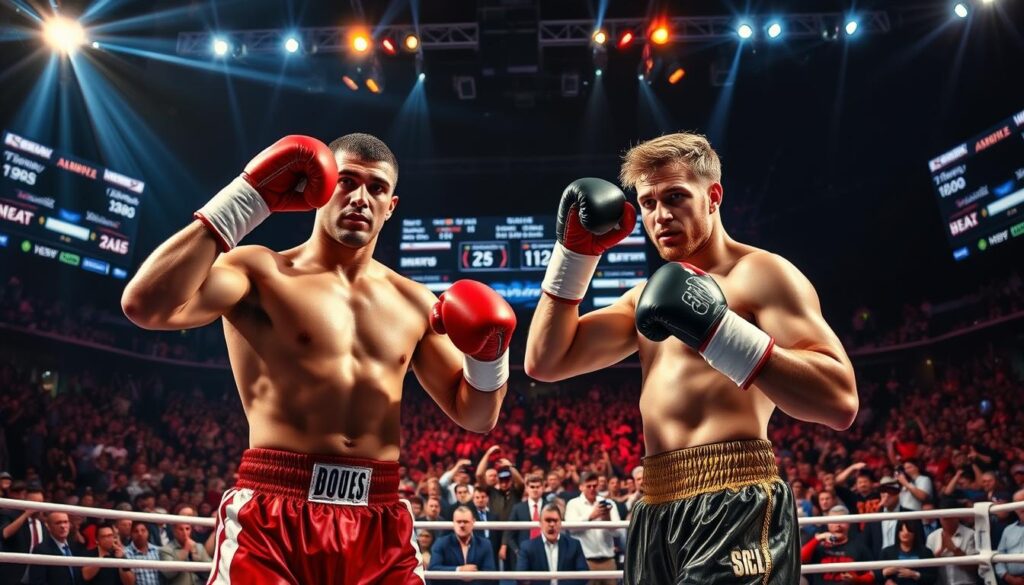
Oddsmakers set a clear favorite and underdog for this crossover bout. Multiple books list Anthony Joshua around −1100 while Jake Paul sits near +625 to +650. Some markets include a draw line and expanded prop pricing for early stoppages or longshot rounds.
Joshua vs Paul odds show heavy market support for a Joshua victory. Moneyline pricing compresses implied probability toward Joshua, while method markets favor stoppage outcomes for the former world champion.
Physical contrast shapes fight theory. Joshua stands roughly 6’6″ with about an 82-inch reach compared with Paul’s near 6’1″ height and a shorter wingspan. This gap frames the likely game plans and affects how sportsbooks weigh the bout.
The physical matchup Joshua Paul suggests range control will matter. Expect Joshua to use a jab and straight punches to exploit reach. Paul may try to close distance, work the body and make it a mid-range, scrappy fight to avoid extended exchanges at the outside.
Experience and pedigree tilt the narrative. Joshua is an Olympic gold medalist with world-title bouts and a long pro record. Paul’s boxing record features high-profile crossover wins but fewer tests against world-class heavyweights, which keeps him priced as the underdog.
Joshua recent form is factored into lines. His two-round KO of Francis Ngannou improved perceptions of his finishing power. The earlier KO loss to Daniel Dubois remains a cautionary input that tightened some books and opened alternative markets for bettors.
Paul boxing record and recent wins, including the Julio Cesar Chavez Jr. bout, show steady improvement. Books reward that progress with playable odds on props, yet they still price him as a remote chance for an upset over a seasoned heavyweight.
Market makers offer varied props tied to these dynamics. Stoppage markets typically list Joshua as the favorite for KO/TKO, while decision and long-round props give value to contrarian backers. Early-round prices often reflect the belief Joshua can end the fight quickly.
Bet types and markets to target for Joshua fights
Betting Anthony Joshua bouts means picking among several boxing bet types that match your risk appetite. A simple moneyline gives you a straight winner pick. Method-of-victory markets split outcomes into KO/TKO/DQ or decision, letting you target specific scenarios when you expect a stoppage or a long fight.
Moneyline vs. method
Moneyline prices reflect the pure win probability. For example, heavy favorites like Joshua can show steep lines such as −1100. Method markets list separate odds, with KO market Joshua often paying shorter numbers for the favorite, and decision prices paying longer. Use method markets when you predict a particular finish, such as an underdog lasting to a decision or the favorite scoring a late stoppage.
Prop markets and round options
Prop markets add nuance. Round betting Joshua is common: books post odds for a win inside specific rounds and round-by-round outcomes. Typical lines might show Joshua Round 1 at +200 and Round 2 at +300 while opponents carry longshot numbers for early rounds. Fight-to-go-distance props let you wager on whether the bout lasts all scheduled rounds.
Round-by-round bets reward precise reads on tempo and power. If you believe Joshua carries late-round power, look for value in later-round props. If the opponent has early speed, first- or second-round props may carry better payout potential.
Live betting and hedging
Live betting boxing opens chances when in-fight dynamics diverge from pre-fight assumptions. If Joshua starts slow while his opponent finds success, live markets can swing sharply. Traders who bet an early-round Joshua stoppage should watch for opportunities to hedge mid-fight.
Hedge examples include cashing partial profit on decision or second-half props if Joshua dominates early without finishing. Monitor price movement, bet limits, and tools for quick execution. Discipline and preset stop points help convert favorable swings into locked gains or reduced variance without emotional chasing.
Top sportsbooks and promos to get the best odds and value

Shop for price and promos before placing a wager on Anthony Joshua. Many major US books run targeted offers tied to big fights. Opening accounts across books gives access to welcome credits and different lines that can change the expected return on a bet.
DraftKings, FanDuel, BetMGM, Caesars, bet365 and Fanatics all push fight promos regularly. DraftKings often features a DraftKings Joshua promo that converts a small qualifying stake into bonus bets and perks. FanDuel runs similar boosts under a FanDuel Joshua promo that can raise early bankroll value for fight markets.
Use sportsbook bonus codes to claim offers that match your state and payment method. Read terms for rollovers, expirations, and eligible markets. Some offers require a $5 or $10 qualifying bet to unlock bonus funds. Other promos insure a losing first bet or credit fixed bonus-bet amounts on a win.
Match promo structure to your plan. If a site issues bonus bets on a win, deploy them to markets with higher upside such as props or method-of-victory lines. If the book gives insurance on a loss, consider placing a larger initial stake to maximize the protected exposure.
Compare odds across apps to find the best moneyline or prop price. Odds shopping is a straightforward way to lift returns without extra risk. Keep multiple accounts funded so you can take the best available line for each wager.
When books diverge sharply, look for betting arbitrage or middling chances. True arb requires precise execution and sufficient limits across accounts. Middling can work when one book posts a line that lets you win both sides if the result lands inside the middle range.
| Book | Common promo | Qualifying stake | Best use with promos |
|---|---|---|---|
| DraftKings | Bet $5, get bonus bets and extras | $5 | Use bonus bets on props or higher-value futures |
| FanDuel | Bet $5, get bonus bets on win | $5 | Apply to method-of-victory or round props |
| BetMGM | First-bet insurance up to $1,500 | Varies by state | Place larger initial tickets with loss protection |
| Caesars | Bet $1, get profit-boost tokens | $1 | Use boost tokens on value props and parlays |
| bet365 | Instant bonus bets on sign-up | $5 | Lock in favorable moneyline or prop pricing |
| Fanatics | No-sweat bets and FanCash credits | Varies | Stretch FanCash across multiple smaller wagers |
Maintain a ledger of active promos and expiration dates. Use odds-comparison tools to spot mispricings. Combine smart staking with promotional value to expand effective bankroll while keeping downside controlled.
Risk management and responsible gaming for boxing bettors
High-profile fights draw big wagers and emotional stakes. Set simple rules before you bet to protect your bankroll and your peace of mind. Good practices help keep betting a hobby rather than a problem.
Setting bankroll limits and staking plans for big-event bets
Allocate a dedicated bankroll and use fixed-percentage staking. A common range is 1–5% of your bankroll per bet. This bankroll management boxing approach reduces the chance that one loss wrecks your account.
For volatile markets, like round-by-round props or long-shot method bets, cut stakes further. Predefine a loss limit and stop-loss threshold for the event. Avoid chasing losses and resist inflating stake sizes after a few wins.
Tools and account features from sportsbooks
Top books offer controls to help bettors stay in control. Use sportsbook safety tools such as deposit limits, wager caps, time limits and self-exclusion when needed. These features can pause activity before it becomes harmful.
Track promotional terms and expiry dates to prevent accidental overspending. Regional promos vary by operator and state; check terms at sites like DraftKings, BetMGM and FanDuel for the specifics before using bonus offers.
Resources for problem gambling
If gambling patterns feel out of control, reach out for help. National helplines and organizations include 1-800-GAMBLER, Gamblers Anonymous and the National Council on Problem Gambling. Sportsbooks usually list similar gambling help resources within their responsible-gaming sections.
Seek professional counseling or peer support when behavior becomes risky. Early action makes a measurable difference for long-term recovery and stable bankroll management boxing practices.
| Risk Control | Practical Step | Why it matters |
|---|---|---|
| Bankroll allocation | Set a dedicated bankroll and use 1–5% per bet | Limits exposure and smooths variance |
| Staking by market | Reduce stakes for props and round bets | Preserves capital when volatility is high |
| Loss limits | Establish event stop-loss thresholds | Prevents chasing and emotional decisions |
| Account controls | Enable deposit, wager and time limits | Immediate protection using sportsbook safety tools |
| Self-exclusion | Activate temporary or permanent exclusion | Strong measure for when gambling becomes harmful |
| Promos management | Note wagering requirements and expiries | Avoid accidental overspend from bonus chasing |
| Support | Contact 1-800-GAMBLER or Gamblers Anonymous | Access immediate gambling help resources |
For more context on odds, promos and how major sportsbooks structure offers around big fights, see this betting guide at best Jake Paul vs. Anthony Joshua betting sites and. Use that information while keeping responsible gambling boxing front of mind.
Data-driven prediction model for Joshua fights
A data-first approach helps separate hype from measurable edges. Build a boxing statistical model that weights age, reach, KO percentage, recent opponents, and loss history. Factor each input by recency and opponent quality to keep the model responsive to change.
Inputs to consider:
Age adjusts for prime and decline curves. Anthony Joshua is older than Jake Paul, so the model reduces peak athleticism over time. Height and reach favor Joshua at about 6’6″ with roughly an 82″ reach versus Paul’s near 6’1″ and ~76″ wingspan, shifting power and control metrics.
KO percentage drives stoppage likelihood. Joshua’s 25 KOs in 28 wins push the KO probability higher compared with Paul’s lower rate. Recent results matter: Joshua’s KO of Francis Ngannou and his loss to Daniel Dubois change momentum and durability estimates. Paul’s wins over Julio César Chávez Jr. and other crossover opponents influence his experience score.
Loss history feeds durability modeling. Two career knockout losses for Joshua increase scenario weight for prolonged recovery and susceptibility in certain rounds. The boxing statistical model captures this by boosting variance in mid-to-late rounds.
Sample prediction logic for a Joshua vs. Paul matchup:
Start with baseline probabilities from historical bouts and physical deltas. Give a higher early-round KO weight to the larger puncher with superior stoppage rate. For Joshua, that raises the chance of a KO/TKO in rounds 1–4.
Segment outcomes into early stoppage (1–4), mid-to-late stoppage (5–9), and decision (full distance). Assign scenario weights from past patterns, then adjust for game plan, conditioning, and corner strategy. If Paul neutralizes the jab and extends range control, decision probability grows.
How odds translate to implied probability and spotting value:
Convert sportsbook lines to implied probability boxing to compare with your model. A favorite priced around −1100 implies roughly 91.7% for the win. An underdog at +650 implies about 13.3%. Books include vigorish, so totals exceed 100%.
Identify value bets Joshua by contrasting model output with market odds. If the Joshua prediction model returns 95% win equity while the market implies 91.7%, profit from overlay is limited because payout is small. If your boxing statistical model projects Paul at 20% while the market shows 13.3%, a small underdog stake can offer positive expected value.
| Input | Joshua | Paul | Model Effect |
|---|---|---|---|
| Age | Older; slight decline adjustment | Younger; smaller decline hit | Reduces peak athleticism for older fighter |
| Height / Reach | 6’6″ / ~82″ | 6’1″ / ~76″ | Boosts control, jab effectiveness, KO leverage for Joshua |
| KO % | High (25 KOs / 28 wins) | Lower (7 KOs / ~13 fights) | Raises Joshua’s stoppage probability |
| Recent opponents | Ngannou (KO win), Dubois (KO loss) | Chávez Jr. win, crossover bouts | Increases variance; weights recent form |
| Loss history & durability | Two KO losses; recovery factor applied | Fewer career knockouts against top heavy hitters | Adjusts late-round survival and upset likelihood |
| Market example | −1100 (implied ~91.7%) | +650 (implied ~13.3%) | Used to find overlays vs. model projections |
Use the model as a decision engine, not a crystal ball. Track implied probability boxing across books and update your Joshua prediction model with new film, sparring reports, and weight data. Repeat calibration after each major fight to refine detection of value bets Joshua over time.
Live-fight scenarios and contingency betting plans
Plan specific responses before the bell. For live betting Joshua, map out Scenario A, B, and C with stake sizes and exit rules. If Anthony Joshua controls range and looks likely to stop Jake Paul early, consider hedging aggressive early-round prop positions or use live markets to lock profit by taking a reduced price on Paul or decision lines.
If Paul survives and gains momentum, live odds on Paul will shorten quickly. In that case, small, selective hedges or contrarian live bets on Paul can protect a pre-fight position. Monitor visible signs like corner activity, swelling, and punch output as part of your in-fight strategy before committing more stake.
When the bout turns scrappy and favors body work or clinches, decision markets tend to lengthen. Bettors who backed stoppage should shift to distance or decision props and consider partial hedges to preserve upside. Use contingency betting boxing rules: pre-define size of hedges, set clear entry/exit points, and avoid emotional chasing after single exchanges.
Practical tips: keep multiple apps open to capture best live prices, be mindful of stream latency, and use quick bet sizing tools. Hedge live bets or cash out to lock profit or reduce downside when your pre-fight thesis is threatened. Above all, stick to disciplined limits aligned with your bankroll plan—live action can magnify risk fast during high-profile fights.