
The Ascot Gold Cup is the centerpiece of Royal Ascot betting for stamina lovers. This Group 1 marathon of about 2 miles 4 furlongs demands a distinct approach to Ascot Gold Cup odds, form study, and race-day tactics.
Bookmaker promotions such as “Bet £10 Get £30 in Free Bets” or matched refunds often nudge ante-post interest and shift liability on the big markets. Typical welcome offer terms — minimum qualifying stakes, odds floors near evens, and short expiry windows for free bets — change how and when bettors place money.
Historical context matters: the race dates back to 1807, with modern patterns showing favourites win frequently and most winners coming from the top nine in the market. Data from recent renewals, including fast times and over-round figures, underpins practical Ascot betting tips for marathon horse race betting.
In this guide we combine market mechanics, trainer and jockey form, statistical angles, and staking strategy to help bettors make informed choices at Royal Ascot. The following sections break down how odds are set, who to watch, and clear race-day tactics.
ascot gold cup betting: market overview and how odds are set
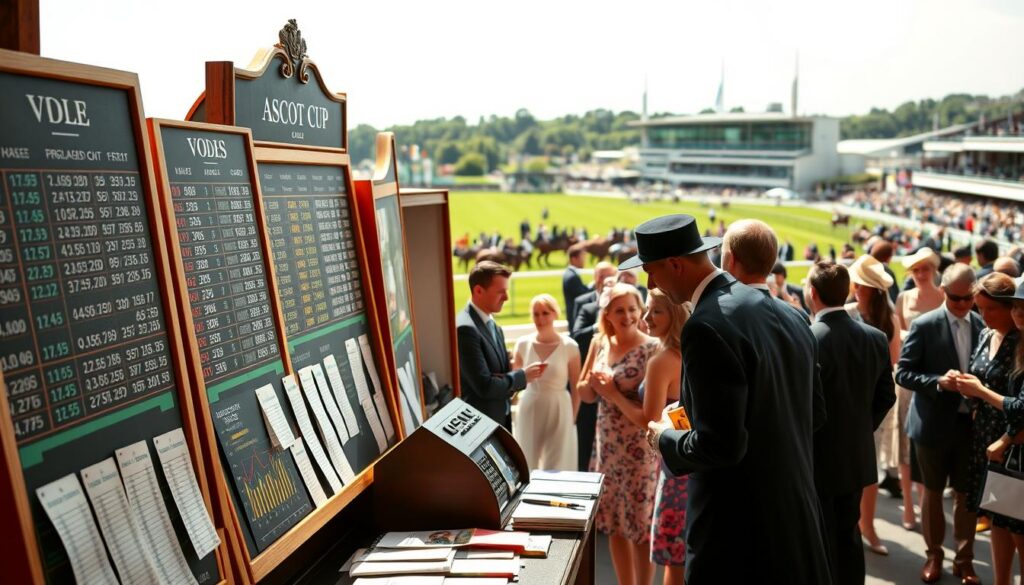
The Ascot Gold Cup market overview explains why this 2m 4f Group 1 marathon tests stamina and shapes horse prices. Race distance rewards proven stayers with strong pedigrees and race experience at Leopardstown, Sandown or Goodwood. Bookmakers and traders weight recent run style more than raw speed when evaluating contenders for marathon contests.
Understanding Group 1 marathon race markets
Group 1 marathon markets differ from sprints because form over longer trips matters most. Horses that have won at similar distances or shown staying power in top staying contests attract early support. Field size directly affects place terms and each-way appeal, while the over-round Ascot Gold Cup varies by renewal and shifts perceived value.
How bookmakers form odds and early betting patterns
Bookmakers set prices by combining form, trainer and jockey trends, stamina data and liabilities across books. Large firms such as Bet365 and William Hill monitor professional money and syndicate activity to adjust lines. Early markets reveal where smart money lands and can foreshadow late SP moves as liquidity builds.
Ante-post markets draw support for proven stayers and leading trainers ahead of declarations. Backing can offer value, but ante-post markets carry non-runner and form-change risks that shorten or lengthen prices before race day.
Key betting markets to follow
Win and each-way remain the core markets in Group 1 marathon markets. Enhanced place terms appear for big events and can improve value. Match bets and head-to-head selections let bettors isolate likely stayers, while exchange liquidity offers lay and hedge options. Monitor over-round Ascot Gold Cup figures to compare bookies and spot value between ante-post markets and SP offers.
Form, trainers and jockeys to watch
This section flags the patterns that matter when assessing contenders for the Ascot Gold Cup. Look for yards that target the race year after year and riders who carry a proven marathon record at Royal Ascot. Combining stable form, prep races and jockey bookings gives the clearest signal of intent.
Leading trainers with proven Ascot Gold Cup records
A P O’Brien has the standout A P O’Brien Ascot record, with nine wins from recent renewals. That level of success means his runners merit close attention in ante-post markets and on the day.
John Gosden Ascot Gold Cup form is also strong. John and Thady Gosden have produced multiple winners and positive long‑term returns for backers. Their horses often come via targeted prep races such as the Henry II at Sandown or the Yorkshire Cup.
By contrast, some trainers place frequently yet fail to win. Andrew Balding and W P Mullins have struggled in this contest across several attempts, showing how raw runner volume does not always translate into Gold Cup success.
Top jockey statistics and what they mean for betting
Frankie Dettori Ascot Gold Cup credentials make his rides market movers. His recent strike rate and profit figures mean a Dettori booking can shorten a horse’s odds sharply.
Ryan Moore, William Buick and other top riders shape markets through their strong associations with leading stables. Past records show that jockeys such as Moore and Buick influence both price and perceived chance, even when long‑term LSPs vary.
When a top jockey is confirmed, adjust staking sizes and reassess value. Bookings can reveal which horses the connections rate and which are second-string entries.
Trends from recent winners
Recent winners tend to have run within their last four starts and often won their previous race by at least half a length. Prep races like Leopardstown’s Saval Beg, Sandown’s Henry II and the Yorkshire Cup have supplied multiple recent Gold Cup winners.
Career profiles offer useful filters. Typical winners have between 3 and 23 career starts, three to 14 career wins and possess recent RPR/Timeform-style figures above key thresholds. These metrics help narrow fields in ante-post betting.
Use trainer strike rate, stable form and jockey bookings together to find value. For further context on trainers and jockeys to watch at Royal Ascot, consult this detailed guide on trainers and jockeys to watch at the meeting: trainers and jockeys to watch.
Past trends and statistical angles that matter
Understanding historical patterns helps bettors narrow the field and find value. This section outlines measurable filters that often separate realistic contenders from long shots. Use these angles as a starting point, not as a guarantee.

Market position and favorite performance
The market has a strong track record in this race. Thirteen favorites won in the last 20 renewals. Seventy-nine to eighty-four percent of winners came from the first nine in the betting market. The top market position shows the best long-term profit on stakes, with notable positive LSP figures. Big-priced winners like Rite Of Passage at 20/1 are rare outliers.
Form and rating thresholds
Winners tend to clear concrete rating and form bars. A last-win RPR of 104 or higher is common. Performance scores equivalent to a TS of about 74 or above across the last three runs appear regularly among winners. Recent win margin of at least half a length and a victory within the last four starts are typical filters.
Career and running-history limits
Career metrics narrow options further. Successful runners historically had between three and 23 career starts and three to 14 career wins. Avoid horses coming solely from restricted 3-year-old events. Last-run ground matters too; roughly 83% of past winners did not race on Heavy or Good-to-Soft on their most recent start.
Course, draw and breeding insights
Certain preps and sire lines keep showing up. Leopardstown and Sandown are frequent lead-up tracks, with Leopardstown producing five winners who ran there last time. Sandown and Navan each supplied three winners in the examined window. Stallion influence is notable: Sadler’s Wells leads with four wins, Galileo and Sea The Stars each have three, and Montjeu has two.
Sire lines and national trends
Some high-profile stallions have many attempts without success. Dubawi has had around ten runners with no wins, and Halling shows a similar non-winning pattern. Trainers from Great Britain and Ireland dominate recent renewals, each supplying roughly ten winners over the period. France and Germany show little success in this event.
Practical layered filter
Apply a stepwise process: start with market position, then RPR thresholds and TS-like scores, check for a recent win and margin, confirm suitable prep course, and finally consider sire lines Ascot Gold Cup. This layered approach reduces the field to realistic win or each-way options.
| Filter | Typical Threshold | Why it matters |
|---|---|---|
| Market position | Top 9; favorite strong (13/20) | Market reflects form and trainer support; top picks win most often |
| RPR thresholds Ascot | 104+ on last win | Higher RPR correlates with proven staying ability at group level |
| Performance score (TS equivalent) | 74+ across last 3 runs | Shows consistent recent form, not a one-off peak |
| Recent win timing & margin | Win within last 4 starts; ≥½ length | Confirms current race fitness and finishing ability |
| Prep course | Leopardstown, Sandown, Navan | These venues produced multiple recent winners; useful form pointer |
| Sire lines Ascot Gold Cup | Sadler’s Wells, Galileo, Sea The Stars, Montjeu | Stallions with repeated success often pass on stamina traits |
| Ground on last run | Not Heavy or Good-to-Soft | Most winners did not come off very testing ground last time |
| Career runs/wins | 3–23 starts; 3–14 wins | Filters out raw improvers and fully exposed veterans |
Race day tips, staking and betting strategy
Turn data into a clear game plan for Royal Ascot day. Start with a concise checklist that links form lines, trainer intent and recent race pattern to your wagering. This helps you decide when to commit to ante-post bets and when to wait for race-day prices with a practical Ascot Gold Cup betting strategy.
Ante-post timing
Back proven stayers ante-post when they meet trend criteria such as a pattern of strong recent wins, ratings near RPR 104+, and clear stamina pedigrees. Venue prep at Leopardstown or Sandown and trainer targeting should raise confidence. Use ante-post betting Ascot sparingly when prices offer clear value compared with likely starting-price movement.
Manage ante-post risks
Keep stakes small because non-runners, ground shifts and late injuries can wipe out early bets. Use refunds or free-bet terms where available. Allocate only a fraction of the festival bankroll to ante-post positions to reduce attrition while retaining upside in value selections.
Each-way rules for staying races
Target each-way Ascot Gold Cup plays when bookmakers offer favorable place terms, such as 1/4 or 1/5 for three to four places depending on field size. Prioritize horses that sit in the top nine market positions, carry consistent staying form and run for strong yards like Aidan O’Brien or John Gosden. Compare bookie terms with exchange-implied probabilities to spot overlays.
Combining overlays
If a high-profile trainer has a confirmed ride and the price underestimates the model probability, increase each-way weight slightly. This is useful when a jockey booking or late positive market movement points to underestimated chances while still preserving overall bankroll control.
Staking plan Royal Ascot
Use unit sizing across the festival. Divide the bankroll into 50–100 units. For ante-post betting Ascot, stake 0.5–2 units per pick depending on confidence. For day-of-race win or each-way bets, use 1–5 units per selection when an edge exists. Set a per-race cap of 3–5% of the total bankroll to avoid chasing losses.
Bankroll management
Track results and adjust unit size only after a sustained run, not on a single loss. Rebalance the unit value monthly during the campaign. Maintain a cold bankroll reserve so promotional funds do not distort core staking choices.
Using promotions responsibly
Evaluate offers for compatibility with your Ascot Gold Cup betting strategy. Welcome bonuses that exclude ante-post stakes have limited use for early bets. Treat free-bet credits as restricted capital and read minimum-odds, expiry and payment exclusions carefully before boosting stakes with promo funds.
Profiles of likely contenders and explicit betting tips
Use trend filters to shortlist Ascot Gold Cup contenders: age four or older, recent win in the last four starts, and last-win RPR 104+ with a TS 74+ in the latest three runs. Trainers such as Aidan O’Brien and John Gosden have patterns worth following; horses with Leopardstown or Sandown preps and a strong stamina pedigree fit the template. Recent examples — Kyprios betting patterns in 2022 and 2024 and the Stradivarius Ascot Gold Cup era — show how consistent seasonal targets and course-specific prep map to success.
Trawlerman betting (2025) illustrates the ideal profile: a 7-year-old with a seasonal win at Sandown (Henry II) and a fast Ascot time of 4:15.02. Assess an entry against career runs (commonly 3–23) and career wins (typically 3–14). Market position inside the top nine and avoidance of runners from historically weak source countries improve the probability of scoring. Use these filters when building ante-post and day-of-race books.
Betting tips Ascot Gold Cup — ante-post and each-way plans are practical. Candidate A (ante-post play): back a proven stayer from O’Brien or Gosden when RPR/TS thresholds are met and the prep is solid; stake 0.5–2 units ante-post, splitting positions across market moves. Candidate B (each-way play): choose a horse with course form or Leopardstown/Sandown prep, top-nine market status and RPR 104+; bet 1–3 units each-way on race day and confirm place terms before committing.
Hedging and staking rules: divide your bankroll into 100 units, reserve 5–10 units for late opportunities or hedges, and allocate primary day-of-race bets of 2–5 units where an edge exists. If an ante-post favourite shortens sharply, consider partial cash-out or an exchange lay to lock returns. For long-shot each-way plays, hold unless a sharp market move signals superior inside information. Apply the trend filters from earlier sections and monitor market over-round to spot real value.