
This Asian betting guide helps US bettors get up to speed quickly. The global sports betting market tops $85 billion, and American players now encounter varied odds, markets, and platforms when they wager.
In this short introduction we explain what to expect: how odds formats differ, where Asian Handicap fits in, and why live markets matter. Major platforms such as Bet365, DraftKings, William Hill, FanDuel, Pinnacle, and SBOBET shape pricing and product choices across regions.
Mobile-first betting is the norm: over 75% of wagers come from smartphone apps. Features like live betting, cash-out, streaming, and push notifications change how value appears in-play and off it.
The purpose of this sports betting guide is practical. US bettors will learn to read and convert odds, understand core markets including Asian Handicap, compare Asian bookmakers with international and U.S. sportsbooks, and apply basic bankroll and responsible-gambling practices.
Understanding Odds Formats and Conversions for US Bettors
Betting platforms use three main displays that US players will meet: american odds, decimal odds, and fractional odds. DraftKings and FanDuel favor american odds with clear + and – values. Bet365 shows decimal odds for easy payout math. William Hill and Paddy Power still list many markets in fractional odds for UK-style events.
Overview of American, Decimal, and Fractional Odds
American odds express underdogs with a + sign and favorites with a -. A +150 line means a $100 stake returns $150 profit. A -150 line means you must risk $150 to win $100. This format makes favorite and underdog status obvious at a glance.
Decimal odds give the total payout per unit staked. A 2.50 quote returns $2.50 for every $1 wagered, which simplifies quick math. International and Asian sites prefer decimal odds for that reason.
Fractional odds use ratios like 7/2 or 1/4. A 7/2 price pays 7 units for every 2 staked. This style remains common in horse racing and older British markets. Each format converts into a percentage chance through implied probability.
How to Convert Between Formats
To convert positive american odds to decimal, divide by 100 and add 1. Example: +200 becomes 3.00. For negative american odds, divide 100 by the absolute value then add 1. Example: -150 converts to roughly 1.67.
Decimal to implied probability uses 1 ÷ decimal × 100. A 2.00 decimal equates to 50%. Fractional odds convert to implied probability using denominator ÷ (numerator + denominator) × 100. These formulas help bettors convert odds and check whether a line matches their forecast.
| Format | Example | Decimal | Implied Probability |
|---|---|---|---|
| American (underdog) | +100 | 2.00 | 50.0% |
| American (favorite) | -200 | 1.50 | 66.7% |
| American (standard) | -110 | 1.91 | 52.4% |
| Fractional | 7/2 | 4.50 | 28.6% |
Why Format Choice Matters for Value and Comparison
Format affects speed and clarity when you compare markets across bookmakers. Decimal odds make implied probability checks fast. American odds highlight underdogs and favorites, which helps when you want to evaluate risk at a glance.
Knowing how to convert odds gives a tangible edge. You can convert odds between Bet365 decimals and DraftKings american odds to spot differences in vig and value. Use quick mental math or a simple conversion chart to convert odds before placing a stake.
For more in-depth examples and a practical guide to conversions, consult this detailed primer on betting odds and formats at how to understand betting odds. Mastering these basics reduces mistakes and sharpens your ability to find value across platforms.
asian betting: Core Markets and How They Work

Asian betting markets center on a few core options that shape most wagering strategies. Start by understanding match odds and the three-way market in soccer, since these give the basic price for outcomes. US bettors often see two-way moneylines in NBA or NFL games, while Bet365, William Hill, and Unibet list a full three-way market for international soccer fixtures.
Match odds set the baseline for value hunting. The three-way market prices win, draw, and loss separately, which changes how you approach underdogs and favorites. Moneylines in US sports remove the draw, so stake-sizing and edge calculation differ between formats.
Asian Handicap removes the draw by assigning goal or point lines that level favorites and underdogs. A -0.5 handicap needs the favorite to win by one or more, while +1.5 wins if the team draws or loses by a single goal. Whole handicaps like -1 can lead to a push when the margin equals the line, triggering a stake refund on many books.
Quarter handicaps split the stake across two lines. For example, -0.75 equals half on -0.5 and half on -1.0. A one-goal win then pays half as a full win and half as a push or half-win depending on the pair of lines. This mechanic reduces variance and often lowers bookmaker margin versus 1X2 pricing.
Asian Handicap offers advantages for value seekers. It typically features lower margins, better returns on strong favorites, and protections like pushes and quarter lines. Asian bookmakers and mainstream names such as Bet365 make these markets widely available across leagues.
Totals over under bets target the combined goals or points in a match. Popular in soccer and basketball, these markets let bettors back over or under a set line. Live totals shift quickly during a match, opening chances for in-play value when momentum or injuries change scoring probability.
Betting props and specials cover niche outcomes like corners, cards, next-goal, and player milestones. Soccer prop markets often include corners and cards, while basketball features game and quarter markets. Tennis props focus on game handicaps and next-point markets. Asian books frequently offer small-segment props that move rapidly in-play.
Sports-specific menus matter when crafting a plan. Soccer’s strongest suites are Asian Handicap, totals over under, and betting props such as next-goal and corners. Basketball bettors should weight point spreads, totals, and quarter markets. Tennis markets lean on game handicaps, set winners, and next-point markets.
Live Betting Dynamics and Strategies for Asian Markets
Live action changes everything for bettors. Live Asian odds update in real time as goals, cards, and momentum swings occur. This makes in-play betting fast-paced and reactive, with prices shifting by the second on major events.
How Live Asian Odds Move During Matches
Bookmakers like Pinnacle, SBOBET, and Bet365 push streams of prices that reflect immediate events. A red card or early goal can swing handicaps and totals within minutes. For example, if a favorite falls behind in soccer after 20 minutes, their win odds lengthen and the underdog’s odds shorten.
Basketball shows even faster shifts. A 10-point deficit early can drive a handicap from -10 to -15 in a few possessions. Tennis lines change on each point; break chances and service games move prices rapidly.
Popular Live Markets and When to Use Them
In-play markets that thrive in Asian contexts include Asian Handicap in-play, adjusted live totals, next goal or next point, and corner and card markets. Quarter and period bets in basketball, along with set-winner or game handicap in tennis, offer focused exposure.
Use next-goal and next-point markets for short-term plays with quick resolution. Pick corners and cards when match flow shows clear attacking or defensive patterns. Choose Asian Handicap live when you want cleaner value on a match-level outcome.
Practical Live Betting Tips and Risk Management
Watch matches live when possible to spot moves before Asian bookmakers live platforms update prices. Line shopping between fast feeds can capture transient value. Safer live options include double chance and +1.5 handicaps to reduce volatility.
Follow bankroll rules of 1–5% per bet for consistent risk control. Use cash-out selectively to lock profit or limit loss. Avoid chasing losses and keep a betting log to identify strengths across live markets.
Mobile apps with live streaming and quick bet interfaces matter. Pick platforms with high live limits and fast price feeds like Pinnacle, SBOBET, or Bet365 to exploit in-play betting opportunities and apply measured live betting strategies.
Top Asian Bookmakers, Global Platforms and US-Focused Options
Choosing where to place bets means weighing odds quality, market depth, licensing and app performance. This section compares leading names and gives practical steps for U.S. bettors who want access to strong international markets alongside regulated domestic options.
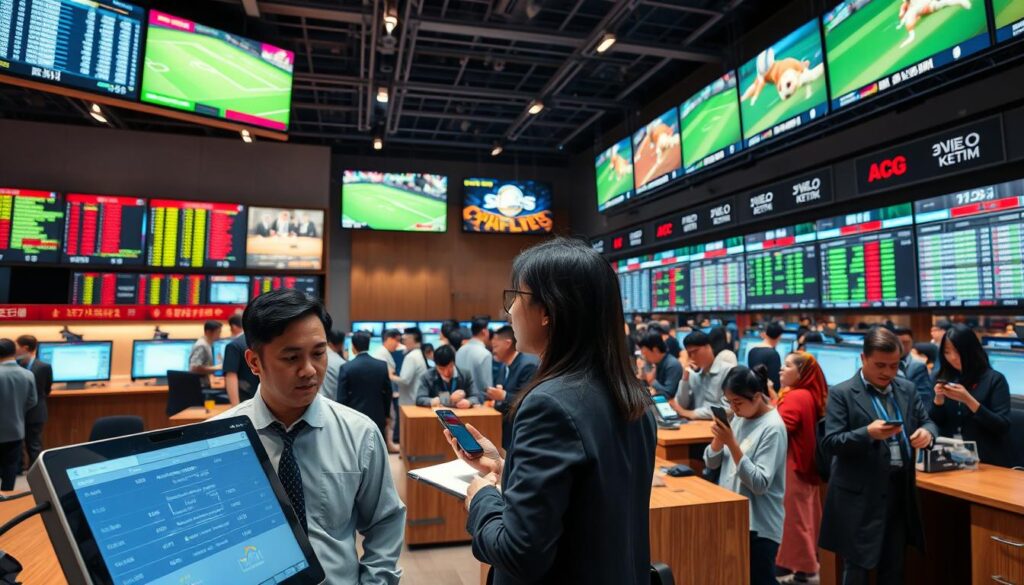
Notable operators and what they do best
Pinnacle stands out for ultra-competitive odds, low vig and high limits. Sharp bettors favor Pinnacle for fast live pricing and deep stakes on major events.
SBOBET offers a robust live-betting interface and broad Asian market coverage. It handles large wagers and maintains strong in-play markets for soccer and regional leagues.
Bet365 serves millions with deep market depth and excellent in-play streaming. Bet365 is strong on international soccer, Champions League lines and decimal-odds markets.
How international platforms differ from US sportsbooks
DraftKings and FanDuel dominate the U.S. landscape with mobile-first apps, extensive prop menus and same-game parlays. Their focus is heavy on NFL and NBA products and regulated state licensing.
International books tend to offer lower vig on major matches. Asian bookmakers often cut vig below 2% on big fixtures. Typical U.S. books run -110 which produces roughly 4.55% vig.
Choosing the right platform for your needs
Decide on the sports and markets you bet most. Compare odds competitiveness, availability of Asian Handicap lines and live features. Check licensing to ensure legal access where you live.
Open accounts with multiple providers to line-shop and find the best prices. Use U.S.-regulated DraftKings or FanDuel for domestic play when required. Add Bet365, Pinnacle or SBOBET where legal to capture better international soccer markets.
Checklist for platform selection
| Factor | Pinnacle | SBOBET | Bet365 | DraftKings / FanDuel |
|---|---|---|---|---|
| Odds Competitiveness | Very high, low vig | High for Asian markets | Strong across markets | Competitive on US sports |
| Live Betting | Fast pricing, limited streaming | Excellent live interface | Live streaming and deep in-play | Mobile-first live features |
| Market Depth | High on major events | Broad Asian coverage | Extensive global markets | Extensive US props and parlays |
| Limits & Account Size | High stakes accepted | High limits available | Varies by region | Standard retail limits |
| Licensing | International licenses; check access | Asia-focused licenses | Multiple jurisdictions | US state-regulated |
| Best Use | Value hunting and high stakes | Live Asian markets | International soccer & in-play | Legal US wagering, NFL/NBA focus |
Use this sportsbook comparison to match your priorities with the best betting platforms. Keep accounts across international and domestic operators to access varied lines, protect your play under local law and capture the most value.
Advanced Market Concepts: Vig, Implied Probability, and Value Hunting
The sharp bettor treats odds as data. Begin with the sportsbook commission known as the vig or juice, then move to implied probability and disciplined value hunting. Mastering these ideas separates casual wagering from professional approaches used by operators like Bet365, Pinnacle, DraftKings, and FanDuel.
What vig (juice) is and how it varies by market
Vig, often called juice, is the built-in commission in posted odds. Typical US -110 lines reflect about 4.55% vig. Big European markets commonly sit around 2–3%. Asian markets can drop under 2% on high-liquidity events, which explains why sharp bettors favor Pinnacle and Bet365 for reduced margins.
Smaller markets and props carry higher juice because liquidity and pricing data are weaker. Entertainment bets and niche props can exceed standard margins, which increases the cost of doing business over time.
Calculating implied probability and spotting value
Convert decimal odds to implied probability using 1 ÷ decimal × 100. For American odds, use these formulas: favorites: |Odds| ÷ (|Odds| + 100) × 100; underdogs: 100 ÷ (Odds + 100) × 100. Compare the implied probability to your own assessed probability to find edges.
Example: if you assess Manchester City at 65% and Bet365 shows 1.60 (62.5% implied probability), you hold a 2.5% edge. Small edges compound over many bets, producing measurable profit if staking and bankroll management are disciplined.
Arbitrage, line shopping and bankroll rules
Arbitrage seeks discrepancies across books to lock a risk-free profit. Successful arbitrage requires fast execution, multiple accounts and clear tracking of limits. Line shopping—from DraftKings to FanDuel—captures half-point swings that can change expected value in NFL spreads or totals.
Bankroll management matters more than a single wager. Professionals commonly risk 1–5% of bankroll per bet based on confidence and edge size. Track performance by sport, market and sportsbook to refine staking plans and protect capital during losing runs.
| Concept | Typical Range | Practical Tip |
|---|---|---|
| Vig / Juice | Under 2% (Asia) to ~4.55% (US -110) | Prefer tight books like Pinnacle for sharp markets; avoid high-juice props |
| Implied Probability | Calculated from odds (decimal or American) | Use conversion tools to compare to your assessed probability quickly |
| Value Betting | Small edges: 1–5% per wager | Compound small edges with consistent staking and record-keeping |
| Arbitrage | Occasional, depends on discrepancies | Maintain multiple accounts and act fast to capture spreads |
| Line Shopping | Half-point swings can matter | Compare Bet365, Pinnacle, DraftKings, FanDuel before betting |
| Bankroll Management | Risk per bet: 1–5% typical | Adjust stake with confidence and edge; track metrics by market |
Responsible Betting, Legal Landscape, and Tools for US Bettors
Responsible betting starts with simple controls: set deposit limits, loss limits, and session timers on apps like DraftKings, FanDuel, and BetMGM. Use self-exclusion and timeout features when needed to pause activity, and treat wagering as entertainment rather than a source of income. Keeping stakes to a fixed bankroll percentage—commonly 1–5% per unit—helps prevent large drawdowns and supports long-term play.
The legal sports betting US environment is state-regulated, so always confirm that a sportsbook holds the proper license before depositing. Prioritize state-licensed operators for consumer protection and financial security. When considering international platforms, verify whether account access and market participation are permitted in your state and whether the operator holds recognition from authorities such as the UK Gambling Commission or Malta Gaming Authority.
Practical tools boost control and insight. Track bets in a simple spreadsheet or app to calculate return on investment and spot leaks. Use mobile features to enforce betting limits and enable self-exclusion when patterns suggest harm. For help with problem gambling, consult the National Council on Problem Gambling and state hotlines; international counterparts include GambleAware and GamCare. These gambling support resources can connect players to counseling and recovery programs.
Combine technical know-how—odds formats, Asian Handicap mechanics, and implied probability—with responsible-play habits and legal awareness to create a sustainable approach to asian betting tailored for US audiences. Selecting regulated sites, applying betting limits, and using support tools keeps play safer and more enjoyable over the long run.