
Asian lines betting, commonly called the Asian handicap, is a football-focused market that removes the draw to create two-way outcomes. By applying goal handicaps to teams, bookmakers level the field and produce clearer betting odds for matches ranging from the English Premier League to MLS.
The Asian lines meaning is simple: subtract goals from the favorite with a negative handicap or add goals to the underdog with a positive handicap. This system reduces variance from draws and gives bettors options like draw no bet-style protection, partial refunds on pushes, and more precise risk control with half- and quarter-goal lines.
Core mechanics split into three types: half-goal lines remove push outcomes, full-goal lines can result in refunds when margins match the handicap, and quarter-goal (split) lines divide stakes between adjacent handicaps. These features make Asian handicap and soccer handicap betting attractive to bettors who prefer analytical football betting strategy and advanced pricing options.
U.S. bettors now find Asian lines betting available on major sportsbooks and international exchanges. For fans who track expected goals, form, and matchup data, the market offers refined tools to express conviction and manage bankrolls with more nuance than a simple draw no bet market.
What asian lines betting Means and Where It Came From
The Asian lines betting format changes the typical three-way soccer market into a two-way contest by using handicaps to level teams. Bettors find this style attractive for clearer outcomes and reduced variance. The origin of Asian handicap traces back to Indonesia in the late 1990s, when local bookmakers started offering goal adjustments to balance mismatched fixtures.
Early adoption across Southeast Asia led to rapid refinement of rules and new line types. The history of asian lines betting shows how quarter- and half-goal splits became standard tools for managing pushes and partial refunds. Asian bookmakers in places like Singapore and Hong Kong helped popularize these innovations during the early 2000s.
International operators took notice as demand for more nuanced markets grew. The Indonesia Asian handicap proved a practical model, so major firms added similar products. Over time modern platforms listed full-goal, half-goal, and quarter-goal options next to moneylines and totals.
Global sportsbooks Asian markets now serve a wide range of customers, from casual fans to sharp punters. These markets reduce exposure to draws and attract players who use metrics such as expected goals. The shift widened choices and encouraged clearer pricing across major leagues.
U.S. bettors Asian lines have gained traction through streaming and wider coverage of European football. American bettors appreciate draw-no-bet outcomes and the strategic edge that split handicaps provide. U.S. sportsbooks respond by offering Asian-style markets to retain experienced customers and to differentiate their product lines.
This section outlines how a regional innovation became an international staple and why it matters for bettors seeking precise risk control. The evolution from Indonesia to established global offerings highlights practical benefits and market demand that keep Asian lines central to modern soccer wagering.
How Asian Handicap Mechanics Work: Handicaps, Pushes and Refunds

Understanding how Asian handicap works starts with the idea of leveling matches so bets focus on margin of victory. Bookmakers assign negative handicaps to favorites and positive handicaps to underdogs to create balanced markets and sharper odds.
Positive vs. negative handicaps
Negative handicaps, like -1 or -1.5, mean the favorite must win by more than the handicap for a full win. A -1.5 line removes the draw option; the favorite needs a two-goal margin. Positive negative handicaps for underdogs allow them to keep the bet alive even if they lose by a small margin. A +1.0 line means the underdog can lose by one goal and the bettor still gets a refund or a win depending on the exact line.
Push outcomes and refunds
A push occurs when the final result exactly matches a full-goal handicap, such as a favorite at -1 winning by one goal. The stake is refunded rather than lost or paid out. Push refund explained: refunds protect bankrolls and lower variance compared with three-way markets where draws cause losing bets.
Quarter and split lines
Quarter handicaps like -0.25 split the stake between 0 and -0.5. Outcomes can be full wins, half wins, half losses, or partial refunds. These split lines create nuanced payout scenarios that reward precise reading of match dynamics.
Reading the line into payout scenarios
Reading asian lines means translating numbers into required margins for full win, half win, or push. A 0 line is a draw no bet: win returns payout, draw refunds stake. A -1 line requires a two-goal win for full payout; a one-goal win triggers the push refund. For -0.5 the favorite must simply win to pay out.
| Handicap | What bettor needs | Typical payout scenario |
|---|---|---|
| -1.5 | Favorite wins by 2+ goals | Full win |
| -1 | Favorite wins by 2+ (full), by 1 (push) | Full win or push refund |
| -0.25 | Split stake on 0 and -0.5 | Win = full; draw = half refund/half loss |
| +1 | Underdog loses by 0 or 1, or wins | Win or push refund or full payout |
Clear examples help bettors predict payout scenarios before placing a wager. Knowing when a push refund explained applies can save money and guide smarter staking choices.
Common Asian Lines and What They Mean for Odds
The five most used types of handicaps shape how bets settle and how bookmakers set prices. Understanding full-goal asian lines, half-goal handicap choices, and quarter-goal split lines helps you read markets and judge asian lines odds meaning before staking money.
Full-goal lines like 0, ±1, ±2 offer clear outcomes and frequent refunds under push rules. A 0 line acts as draw no bet: a win pays, a draw refunds, a loss loses. A -1 on the favorite needs a two-goal margin for a full win; a one-goal victory produces a push and returns the stake. The ±2 behaves the same at a larger scale, with exact two-goal swings often triggering push logic.
Half-goal handicaps such as ±0.5 and ±1.5 remove draws from the settlement. A favorite at -0.5 must win outright to cash. An underdog with +0.5 wins on draw or victory. For -1.5, the favorite must win by two or more goals. Half-goal handicap lines produce binary results, which traders price to steady implied probabilities because refunds do not occur.
Quarter-goal split lines split stakes across adjacent full or half figures. A -0.25 equals half on 0 and half on -0.5. Settlement can return half wins, half losses, or half refunds, depending on the score versus each leg of the split. For example, -0.75 splits into -0.5 and -1.0; a one-goal margin yields a half win on -0.5 and a half push on -1.0, producing a reduced net payout that blends profit with stake return.
Bookmakers weave quarter-goal split lines to let bettors fine-tune risk and reward. These lines lower variance and allow partial protection against narrow defeats. Reading asian lines odds meaning requires noting how each split affects net returns and how push logic applies when whole-number components meet exact margins.
| Line | How It Settles | Typical Outcome |
|---|---|---|
| 0 (draw no bet) | Win = paid; Draw = stake refunded; Loss = lost | Refunds on draws; clear payouts otherwise |
| -1 / +1 | Favorite needs +2 to win; 1-goal margin = push; underdog benefits on draw | Frequent pushes; mid-level variance |
| -0.5 / +0.5 | No draws; favorite must win outright; underdog wins on draw or win | Binary result; steadier implied prob. |
| -1.5 / +1.5 | Favorite must win by 2+; underdog can lose by 1 and still win bet | Clear two-goal threshold; fewer refunds |
| -0.25 / -0.75 / -1.25 | Stake split across adjacent lines (e.g., -0.25 = 0 & -0.5) | Half wins or half refunds possible; lower variance and blended payouts |
Practical Examples and Asian Handicap Tables for Quick Reference
The examples below turn abstract rules into clear outcomes. Use these asian handicap examples and handicap settlement examples to read markets faster and avoid surprises when a result triggers a push or half-win. Start with the simple scenarios for favourites and underdogs, then move to worked numeric examples and how bookmakers label asian lines in combined markets.
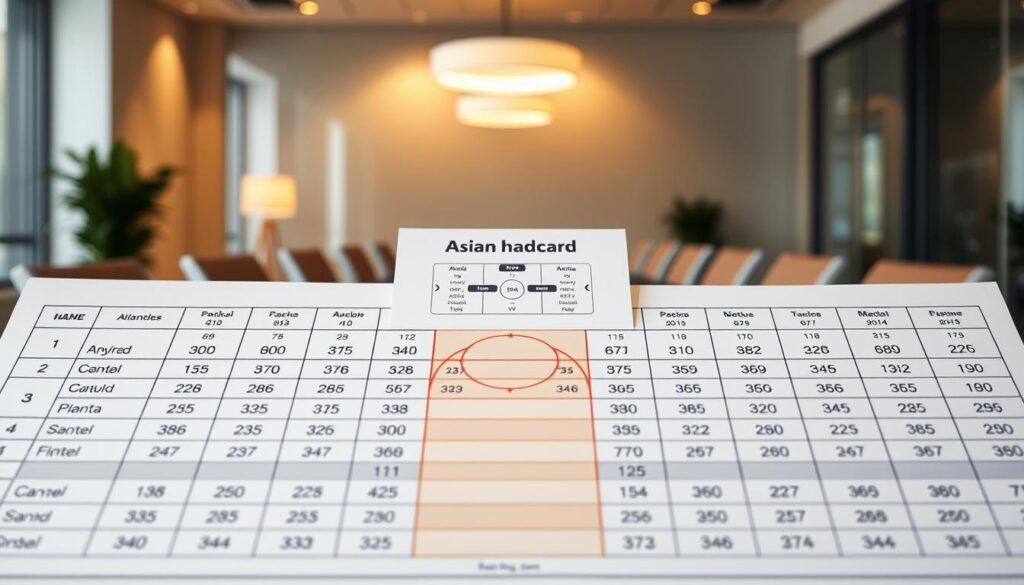
Common scenarios show the result for each match score against the listed handicap. The table that follows maps favourites on negative lines and underdogs on positive lines. This layout mirrors asian handicap tables published by sportsbooks and betting guides for quick reference.
| Handicap | Typical Settlement | Win by 2+ | Win by 1 | Draw | Lose |
|---|---|---|---|---|---|
| -0 | Full win if scores higher; push if equal | Win | Win | Push (refund) | Lose |
| -0.25 | Split stake 0 and -0.5; half loss on draw | Win (both parts) | Win (both parts) | Half loss (0 refunded, -0.5 loses) | Lose (both parts) |
| -0.5 | No draw; win/lose only | Win | Win | Lose | Lose |
| -0.75 | Split stake -0.5 and -1.0; half win on 1-goal | Win (both parts) | Half win (0.5 wins, 1.0 push) | Lose | Lose |
| -1.0 | Full-goal: push on 1-goal win | Win (by 2+) | Push/refund (by 1) | Lose | Lose |
| -1.25 | Split -1.0 and -1.5; partial refund possible | Win (both parts) | Half win (1.0 push, -1.5 loses) | Lose | Lose |
| -1.5 | Half-goal: must win by 2+ | Win (by 2+) | Lose (by 1) | Lose | Lose |
| +0 | Mirror of -0 for underdog | Lose | Lose | Push (refund) | Win |
| +0.25 | Split +0 and +0.5; half win on draw | Lose | Lose | Half win (0 refunded, +0.5 wins) | Win |
| +0.5 | No draw; win if draw or win match | Lose | Lose | Win | Win |
| +0.75 | Split +0.5 and +1.0; half win on draw | Lose | Lose | Half win (+0.5 wins, +1.0 pushes) | Win |
| +1.0 | Push if underdog loses by 1 | Lose | Push/refund | Win | Win |
| +1.25 | Split +1.0 and +1.5; half refund in some cases | Lose | Half win (+1.0 push, +1.5 wins) | Win | Win |
| +1.5 | Win if draw or win or lose by 1 | Lose | Win | Win | Win |
Next are worked numeric examples to make handicap settlement examples concrete. All figures assume a $10 stake and decimal odds for simplicity.
-0.25 worked example: Stake $10 split as $5 on 0 and $5 on -0.5. If the team draws, the 0 part is refunded ($5), the -0.5 part loses ($0 return). Net loss = $5. If the team wins, both parts pay; at 2.00 odds you would get $20 return, net profit $10.
-1.0 worked example: Stake $10 on -1.0 at 1.90 odds. If the team wins by 2+, return = $19 net profit $9. If the team wins by 1, push, stake refunded $10. If draw or lose, return $0.
-1.5 worked example: Stake $10 on -1.5 at 2.30 odds. Team must win by 2+ to return $23. Any 1-goal win, draw, or loss yields $0. No push applies on half-goal lines.
Bookmakers label lines with plus/minus signs and decimal shorthand such as .25 or .75. Recognize these conventions to read a market instantly. Some operators use a slash like -1/-1.5; others write -1.25. Learn how bookmakers label asian lines so you avoid misreading a quarter or three-quarter market.
Combined markets let you parlay Asian handicap legs with totals or outright winners. Pay attention to settlement order and refund rules. If one leg is pushed, some sportsbooks void that leg and recalc the parlay; others return stake portions and settle the remaining legs. Cashout, bet-split, and live adjustments can alter payouts. Always check the operator rules before combining legs.
Using Data and Tools to Improve Your Asian Lines Betting
Good match analysis starts with metrics that matter. Expected goals models help reveal whether a team truly created chances or just overperformed on conversion. That matters when weighing an underdog against a favorite and choosing an xG asian handicap line.
Form and venue split are compact, actionable signals. Look at goals for and against over the last six matches rather than a full season. Home/away splits change expected margins dramatically. Clean sheet probability and defensive xG against guide decisions when a favorite must cover multi-goal handicaps.
Fantasy Premier League stats add a layer beyond team numbers. FPL gives minutes, attacking returns, and rotation risk that reflect real selection chances. Use FPL stats for betting to spot when a top scorer might be rested or heavily rotated for upcoming fixtures.
Fixture lists carry clear signals. A fixture difficulty rating is useful for anticipating lineup strength and effort. Teams facing a run of tough matches often rest starters, which reduces the likelihood they will cover a negative handicap.
Head-to-head patterns matter in tactical matchups. Some pairings trend to low-scoring draws, others to one-sided contests. Combine this intel with injury and suspension updates before sizing a wager.
In-play opportunities come when injuries or momentum swings alter the expected flow. Real-time injury data betting is critical during live markets. A losing side that loses its main striker often fails to cover a -1.5 line after the change.
Below is a compact comparison of useful inputs and how they change line selection. Use this as a quick checklist before placing an Asian handicap bet.
| Input | Why it Matters | How it Changes Line Choice |
|---|---|---|
| Expected Goals (xG) | Estimates chance quality, flags over/underperformance | Higher xG for favorite supports taking -0.5 or -1.0; low xG suggests caution on -1.5 |
| Recent Form | Shows current scoring and defensive trends | Good form favors taking a negative handicap; poor form suggests backing the draw or underdog |
| Home/Away Splits | Adjusts expected margin based on venue effects | Strong home split can justify a larger handicap for the host |
| FPL Stats | Reveals rotation risk, minutes, and attacking returns | High minutes and captaincy signals support taking more aggressive lines |
| Fixture Difficulty Rating | Predicts squad strength and likelihood of rotation | Tough upcoming fixtures lower the chance a coach fields a full-strength XI, reducing expected margin |
| Head-to-Head | Highlights tactical match patterns over time | Consistent low-scoring H2H suggests avoiding steep negative handicaps |
| Injury Data Betting | Shows availability of key attackers and defenders | Loss of key striker weakens favorite’s ability to cover -1 or -1.5; loss of center-back raises conceding risk |
Strategy and Bankroll Management for Asian Lines Betting
Smart betting starts with clear rules. Pick lines that match your risk profile and test them with small stakes before scaling. Conservative players often favor 0.0 or ±0.5 to limit variance. Aggressive bettors target -1.0 or -1.5 for bigger payouts after careful value checks.
Choosing the right handicap lines
Quarter-lines such as -0.25 and -0.75 split stakes and cut downside on marginal favorites. Use these when you expect a narrow win but want partial protection. For multi-goal handicaps, adjust implied probabilities to reflect team form and goal expectancy.
Live entry and momentum reads
Live markets shift fast after goals, red cards, or tactical changes. Predefine triggers to act in-play: a conceded early goal, a key injury, or a clear momentum swing can create edges. Watch liquidity and line moves to avoid following insider-driven swings in live betting asian handicap markets.
Staking discipline and split approaches
Fixed-percentage staking, such as 1–2% of your bankroll, keeps losses manageable and supports long-term growth. Use staking plans split handicaps to spread risk. Splitting stakes across quarter or half lines smooths variance while keeping upside on winners.
Track returns by handicap type and refine your entries. Measure ROI on quarter, half, and full lines to see where your edge sits. Good bankroll management asian handicap combines staking rules with clear line selection, keeping you in the market through streaks.
Risks, Limitations and Best Practices for Smart Wagering
Asian handicap betting reduces the impact of draws, but it brings specific risks asian lines betting that new bettors must learn. The quarter- and half-goal logic can confuse beginners and lead to unexpected refunds or losses if a line is read incorrectly. Start with simple lines like 0.0 and ±0.5 and practice small stakes to understand settlement quirks before moving to split or multi-goal handicaps.
Limitations asian handicap include varied market depth and rule differences among operators. Some niche leagues lack full Asian lines and liquidity, which affects price quality. Always check sportsbook rules for settlement, parlay interaction, and cashout handling; these details change how pushes and split stakes are treated and can alter returns on multi-leg bets.
Adopt betting best practices by relying on objective data—xG, recent form, home/away splits, and verified lineups—while remembering that stats are probabilistic. Injuries, red cards, refereeing decisions, and weather can undo models. Track line movements and use market signals to find value, placing wagers when handicaps have not fully reacted to new information.
For long-term sustainability, apply strict bankroll rules and responsible wagering. Stake a small fixed percentage per bet (commonly 1–2%), keep clear records, and use hedging or avoidance when risk-to-reward is poor. For deeper reading on practical tips and settlement examples, see this guide on Asian handicap betting. Asian handicap betting tips