
This short guide turns beginners into informed bettors by covering the basics of sports and casino betting and the key strategies that matter. Sports betting is predicting a sporting result and placing a wager, from simple moneyline bets to complex parlays and accumulators offered on major apps like BetMGM, FanDuel, and DraftKings.
One clear success example: a novice in Nevada studied odds and applied disciplined bankroll rules to grow a $200 stake into $847 at a regulated sportsbook. That story shows the three pillars of consistent success: understanding odds and probability, finding value, and strict bankroll management.
Combined wagering blends sportsbook markets with casino-style staking systems. Many players use structured systems such as 1-3-2-6 and Paroli in even-money markets and table games like blackjack or baccarat, but no sequence eliminates the house edge. Responsible bettors prefer regulated platforms such as FanDuel and ESPN Bet, complete identity verification including Social Security number where required, and confirm the minimum betting age—typically 21 in most states.
This sports betting guide explains how to place basic bets, compare odds across sites, and use cash-out options wisely. Later sections will cover casino betting strategies, parlays’ payout math and EV, and how to manage a shared bankroll across multiple products in the growing betting casino marketplace.
How the Legal Sports Betting Landscape Shapes Casino Markets
The 2018 U.S. Supreme Court decision that removed the federal ban opened a path for fast growth in regulated wagering. The PASPA repeal accelerated state legalization, turning isolated markets into a national conversation about consumer choice and protections. New Jersey led the charge and showed that regulated markets can produce high volumes while protecting players.
Market size has grown quickly since 2018. Industry estimates put the American market in the hundreds of billions, with sports betting handle hitting record monthly totals in states like New Jersey and Nevada. Projections to 2030 point toward further expansion as technology and new entrants push total handle higher.
Nevada, New Jersey, and Ohio offer contrasting regulatory models. Nevada remains the long-standing leader with broad product menus and high limits. New Jersey blends retail and mobile access with aggressive promotional strategies. Ohio adopted rules focused on licensing fees and integrity monitoring that affect how operators scale in that market.
Mobile availability changes player behavior and revenue mix. States that permit full apps see stronger retention, larger wallets per customer, and richer mobile betting cross-sell opportunities. Operators such as FanDuel, DraftKings, and BetMGM tie live betting and same-game parlays to casino offers to boost engagement across products.
Competition from legal markets improved pricing and variety compared with underground channels. A regulated environment raised standards for age checks, responsible gambling tools, and payout transparency. Those advances helped convert casual fans into recurring customers who use both casino games and sportsbook products.
Tracking the sports betting handle gives operators and regulators a clear view of demand patterns. Peaks during NFL Sundays and March Madness test platform reliability and promotional designs. Reliable performance during those windows matters for retaining users and for the effectiveness of cross-promotional casino campaigns.
Reading Odds and Converting Formats for Better Value
Understanding how odds are shown helps you spot value and manage risk. American odds use a plus or minus to show payout direction. A plus shows how much profit a $100 stake returns for an underdog. A minus shows how much you must stake to win $100 on a favorite. Use simple formulas to turn American odds into implied probability so you can compare markets quickly.
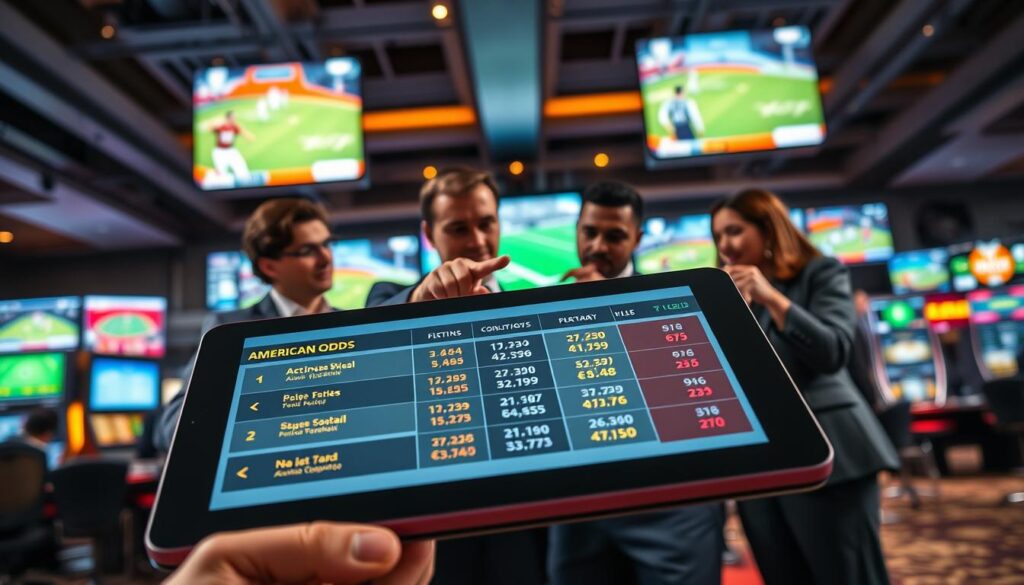
Understanding American odds and implied probability
For positive American odds, implied probability = 100 ÷ (odds + 100). For negative odds, implied probability = |odds| ÷ (|odds| + 100). Apply these to see how likely the market thinks an outcome is. For example, +200 gives 33.3% and -150 gives 60%. These conversions let you judge if a bookmaker has under- or over-priced an outcome.
Converting between American, decimal, and fractional formats
Converting odds makes cross-market math easier, especially for parlays. To convert American to decimal, positive odds: decimal = (odds ÷ 100) + 1. Negative odds: decimal = (100 ÷ |odds|) + 1. Fractional odds show profit relative to stake, such as 7/2. That fractional converts to decimal 4.5, which corresponds to American +350. Use a quick conversion chain to compute parlay payouts: convert odds to decimal, multiply the decimals, multiply by stake, subtract the stake to get profit.
Using odds comparison and line shopping to improve long-term ROI
Odds comparison tools and multiple sportsbook accounts let you shop lines. Line shopping means finding the best price across books before placing a bet. Small edges compound over many wagers and boost ROI. FanDuel and DraftKings often differ on limits and markets, while ESPN Bet focuses on integrated content and commentary; comparing these helps you capture the best available value.
Below is a quick reference to guide conversions and decision-making when you convert odds for bet sizing or parlay math.
| Display Type | Example | Decimal | American | Implied Probability |
|---|---|---|---|---|
| Fractional | 7/2 | 4.50 | +350 | 22.2% |
| Fractional | 7/1 | 8.00 | +700 | 12.5% |
| American (underdog) | +200 | 3.00 | +200 | 33.3% |
| American (favorite) | -150 | 1.67 | -150 | 60.0% |
| Parlay example (three -110 legs) | -110, -110, -110 | 1.91³ = 6.97 | ≈ +597 | Combined implied varies by leg |
For a deeper primer on fractional, decimal, and American moneyline formats, consult this short guide from Investopedia to help you convert odds and check implied probability before committing capital: betting odds basics.
Betting Casino: Overlap of Sportsbooks and Casino Offerings
Operators like FanDuel and DraftKings have blurred lines between sports and table gaming. A shared account lets customers move funds from a sportsbook wallet to slots or live dealer tables without separate logins. This setup simplifies bankroll management and speeds up play across products.
Funding options include bank transfers, debit cards, and digital wallets such as PayPal and Apple Pay. Deposit bonuses often tempt players, yet most offers include wagering requirements that restrict when and how you can withdraw winnings. Read terms to know playthrough limits and eligible markets.
Cross-promotions drive retention with free bets, odds boosts, and loyalty points that work across casino and sportsbook catalogs. Platforms run same-game parlay promos and enhanced props to keep bettors engaged during major events. These offers often tie into loyalty tiers or time-limited campaigns.
In-play betting and live dealer streams create a common user experience for bettors and casino players. Cash-out tools let users lock in partial wins on unsettled sports bets, while live dealer games deliver real-time interaction that mirrors the intensity of live markets. Both features promote continuous engagement on a single platform.
Parlay boosts, parlay insurance, and combo promotions mix sportsbook excitement with casino-style bonus mechanics. Reliability during high-traffic events affects how well these cross-promotions convert new users into regular customers. Expect margins baked into cash-out and live pricing that favor the house.
Smart bankroll strategies matter when one balance covers multiple products. Separate mental ledgers help: assign a portion for sports wedges and another for casino play. This reduces impulse switches between in-play betting and table sessions, helping players keep to limits and track outcomes.
Types of Sports Bets and Casino Strategies That Translate
Sports bettors and casino players share common ground when it comes to risk, odds, and staking. A clear grasp of moneyline, point spread, and over/under bets helps bettors map familiar casino tactics onto sports markets. The examples below show how simple staking plans and market selection cross over between the two worlds.
Moneyline bets are straightforward picks on a winner. A moneyline like Cowboys -180 means a favorite must win outright. These suits bettors who prefer direct outcomes, similar to single-hand wagers at a blackjack table.
Point spread creates a handicap to level mismatched teams. A +7.5 spread gives the underdog a 7.5-point cushion. Pushes and backdoor covers matter here. The spread rewards margin control rather than just the final winner.
Over/under or totals focus on combined scoring. An over 1.5 in soccer requires two or more goals. Totals can act like parity markets in casinos, where the bet’s outcome depends on combined results rather than sides.
Casino even-money bets include red/black in roulette, banker/player in baccarat, and pass/don’t pass in craps. These even-money bets share risk profiles with certain sports markets, such as moneylines on evenly matched teams or props that trade near even odds.
Positive progression systems are common in casinos and sometimes used on the sportsbook. The 1-3-2-6 sequence increases stakes after wins and returns to base after a loss. Paroli doubles stakes after a win and resets when a loss occurs.
Example of 1-3-2-6 with a $10 unit: bet $10, win and bet $30, win and bet $20, win and bet $60. A clean four-win run yields profit while limiting exposure on losers. Paroli works best on even-money bets where short win streaks are plausible.
Advantages of these systems include simple rules, disciplined staking, and clearer loss limits. Use cases include blackjack base bets, craps pass/don’t pass, roulette red/black, baccarat banker/player, and certain sports props near evens like first goalscorer or specific lower-risk totals.
Limits appear fast. Progressive betting systems cannot erase the house edge or sportsbook margin. Long losing runs break sequences. Bookmakers may restrict aggressive winners. Proper bankroll sizing keeps you in play.
Percent-based staking is a safer path. Many pros recommend 1–3% of bankroll per base unit to survive variance. That approach pairs with tactical market selection and measured use of 1-3-2-6 or Paroli to reduce risk of ruin.
| Bet Type | Typical Market | Similar Casino Bet | Best System | Key Risk |
|---|---|---|---|---|
| Moneyline | Pick winner (baseball, hockey) | Single-hand blackjack wager | Paroli on even matchups | Sharp favorites reduce value |
| Point Spread | Handicap to balance teams | Bets on margin like high/low | 1-3-2-6 on near-even spreads | Backdoor scores and pushes |
| Over/Under | Totals on combined scoring | Even-money parity markets | Paroli for short streaks | Game pace and late variance |
| Even-money bets | Props around 50/50 | Red/black, banker/player | 1-3-2-6 for structure | House edge and betting limits |
Advanced Betting Concepts: Mathematical Edge and Bet Sizing
Understanding how to convert a perceived advantage into sustainable returns requires a clear grasp of finding value and true probability. Sharp bettors build models to estimate true probability, then compare those estimates to implied odds posted by bookmakers. Line movement often signals where sharp money flows, so tracking shifts helps confirm value before committing capital.
Kelly Criterion offers a formal way to size bets when you can quantify an edge. The Kelly formula f = (bp – q) / b uses b for decimal odds, p for your assessed win probability, and q for 1 – p. Full Kelly maximizes long-term growth but raises variance. Many professionals use fractional Kelly—commonly 25–50% of full Kelly—to cut volatility while preserving growth potential.
Simple percentage rules complement Kelly approaches. Conservative bankroll management often prescribes staking 1–3% of your bankroll per wager. This avoids oversized bets after wins and prevents catastrophic drawdowns after losses. Unit sizing should scale with bankroll changes so risk remains proportional over time.
Diversification across sports, bet types, and casino offerings smooths variance and reduces single-event exposure. Spreading stakes across uncorrelated markets preserves liquidity and lowers the immediate risk of ruin. Even skilled bettors face limits from variance and sportsbook account restrictions, so managing exposure is essential.
Monitoring account limits and adapting to market conditions helps protect capital. Sharp action can trigger bet caps, forcing strategy shifts. Ongoing reassessment of models and bankroll after run stretches keeps sizing aligned with current edge and reduces long-term risk of ruin.
A concise table below summarizes practical bet-sizing choices and their trade-offs for typical bettors.
| Approach | Stake Size | Volatility | When to Use |
|---|---|---|---|
| Full Kelly | Calculated % from Kelly | High | When model confidence is strong and bankroll can tolerate swings |
| Fractional Kelly (25–50%) | 25–50% of Kelly stake | Moderate | Preferred by pros seeking growth with controlled swings |
| Flat % Rule | 1–3% of bankroll | Low | Conservative bettors and those early in bankroll building |
| Unit-Based Scaling | Fixed units that change with bankroll | Variable | Recreational bettors who prefer simplicity and steady stakes |
Parlays, Teasers, and Casino Parallels: Risk, Reward, and Payout Calculations
Parlay wagers bundle two or more individual bets into one ticket, creating larger returns when every leg wins. A clear parlay calculation begins by converting American odds to decimal, multiplying the decimals, multiplying by the stake, then subtracting the original stake to show profit. For a practical walk-through, see the primer on parlays at parlay basics.
How the math works
Start with each leg in decimal form. Multiply those decimals together to get the combined multiplier. Multiply that number by your wager to get the gross return. Subtract your stake to show the net parlay payout. For example, three -110 legs (about 1.91 each) give 1.91 × 1.91 × 1.91 ≈ 6.97; a $10 stake returns $69.70, a profit near $59.70.
Teasers compared to parlays
Teaser bets let bettors move spreads or totals by a fixed number of points—commonly 6 or 7—reducing variance for each leg. That safety reduces the overall payout versus the original lines used in a parlay. Teasers lower upside while improving the chance a multi-leg wager survives.
Promotions, boosts, and insurance
Major sportsbooks like BetMGM, FanDuel, and DraftKings use parlay boosts to increase advertised parlay payout on selected combinations. Parlay insurance can refund a portion of the stake if one leg loses, softening the blow on long tickets. These offers change the short-term appeal but they do not remove the house edge embedded in the combined odds.
Practical considerations for bettors
Parlays produce larger winners from small stakes, but long-term expected value is usually negative unless each selection has positive EV. Multi-week parlays can lock up funds when an outcome depends on distant events. Cancellations typically drop a leg and adjust the ticket per sportsbook rules, which can alter the final payout. Cash-out options let bettors lock in value or cut losses; sportsbooks price cash-outs using live probabilities and margins.
Quick comparative table
| Feature | Parlay | Teaser |
|---|---|---|
| Line used | Original market lines | Adjusted spreads/totals |
| Risk | High — all legs must win | Lower per leg due to points |
| Typical payout | Higher parlay payout; multiplies odds | Lower overall payout than parlay |
| Promotions | Parlay boosts, parlay insurance, cash-out | Occasional boosts, fewer insurance offers |
| Best use case | Small stake, high upside, correlated events | Moderate stake, reduce variance, protect favorites |
Keeping parlay calculation steps simple helps bettors compare real returns to single bets or split stakes. Use promotions with care, and weigh the trade-off between excitement and mathematical value before building multi-leg tickets.
Safe Play, Platform Choice, and Responsible Gambling Tools
Problem gambling affects about 2–3% of adults, and early warning signs include chasing losses, borrowing money for bets, and changes in mood or sleep. Licensed sportsbooks such as FanDuel, BetMGM, DraftKings, and ESPN Bet offer built-in responsible gambling features to help players stay in control. When you open an account, set deposit and wager limits immediately to reduce impulse decisions while your judgment is clear.
Most regulated operators provide self-exclusion options that range from short cooling-off periods to permanent bans. Use these tools if you notice risky behavior, and consider daily or weekly betting limits to manage spending. Prioritize platform choice by checking odds competitiveness, withdrawal speed, secure payment methods, and system reliability during peak events like NFL Sundays and March Madness.
If betting becomes problematic, contact the National Council on Problem Gambling at 1-800-522-4700 for confidential problem gambling support and resources. Good platforms make limits, timeout features, and account controls easy to find. Clear limits and reliable safeguards not only protect your bankroll but also improve your long-term enjoyment of sports and casino play.