
This guide shows U.S. bettors how betting odds work and how to read betting odds across formats. You will learn what odds mean, why bookmakers price markets the way they do, and how to convert between moneyline, decimal odds, and fractional odds.
Bookmakers use odds to express probability: lower odds signal a higher chance of an outcome and smaller payouts, while longer odds mean bigger payouts but lower probability. Odds also include the bookmaker’s margin, often called vigorish or juice, which lets sportsbooks like FanDuel and DraftKings earn profit even when action is balanced.
Practical outcomes matter. By the end of this article you should be able to interpret implied probability, spot value bets, shop lines between operators, and use simple calculators and bankroll rules to make smarter wagers. This sportsbook odds guide focuses on clear examples and easy steps so you can read betting odds and act with confidence.
Betting Odds Explained
Odds translate a forecast into money. They show the market view of an event and let you compare the probability to payout if that outcome occurs. Professional bettors at FanDuel and DraftKings look at odds to judge value before placing a stake.
What odds represent: probability and bookmaker margin
At their core, odds express probability. A favorite carries low odds because models and market action assign it a higher chance to win. An underdog carries higher odds since its likelihood is lower.
Bookmakers fold their bookmaker margin into the posted prices. That means the sum of implied probabilities typically exceeds 100%. The excess is the sportsbook’s buffer against variance.
How odds convert subjective probability into payouts
Traders and models assign a subjective probability to each outcome. Bookmakers convert those percentages into a price that tells bettors the return on a winning ticket. A 50/50 coin flip would pay even money in theory, but sportsbooks adjust that price to cover costs.
When you see an odd, you can reverse it to estimate the probability to payout. Use 1 divided by the decimal odd to get the implied chance. That result shows how the market prices the risk versus return.
Why bookmakers include vigorish (vig/juice) in every market
Vigorish explained: the vig is the fee sportsbooks collect to ensure profit over time. Typical retail markets use a vig around 5–6% per side, which shows up as prices like -110 instead of +100.
This margin changes behaviors. It reduces long-term returns for bettors and makes the summed implied probabilities exceed true probabilities. Understanding the vig helps you shop lines and find healthier edges across books.
How Betting Odds Work: Probability and Price Formation
Bookmakers turn raw data into prices that bettors can use. They blend statistical models, feeds from professional data suppliers, and expert judgment to estimate the chance of each outcome. Those estimates become the starting point for price formation before the market starts to trade.

How bookmakers estimate probability with models and data
Sharp operators at DraftKings and William Hill build models that pull from team stats, player metrics, and past results. When in-house resources fall short, they tap trusted data suppliers such as Opta or Sportradar for play-by-play feeds and advanced metrics.
Models weight recent form, situational factors, and matchup history. The output is an objective probability that guides initial lines.
How public money and news trigger odds movement
Odds movement mirrors new information. Injury reports, weather updates, and late lineup changes force markets to react quickly. Heavy public betting on one side will shorten its price as bookmakers try to limit exposure.
Markets behave like financial exchanges: as bettors push money toward one outcome, the book updates to reflect liability and balance risk.
How margins and market balancing produce final prices
After estimating probabilities, bookmakers add a margin to guarantee profit. That built-in vig shifts fair odds down; a true 50/50 event with a decimal 2.00 fair price can appear as 1.90 once a 5% margin is applied.
Market balancing is the act of adjusting prices so liability is spread across outcomes. If one side attracts too much action, the operator tightens odds to encourage bets on the other side and lock in revenue regardless of the result.
Fractional Odds Explained for US Readers
Fractional odds can look odd to American bettors who are used to decimals or moneyline figures. This short guide shows how to read fractional odds, how to convert fractional odds into payouts, and where you will most often see UK odds in action.
How to read fractional odds
Fractional (British/UK) odds appear as two numbers separated by a slash, for example 5/2 or 10/1. The number on the left is the profit you win and the number on the right is the stake you must risk. A 10/1 quote means you win $10 for every $1 you stake.
Odds-on selections invert the ratio to show a favorite. For example 1/2 means you must stake $2 to win $1. This format makes it easy to spot whether a selection is favored or an outsider.
Convert fractional odds: payout and profit examples
- Profit = stake × (numerator/denominator).
- Total payout = profit + original stake.
Practical example: a $10 bet at 10/1 yields a profit of $100 and a total payout of $110. Another example: a $100 stake at 13/5 converts to 13 ÷ 5 = 2.6, so profit is $260 and total payout is $360.
When you’ll see fractional odds
Fractional odds remain common in horse racing and on many British-focused markets. Bookmakers like William Hill and Betfred, along with racecourses and British exchanges, often display UK odds in this format.
Knowing how to read fractional odds and how to convert fractional odds lets U.S. bettors compare prices quickly between UK-style markets and American displays. Use the simple formulas above to translate any fraction into clear profit and payout numbers before you place a bet.
Decimal Odds Explained and How to Calculate Returns
Decimal odds are the simplest way to read a price on many global sportsbooks. They show the total return for each unit staked, with your original stake included. This makes it quick to calculate payouts without extra mental steps.
Decimal format basics:
Decimal odds display the full amount you get back per unit wagered. For example, a decimal of 11.0 equals a 10/1 fractional outcome plus your stake. This format is common across Europe, Canada, and Australia and appears on many betting apps.
Step-by-step calculation examples:
- Profit formula: stake × (decimal − 1).
- Total payout formula: stake × decimal.
Practical example: a $100 bet at 3.40 returns $340 total and yields $240 profit. A £5 stake at 7.0 returns £35 in total.
How to calculate returns decimal with quick steps:
- Decide your stake (for example, $50).
- Multiply stake by the decimal to get the total payout ($50 × 2.20 = $110).
- Subtract the stake to find profit, or use the profit formula ($50 × (2.20 − 1) = $60).
Implied probability decimal:
Convert decimal odds into implied probability by taking 1 divided by the decimal. For example, 3.50 gives 1 / 3.50 = 0.2857, or 28.57% implied probability. Use this to compare a bookmaker’s market to your own estimated chance of an outcome.
American Odds Explained for US Bettors
American odds are the default display on most U.S. sportsbooks. They tell bettors who is favored and who is the underdog, and they show how payouts scale for different stakes. Learning to read moneyline prices removes guesswork when you place a wager.
On the moneyline a plus sign marks the underdog. A + number shows how much profit you get on a $100 stake. A minus sign marks the favorite. A − number shows how much you must stake to win $100. Even-money markets can be shown as EV or EVEN, and tight matchups may show minus odds on both sides.
Calculating profit from + and – odds
- Positive example: a $100 bet at +240 returns $340. That is $240 profit plus your $100 stake.
- Negative example: -140 means you must bet $140 to win $100. A $200 stake at -150 wins $133.33 and pays $333.33 total.
- Winnings scale linearly. A $1,000 wager at +240 yields $2,400 profit on top of the stake.
Converting American odds to implied probability moneyline
- For positive odds use: implied probability = 100 / (odds + 100). Example: +180 → 100 / 280 = 35.71%.
- For negative odds use absolute values and this form: implied probability = odds / (odds + 100). Example: -218 → 218 / 318 = 68.55%.
- These formulas let you compare the sportsbook’s implied probability moneyline to your own estimated probability and spot value.
Practice reading American odds and converting to implied probability moneyline before you wager. That habit helps you compare offers across DraftKings, FanDuel, BetMGM, and other platforms, and it makes line shopping simple and exact.
Converting Between Odds Formats and Quick Reference
Understanding how to convert odds formats makes betting easier across apps and books. Below is a clear, practical guide that serves as an odds reference for bettors who move between American, decimal, and fractional displays.
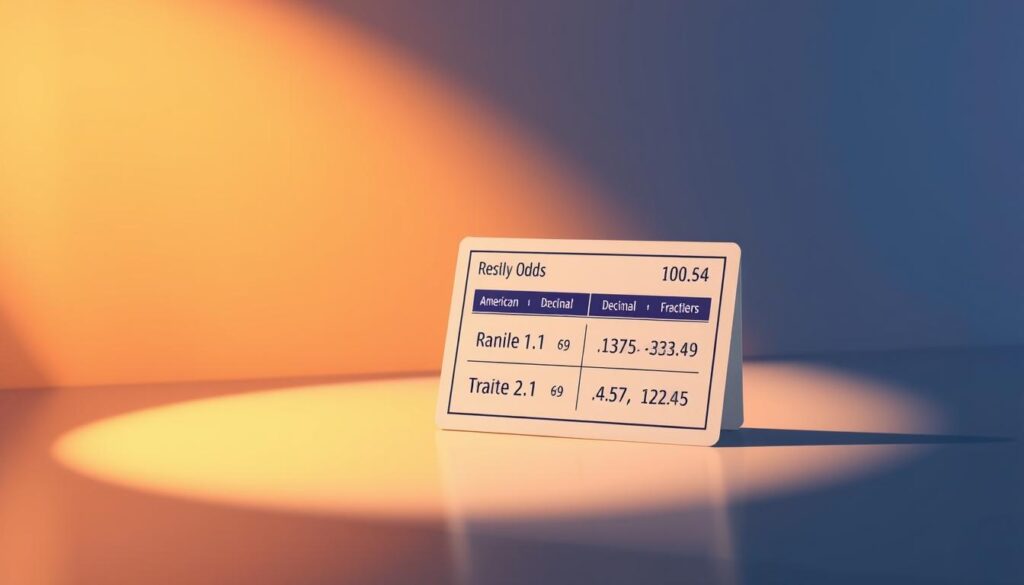
How to convert fractional, decimal, and American odds (practical formulas)
- Fractional to decimal: decimal = (numerator / denominator) + 1. Example: 2/1 → 3.00.
- Decimal to implied probability: implied probability = 1 / decimal.
- American to decimal: for positive American odds, decimal = (American / 100) + 1. For negative American odds, decimal = (100 / |American|) + 1.
Examples converting a single market across all three formats (+200, 3.00, 2/1)
- American +200 converts to decimal 3.00 using (200 / 100) + 1. That decimal equals fractional 2/1 because (2/1) + 1 = 3.00.
- A $100 bet at +200 returns $300 total: $200 profit plus the $100 stake. Decimal math shows stake × 3.00 = total returned.
- Fractional view: 2/1 means profit is 2 × stake. A $50 stake returns $150 total; profit $100.
When to use each display format depending on personal preference or region
- U.S. bettors commonly see American odds on FanDuel, DraftKings, and Las Vegas boards. This format reads quickly for moneyline decisions.
- Decimal odds appear often in Europe, Canada, and Australia. They simplify quick calculations since the stake is included in the return.
- Fractional odds remain standard in UK horse racing and some British markets. Many punters prefer the profit-to-stake clarity of fractions.
For fast odds conversion on the fly, remember the core relationships and use this odds reference to convert odds formats accurately. Mastery of these simple formulas removes confusion when toggling displays during line shopping or live betting.
Implied Probability and How to Spot Value Bets
Implied probability converts odds into a percentage that reflects the market’s view of an outcome. Sportsbooks build odds from models, data, and money flow, so implied numbers diverge from a bettor’s estimate of true probability. Learning to read that gap helps with value betting and lets you spot value bets before the market corrects.
Definition and the gap between market and reality
Implied probability shows how likely a bookmaker thinks an event is, after the vig is included. Bookmakers such as FanDuel and DraftKings set lines to balance action and protect profit, not to match true probability. The result is a systematic difference you can measure.
How to turn odds into your own comparison
Convert decimal odds to implied probability with 1 divided by the decimal. For American odds use the standard formulas for plus and minus values. Next, make a reasoned estimate of true probability based on stats, injuries, and context. If your estimate exceeds the implied probability by more than the break-even margin, you may have an edge.
Simple examples that illustrate value and negative edge
Take a fair coin: true probability is 50%. If a market offers -115 on heads (implied probability about 53.49%), that price is negative expected value because the implied exceeds true. If tails shows +130 (implied about 43.48%), that line represents value when your true estimate is 50%.
In football or baseball, value betting requires the same comparison. Your model might rate a team at 55% while the market implies 48%. That gap signals spot value bets. Vig, line variance across sportsbooks, and delayed public moves can all create opportunities.
- Step 1: Convert the market odds to implied probability.
- Step 2: Calculate your estimate of true probability.
- Step 3: Account for vig-adjusted break-even and stake accordingly.
Consistent success depends on disciplined record keeping and patience. Use small, repeatable plays when you identify value betting edges and avoid overreacting to short-term variance.
Vigorish, Juice, and How to Shop Lines
Vigorish is the fee bookmakers build into odds to ensure a profit. That fee makes implied probabilities add up to more than 100 percent. On standard spread and total lines, the typical -110 setup translates roughly to a 10 percent vigorish. Live markets can charge higher juice, sometimes 15 percent or more, because odds move quickly and books widen margins to protect themselves.

Understanding the vig helps you see why two sportsbooks offer different payouts for the same bet. Line shopping narrows those gaps. Creating accounts at multiple operators lets you compare prices before placing a wager.
How to compare books
- Open lines at FanDuel and DraftKings for the same market to spot price gaps.
- Check total and spread juice; a -108 line costs less than -119 on the same side.
- Watch moneylines for subtle edges. The lower-juice option boosts expected return over time.
For example, if FanDuel posts UNDER -108 while DraftKings shows UNDER -119, the FanDuel price carries less juice. Choosing the lower-juice book improves your long-term edge when you correctly predict the outcome.
Why small differences matter
- Even a few percentage points of extra vigorish reduces your ROI across many bets.
- Consistently taking better prices compounds into a meaningful advantage over months and years.
- Always settling for higher juice erodes bankroll growth, regardless of short-term wins.
Smart bettors monitor top operators such as FanDuel, DraftKings, BetMGM, Caesars, and Bet365. Line shopping FanDuel DraftKings and similar comparisons reveal where to place each bet. Use that data to select the best line and the lowest vigorish for the side you prefer.
Reading Odds for Different Bet Types: Moneyline, Spread, and Totals
Understanding how wagers pay and how lines are set helps bettors make smarter choices. This short guide breaks down moneyline odds, point spread pricing, and totals betting into practical rules you can use at the sportsbook or on an app.
How moneyline odds show winner probability and payouts
American moneyline odds use a plus or minus to show favorite and underdog. A negative number, like -255, means you must stake that amount to win $100. A positive number, such as +210, shows how much you win on a $100 stake.
Those signs reveal implied probability and payout quickly. Use the Investopedia primer for a clear walkthrough of American formats and conversions: American moneyline odds explained.
How point spreads are priced and the role of the vig
Point spreads handicap a favorite to level betting action. The number itself estimates the expected margin of victory. Books set point spread pricing to attract balanced money on both sides.
Most spread markets charge similar juice around -110 per side. That vig ensures the sportsbook earns a margin even when the spread balances. Watch for shifts in the spread to see where public money or sharp action is moving lines.
How totals (over/under) odds work and implied totals
Totals betting asks whether a combined score will be over or under a posted number. Sportsbooks set the line to reflect expected scoring and then price each side, often near -110.
Over/under odds translate to implied probabilities for each outcome. When different books show varying juice on the over or under, that gap can reveal value or lower-cost options for bettors.
- Tip: Compare moneyline odds, point spread pricing, and over/under odds across sportsbooks to find the best payout or lowest vig.
- Tip: Use implied probability from each market to test whether a bet offers value based on your own forecast.
Common Betting Lingo and Practical Examples for New Bettors
New bettors meet a handful of terms that show up on every sportsbook ticket display. Learning common betting lingo makes lines easier to read and reduces mistakes when you place a wager. The short examples below use real math so you can check numbers on apps like FanDuel and DraftKings.
Favorite and underdog are simple to spot in American odds. A minus sign marks the favorite; a plus sign marks the underdog. A heavy favorite is often called the chalk. A pick’em game has no spread and the market treats both sides as equal.
Push meaning: a push happens when the final result lands exactly on the betting line. If you wager $50 and the line pushes, your stake is returned. Payout vs profit matters here: the payout equals your returned stake plus any profit, while profit excludes the original stake.
Real-world examples help cement the math. In the NFL, a $100 bet on +240 returns $340 total payout. That means profit equals $240. If you bet $100 on -140, the payout is roughly $171.43. Your profit there is $71.43. Use the same logic in the NBA when comparing favorites and underdogs.
Soccer shows how fractional and decimal formats interlink. A 10/1 fractional selection converts to 11.0 in decimal odds. A £10 stake at 10/1 returns £110 payout, with £100 profit. Converting among formats clears up confusion when markets switch displays.
Most betting apps break a ticket into three fields: Ticket Cost, To Win, and To Collect. For example, Ticket Cost $30, To Win $25, To Collect $55. The app computes these values instantly so you do not have to do manual math, yet understanding payout vs profit helps when you evaluate cash-out offers and implied probability.
Use this quick list to remember what you will see on a sportsbook ticket display:
- Ticket Cost: your stake
- To Win: profit if the bet wins
- To Collect: payout including your stake
- Push: stake returned when the result matches the line
Knowing these items reduces surprises at settlement and helps you compare offers across Caesars, BetMGM, and other platforms. Small math checks keep you in control and improve decision making when shopping lines or taking cash-outs.
Smart Practices: Calculators, Bankroll, and Choosing Odds Displays
Use betting calculators to remove simple math errors. Odds converters, implied probability calculators, parlay and hedge calculators save time and help compare American, decimal, and fractional formats. Many sportsbooks and third-party tools make quick conversions so you can focus on value, not arithmetic.
Bankroll management is the backbone of long-term success. Pick a staking plan—flat units or a fixed percentage of your bankroll—and stick to it. Line shopping across operators such as FanDuel, DraftKings, BetMGM, Caesars, and Bet365 reduces vig and small price gaps that compound over many bets, preserving your bank and lowering the edge you need to be profitable.
Choose an odds display choice that matches your comfort level. U.S. bettors often prefer American odds; international bettors may favor decimal or fractional. The display does not change payout, but the right format reduces mistakes and speeds decisions when live markets move.
Start small, practice with tools, and compare implied probability from calculators to your own model before increasing stakes. Practice responsible betting: wager within your means, set deposit limits, and use account safety features or self-exclusion if needed.