
Expected Goals (xG) in Betting is the modern yardstick for judging scoring chances. It assigns a probability to each shot based on factors like shot location, angle, assist type, and body part. That makes soccer betting xG far more informative than raw goal counts.
For bettors, an xG betting guide is useful for spotting teams that are due to regress or continue trends. Clubs that consistently outshoot opponents but post low goals often show up as undervalued in markets. Likewise, xGA highlights defensive weaknesses that traditional stats miss.
Professional tipsters and services use expected goals prediction inside Poisson models, simulations, and regression systems. Combining xG with expected assists (xA), expected assisted goals (xAG), and situational inputs like home/away splits and injuries tightens forecasts and creates a robust xG strategy for pre-match and in-play decisions.
What expected goals (xG) measure and why xG matters for bettors
Expected goals turn every shot into a probability. At its core, what xG measures is the chance a given attempt will end up as a goal. This single idea helps bettors see past the final score and evaluate the underlying quality of chances created and conceded.
Below are the main xG model components that most providers use:
- Shot location and angle to goal
- Type of assist or buildup, such as through ball, cross, or set piece
- Body part and shot type, for example header, volley, or footed attempt
- Game context and defensive pressure, plus goalkeeper position when available
Definition and components of an xG model
An xG model assigns a probability to each shot. Advanced versions add post-shot metrics like xGOT to account for placement and goalkeeper impact. Models often include shot context and passing chain detail to give a fuller picture.
Use of xA and xAG complements xG by estimating the chance a pass becomes an assist. Those metrics credit creators for pass quality independent of finishing. For a practical primer on model design and common inputs, see this short guide from Hudl: expected goals explained.
Why xG is superior to raw goal or shot counts
Raw goals are binary and noisy. Shot counts treat all attempts equally. Shot quality metrics convert every attempt into a meaningful value. This reduces variance and highlights true attacking and defensive performance.
In betting, xG vs goals shows where teams might regress. A side with high xG but few goals could improve over time. A team with many goals on low xG may be due to luck and thus vulnerable.
Predictive models that use xG tend to outperform ones based only on totals or simple shot ratios. Bettors who combine xG with form, home advantage, and player availability build a more robust view of value.
Expected Goals (xG) in Betting
Expected goals offer a clear lens on chance quality. Traders and analysts use xG to separate true chance creation from finishing variance. That makes xG in betting markets a core input when assessing long-term value.
Bookmakers xG feeds into line-setting models. Sportsbooks like BetMGM and DraftKings blend xG data with Poisson and regression engines to set initial odds. When a team posts high xG but low scoring, lines may lag behind expected regression and create openings for sharp players.
How bookmakers and sharp bettors use xG
Odds compilers adjust for form, injuries, and lineups while relying on expected-goals metrics for baseline probabilities. Bookmakers xG is often smoothed over several matches to reduce noise from small samples.
Sharp bettors xG-driven models flag mismatches between market prices and xG-implied probabilities. Professionals use those gaps to size stakes and to exploit overreactions after lucky wins or unlucky losses.
Examples of market inefficiencies revealed by xG
Public sentiment can inflate lines for popular teams on short hot streaks. Market inefficiencies xG exposes occur when a club wins by clinical finishing but still records poor chance-generation metrics. That creates fade opportunities for informed bettors.
In hockey and soccer, anticipated-goals measures show recurring patterns. Teams that consistently produce high xG yet sit low in the table often attract value before results normalize. Sharp bettors xG methods target those divergences.
Seasonal trends, managerial changes, and injuries can create temporary mispricings. Spotting when bookmakers xG-based adjustments lag real-world developments gives a practical way to exploit market inefficiencies xG uncovers.
How to read xG data for match prediction markets
Start by treating team xG figures as the core inputs. Use each side’s xGF and xGA to estimate expected goals in a matchup. Adjust raw numbers for home advantage, recent form windows, and confirmed lineups before running any model.
Next, convert those expected goals into outcome probabilities. Poisson distributions or Monte Carlo simulations turn projected goal totals into likely scorelines and implied odds. This process yields an xG win probability for each side and a draw chance that you can compare to bookmaker prices.
Practical modeling blends xG with context. Add head-to-head splits, home/away tendencies, and late team news. That refines probabilities and helps avoid misreads when a squad rotates or a key player is unavailable.
Translating xG into win/draw/lose probabilities
Run a Poisson model using adjusted xGF and xGA values to produce a matrix of score probabilities. Sum rows and columns to get win, draw, and loss chances. Monte Carlo simulation gives a similar output while capturing variance from injuries and form shifts.
- Input: adjusted team xGF and xGA over an appropriate form window.
- Process: Poisson or simulation to produce a full distribution of scorelines.
- Output: implied market probabilities and an xG win probability metric to compare against bookmaker odds.
Compare projected match expected goals to the bookmaker’s totals. When your model’s probabilities diverge from market prices, you have a lead to assess for value bets.
Using xG for totals and both-teams-to-score markets
For totals, sum both teams’ projected goals from your model to get an expected match goal line. Use the full scoreline distribution to calculate the probability of over or under a given bookmaker total.
BTTS markets respond to attacking and defensive profiles. Cross-check home xGF against away xGA, and away xGF against home xGA. Overlap of strong xGF and weak xGA on both sides raises the BTTS xG probability.
- Check variance: teams that generate high xG but allow few shots may still concede due to goalkeeper variance.
- Layer live and historical trends: managerial changes or streaks can shift BTTS xG likelihood quickly.
- Use matchup nuances: set-piece strength, pressing style, and late substitutions affect totals and BTTS outcomes.
When you read xG data, treat it as a structured starting point. Combine it with situational info and sound modeling to produce probabilities you can test against market prices.
Using player-level xG and xA for prop betting and player markets
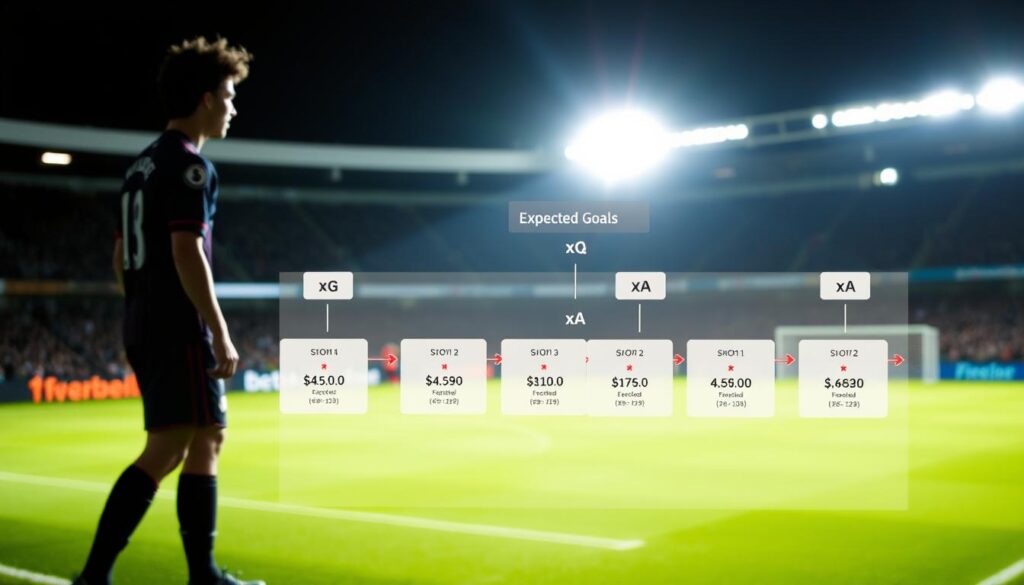
Player metrics give bettors a clearer edge when sizing player prop bets. Start with player xG rates to tell which forwards get high-quality chances. Pair that with minutes and role to judge whether a player will see the volume needed for an anytime-scorer market.
xG per 90 highlights who creates threat over a full match. Use xG per 90 alongside xG per shot to separate high-volume shooters from high-quality chance takers. That split helps identify finishers who outperform raw totals and those who rely on luck.
Post-shot xG and related measures remove finishing noise by crediting the shot quality after placement and goalkeeper impact. This is useful when assessing first-goalscorer lines or anytime scorer props, since it isolates chance quality from pure finishing variance.
Expected assist data changes how you view creators. xA prop betting focuses on the likelihood a pass becomes an assist rather than on final pass counts. Combine xA rates with teammate finishing records to anticipate assist opportunities more accurately.
xAG gives credit to passers for the chance quality that leads to shots on target. Use xAG when evaluating playmakers in markets that pay for assists or combined goal contributions. It balances credit between the shooter and the creator when standard assists miss nuance.
When building specific prop predictions, treat these items as a checklist:
- Player xG and xG per 90 to measure scoring opportunity volume.
- xG per shot and post-shot xG to judge shot quality versus finishing luck.
- xA and xAG to value creators and their chance-building impact.
- Minutes projection, lineup news, and opponent defensive style for context.
Live updates matter for in-play player props. Late substitutions, tactical shifts, or a red card change a player’s expected minutes and role. Monitor live tracking and adjust models when post-shot xG and xAG diverge from pregame expectations.
Advanced models used by analysts rely on shot-level inputs and tracking feeds. Implementing those signals for player props improves predictions for both goal and assist markets, especially when assessing market value against bookmaker lines.
Integrating xG with other advanced metrics to improve prediction accuracy
Start by treating xG as one piece of a puzzle. You can integrate xG metrics with team and player data to create a fuller view of match quality. Pairing xG with possession and shots on target helps separate teams that control the ball from those that create real chances.
Possession and xG
Final-third possession or progressive pass completion gives context to raw possession numbers. Use those measures to see if a team’s time on the ball translates into high-value chances. Tracking possession and xG together reduces false signals from teams that hold the ball but fail to threaten the box.
Shots on target xG
Shots on target correlate strongly with goals. Monitor whether a team’s xG is backed by shots on target xG to estimate finishing likelihood. When xG rises but shots on target remain low, expect regression in the short term.
Situational betting variables
Bring in situational betting variables like home/away splits, injuries, suspensions, and manager changes. Weight recent trends more heavily while guarding against overreaction to one or two matches. Combining situational betting variables with xG and possession uncovers edges that pure metrics miss.
Form, head-to-head, and model blending
Recent form and head-to-head history add layers that raw xG cannot capture alone. Blend team xG, player xG per 90, shot profiles, and head-to-head tendencies. Use a simple weighted scheme so that current form influences model outputs without dominating them.
- Compare final-third possession with xG to test chance quality.
- Check shots on target xG to confirm scoring intent and finishing pressure.
- Apply situational betting variables for lineup and context adjustments.
Practically, build a checklist that includes possession and xG, shots on target xG, recent xG trends, and situational betting variables. Keep models transparent and test on past matches. That process improves predictive accuracy while keeping the approach robust in varied match contexts.
How to build a simple xG-based model for bettors
Start with a clear plan that lists the data you need, the modeling approach you’ll use, and the output you want to compare to bookmaker odds. A compact model helps bettors test ideas quickly and iterate. Keep early versions transparent so you can spot errors and bias.

Data inputs and sources to collect
Collect team xG for and xG against, shots and shots on target, possession metrics, and home/away splits. Add recent form windows and minutes-weighted matches to reflect current performance. Track player availability and lineup news to adjust expected output for key absences.
Use both free providers and paid APIs for team and player xG, live xG feeds, and post-shot metrics. Combine open data with Opta, StatsBomb, or Wyscout feeds if you have access. For live betting, rely on real-time analytics to refresh probabilities quickly.
Modeling approaches and practical tips
Start by converting average xG into match score probabilities. A Poisson xG model offers a simple route to estimate scorelines from expected goals. Run Monte Carlo xG simulations when you want to capture variance and correlated scoring sequences.
Weight recent matches more heavily and include venue adjustments to reflect home advantage. Use regression to calibrate raw xG model inputs against observed goals. Cross-check outputs against market odds and watch line movements for calibration cues.
- Automate data ingestion with Python scripts to reduce manual errors.
- Shop lines across bookmakers to lock in the best prices when your model finds value.
- Monitor late team news and odds shifts; adjust probabilities if a key player is ruled out.
Test models on out-of-sample data and track metrics like Brier score and log loss. Iterate the model structure if persistent bias appears. Keep the system simple enough to explain to others; clarity improves trust in model predictions.
Common pitfalls and limitations of xG in betting
Expected goals are powerful, but they carry limits bettors must respect. Use xG as one tool among many. Clear awareness of xG limitations will prevent overconfidence and poor staking choices.
Model differences can produce strikingly different numbers for the same match. Providers like Opta, StatsBomb, and Wyscout use distinct features, shot definitions, and post-shot adjustments. Those xG provider differences matter when you compare teams or players across sources.
Stick to a single data feed when tracking trends or building models. Mixing sources creates mismatches that look like edge but are just measurement noise.
Model differences and inconsistent definitions
Some providers weight shot placement, body part, and pressure more heavily. Others add goalkeeper positioning after the shot. Those choices shift xG values. A 0.15 chance from one feed might read 0.10 from another.
Audit the provider’s methodology before relying on its outputs. Consistency beats chasing the smallest-seeming advantage caused by divergent definitions.
Small-sample noise and short-term streaks
Small sample xG swings are common. A team may outscore or underperform xG across three to six matches. That does not mean a new baseline has formed.
Professional models weight larger histories and update forecasts gradually. Treat short runs of over- or underperformance as signals to monitor, not as definitive proof. Avoid overreacting in live markets.
Finishing streaks, goalkeeper effects, and context
Individual form influences outcomes. A striker on a hot run or a keeper enjoying a streak can sustain results that diverge from xG for weeks. Tactical shifts and match context will amplify these effects.
Use qualitative scouting and situational data alongside xG. Tactical notes from coaches, injury reports, and weather can explain persistent gaps between xG and actual goals.
- Compare numbers only within the same provider to limit xG pitfalls.
- Weight longer samples to reduce false signals from small sample xG noise.
- Combine xG with context—player form and goalkeeper trends—for a balanced read.
Live and in-play betting strategies using xG and real-time data
Live xG betting turns raw match flow into actionable insight. Watch how xG climbs in the opening minutes and note when markets fail to respond. That lag creates opportunities for smart in-play plays.
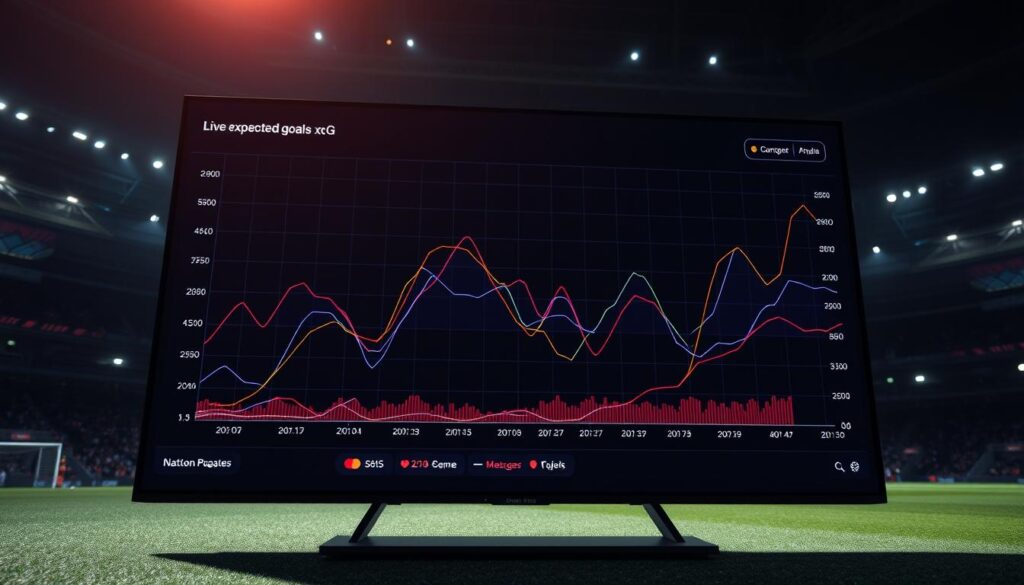
Track live xG graphs to spot sustained pressure. A steady upward slope across 10–15 minutes often signals real chance accumulation rather than a single event. Use that signal to consider totals or in-play BTTS xG markets when teams keep forcing chances.
Match context matters. Recalculate trajectories after red cards, substitutions, or injuries. Those events change expected goals paths and can flip value between a hedged pre-match stake and a fresh in-play bet.
Tracking live xG timelines and momentum shifts
Combine live xG with simple stats: possession, shots, corners, and touches in the box. This mix helps confirm whether a rising xG line reflects genuine danger.
- Watch for clusters of shots or high-quality chances inside the six-yard area.
- Note periods of sustained corner pressure; corners often precede quick xG gains.
- Compare live odds movement to xG divergence to detect market mispricing.
When to place in-play bets based on live xG signals
Enter in-play when live xG and observable dominance match up. If a team posts repeated high-value chances while the odds still favor the opponent, value exists.
Use in-play xG strategies to target late-match over/under plays and BTTS lines. Late sustained xG pressure often translates to goals, making in-play BTTS xG a useful filter for last-20-minute stakes.
Keep stakes modest and update models quickly. Real-time analytics and odds graphs help confirm whether the market is adapting or lagging. React fast; the edge often vanishes within minutes.
Case studies: spotting value with xG in recent leagues and competitions
Several clear examples from top leagues show how expected goals reveal hidden value. Teams with strong underlying numbers often correct after a run of bad luck. Other clubs that overperformed on finishing see their form fade once their finishing rate normalizes.
Manchester United and Chelsea offer contrasting seasons where xG season trends signaled change before results did. Tracking xGF and xGA over an 8–20 match window highlights persistent over- or under-performance. Home and away splits help separate short-term noise from structural issues.
Professional bettors use regression analysis and Poisson simulations to time entries when markets lag behind model signals. Betfair Exchange movement and late team news create opportunities to apply xG regression examples in live markets. Watching odds drift against a rising xG profile can flag a value bet.
Other sports show similar patterns when analysts combine expert picks with predictive metrics. Cross-checking model outputs with betting volume and public sentiment reduces false positives. Diverging signals mean reduce stake sizes or pass entirely.
Practical steps for spotting value with xG include:
- Monitor rolling xG over 8–20 matches to see convergence.
- Compare season-long xG season trends with current form and home/away splits.
- Use Poisson or Monte Carlo runs to convert xG into market probabilities.
- Time bets when market odds haven’t reflected regression signals or when exchange graphs show slow adjustment.
Apply these case studies to future match selection by prioritizing matches where models and markets disagree. Be selective and scale stakes based on confidence, model alignment, and recent team news. This approach turns xG case studies into repeatable, disciplined methods for finding value.
Bankroll management and staking when using xG-driven strategies
A clear plan turns xG edges into sustainable returns. Start with small, defined units and keep staking tied to measured edge and variance. Prioritize high-conviction opportunities instead of frequent low-quality bets to protect long-term capital.
Value identification vs. frequency of bets
Look for genuine market mispricings based on expected goals, not for constant action. Use unit sizing to compare bets across books. Shop lines at DraftKings, FanDuel, BetMGM, and Pinnacle to maximize a discovered edge and reduce sportsbook juice.
Apply a fractional approach to the Kelly concept when your edge comes from xG models. Full Kelly can be volatile; a half- or quarter-Kelly limits drawdowns while capturing value. Label each bet with its estimated edge, suggested stake, and confidence level before risking funds.
Responsible gambling and risk controls
Set deposit and loss limits before you bet. Use bookmaker responsible gambling tools to enforce those limits and to pause activity during losing streaks. Only wager amounts you can afford to lose and avoid chasing losses after emotional shifts.
Discipline and a defined plan separate recreational gamblers from professionals. Never stake a large portion of your bankroll on a single selection. Maintain records of bets, review staking xG strategies, and adjust unit sizes as your bankroll changes.
Practical steps to implement
- Establish unit size as a fixed percentage of bankroll.
- Use fractional-Kelly sizing for Kelly xG betting to balance growth and risk.
- Limit bet frequency; prioritize high expected-value plays from your xG signals.
- Enable deposit and loss limits through sportsbook responsible gambling settings.
- Shop lines across multiple books to secure the best prices.
Keep staking rules written and simple. Review performance monthly and resist impulsive changes during short-term variance. This steady approach to bankroll management xG and staking xG strategies supports longevity in betting while honoring principles of responsible gambling.
Tools, data providers, and resources for xG analysis
Start with reputable xG data providers that offer team and player xG, plus post-shot metrics like xGOT and xAG. Free sources are excellent for learning and building simple models, while paid vs free xG choices matter for scale and reliability. Serious bettors should evaluate live xG feeds and xG APIs from paid vendors when they need consistent updates and richer event detail.
Use xG tools Python R or spreadsheets to run Poisson and Monte Carlo simulations, build regressions, and compare model probabilities to bookmaker odds. Collect team xG for/xG against, shots, shots on target, possession, and lineup availability. Combining statistical outputs with manual scouting reduces blind spots that raw feeds can miss.
Professional tipsters and sportsbooks often pair data feeds with odds APIs and Betfair-style exchange monitoring to spot line movement and market inefficiencies. Tracking odds shifts alongside live xG feeds lets you time bets and shop prices across bookmakers for the best edge.
Emerging tools include real-time dashboards and machine learning pipelines that ingest live xG feeds and odds data. For most bettors, the practical path is to merge automated xG outputs with contextual information — injury reports, tactical notes, and referee tendencies — to make smarter, evidence-based wagers.