
An online betting odds calculator makes fast sense of Fractional, Decimal, American (moneyline) and probability % formats. Enter any value and the odds converter will convert odds instantly, update all fields, and show the implied probability calculator readout in real time.
This betting odds calculator helps bettors understand both return and the likelihood behind a price. Tools like BettorEdge pair converters with bet calculators that estimate payouts for singles, each-way bets, doubles and accumulators so you can compare markets before staking money.
Use the converter to check value quickly and to line up limit orders on peer-to-peer exchanges. Remember: gambling is for adults 21+ and legal availability varies by state. For support, national helplines such as 1-800-GAMBLER and treatment providers like Birches Health (833-483-3838, hello@bircheshealth.com) offer confidential help.
What is an online betting odds calculator and why it matters
An online betting odds calculator answers a simple need: convert one odds format into another and show the implied chance of an outcome. Bettors use it to switch between fractional, decimal, and American displays, check probability percentages, and preview potential returns. The tool reduces guesswork when markets use different displays.
Definition and core functions
An odds converter performs instant math that would otherwise slow a decision. Enter fractional, decimal, American odds, or a probability percentage and the calculator returns matched values and implied probability. Core functions include showing payout estimates, converting input probability back into common odds, and offering quick alerts when values change.
How odds conversion improves betting decisions
Comparing books is easier when every price uses the same language. Odds conversion benefits bettors by clearing format confusion and exposing true value across bookmakers. Seeing implied probability side-by-side with market odds helps spot overpriced or underpriced lines before placing a stake.
Real-time calculation benefits for US bettors
Real-time odds conversion matters most when prices move fast. A calculator that updates instantly keeps US sports bettors responsive during live markets. Integration with platforms such as BettorEdge can let users set target prices or place limit orders on peer-to-peer exchanges, improving execution and transparency.
Use tools within legal state frameworks and follow responsible-gambling guidance. Users must be 21 or older where required and should rely on licensed sportsbooks when wagering.
How to use an odds converter: step-by-step guide
Start with the right input. Select the field that matches the format you have: Fractional for UK and Ireland, Decimal for Europe and Australia, American/Moneyline for the United States, or Probability % for implied likelihood. This choice sets the calculator to accept your entry and perform automatic transformations.
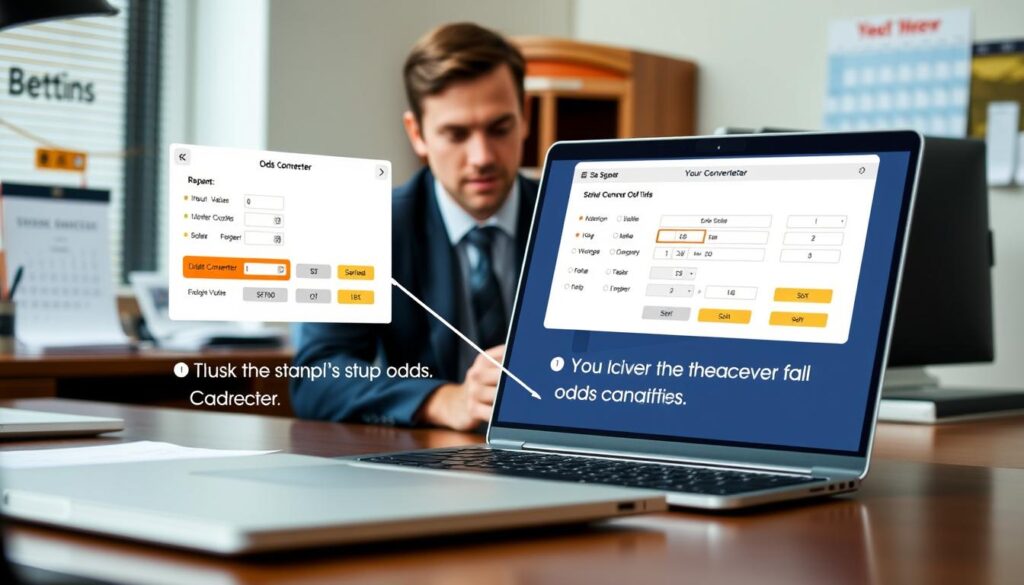
Step 1 — Enter the odds in the chosen field. The tool will convert fractional to decimal and fill the American equivalent while showing the implied probability percentage in real time. For example, typing 3/1 returns 4.00 and 25% instantaneously. These odds conversion steps speed up comparison across markets.
Step 2 — Try entering probability as a percent. Inputting 25% will produce fractional 3/1, decimal 4.00, and American +300. The converter reverses the process without extra math, which makes it easy to move between formats when you shop lines at DraftKings, BetMGM, or Bet365.
Step 3 — Use implied probability to compare value across bookmakers. Convert odds into implied likelihood to spot where a market under- or over-prices an outcome. This implied probability guide helps reveal edges and supports decisions on where to place a wager or set a limit order on an exchange like BettorEdge.
Combine the odds converter with stake calculators to estimate returns for singles, each-way, doubles, trebles, accumulators, and structured bets. Enter your stake and selections to see potential profit and loss. These practical odds conversion steps make it simple to plan stakes across multiple bet types.
When you need to convert American odds, enter the Moneyline value and watch the other formats populate. Knowing how to convert American odds quickly avoids mistakes when comparing U.S. offers to international sites. Use these quick conversions to confirm value before committing funds.
Odds formats explained: Fractional, Decimal, and American
Understanding how odds formats work helps you compare markets and spot value across sportsbooks. This section breaks down the three main displays you’ll see, shows simple math for payouts, and ties each format to implied probability so you can make smarter wagers.
Fractional odds: meaning and UK/Ireland usage
Fractional odds are the traditional UK odds format used by British bookmakers such as William Hill and Betfred. The fraction shows profit relative to stake. For example, 2/1 on a $5 stake returns $10 profit and $15 total payout.
That format makes it easy to calculate profit-on-stake. Bookmakers in Ireland use the same style. If you want to convert fractional odds quickly, an online tool like the odds calculator offers instant changes between formats.
Decimal odds: returns and simple multiplication examples
Decimal odds display the total return per unit staked. Multiply your stake by the decimal to get the payout. A $5 bet at 3.0 returns $15 because $5 × 3 equals $15.
Decimal odds are common across Europe and Australia. Decimal odds examples include 1.50 for a short favorite and 3.10 for a longer shot. The format simplifies quick mental math for total returns.
American (Moneyline) odds: positive vs negative formats
American moneyline odds appear as positive or negative numbers. Positive odds, like +150, show profit on a $100 bet — +150 yields $150 profit on a $100 stake. Negative odds, like −200, show how much you must stake to win $100 — −200 requires $200 to win $100.
US sportsbooks such as DraftKings and FanDuel default to American moneyline odds for most markets. Learning this display helps bettors in the United States compare lines and implied probability across events.
For a quick conversion between fractional, decimal, and American odds, try the interactive odds calculator at RotoWire’s odds calculator. Use it to check payouts, implied probability, and to confirm how odds formats work in real time.
Formulas behind the converter: how conversions work

Understanding the math makes conversions simple. This short guide lays out key odds conversion formulas so you can move between formats with confidence.
Fractional to Decimal and to Probability
The fractional to decimal formula is straightforward: Decimal = (Numerator / Denominator) + 1. For example, 3/1 becomes 4.00. Use this when UK-style odds need to be shown as returns per dollar.
Turn fractional odds into implied probability with a simple ratio. Probability % = Denominator / (Numerator + Denominator) × 100. That gives 3/1 a 25% chance and 1/3 a 75% chance.
Convert fractional to American by scaling the fraction. If fraction > 1 then American = (Numerator / Denominator) × 100, producing +300 from 3/1. For fractions below 1 use −(Denominator / Numerator) × 100, giving −300 from 1/3.
Decimal to Fractional, American, and Probability
To get fractional odds from decimal use Fractional = Decimal − 1. A 1.50 decimal converts to 0.50, or 1/2 in fractional form. That makes reading returns easier for bettors who prefer ratios.
The decimal to American formula uses a two-case rule. If Decimal ≥ 2 then American = (Decimal − 1) × 100, so 4.00 becomes +300. If Decimal
Find implied probability formulas for decimal odds with Probability % = (1 / Decimal) × 100. A 4.00 decimal implies 25% probability, while a 1.33 decimal implies about 75%.
American to Fractional, Decimal, and Probability
Positive American odds convert to fractional by dividing by 100: Fractional = American / 100. For +110 that yields 11/10. Negative American odds use Fractional = 100 / ABS(American), so −200 becomes 1/2.
Convert American to decimal using separate rules. If American > 0 then Decimal = American / 100 + 1, turning +110 into 2.10. If American
Calculate probability from American odds with two formulas. For positive odds use Probability % = 100 / (American + 100) × 100. For negative odds use Probability % = ABS(American) / (ABS(American) + 100) × 100. These give practical percentages for comparing markets.
If you want an interactive check, try the odds converter at aceodds odds converter to verify these conversions in real time.
Implied probability: turning odds into likelihood
The concept of implied probability lets bettors convert odds to probability and view a bookmaker’s pricing as a percentage chance. You can use this to compare markets, check for discrepancies, and improve betting decisions without complex math.
Calculating implied probability from Decimal odds
Decimal odds give a quick route to implied probability. Use Probability % = (1 / Decimal) × 100. For example, Decimal 4 converts to 25% implied probability. That calculation helps you judge whether a quoted price matches your own estimate of an event’s chance.
Interpreting implied probability from Fractional and American odds
Fractional odds convert by dividing the denominator by the sum of numerator and denominator, then multiplying by 100. A 3/1 quote yields 25% and 1/3 gives 75%.
American odds follow two formulas. For positive numbers, use 100 / (American + 100) × 100; +110 becomes roughly 47.62%. For negative numbers, take ABS(American) / (ABS(American) + 100) × 100; −110 becomes about 52.38%.
Using probability to spot value bets and reduce bookmaker margin
Implied probability reveals how sportsbooks price each outcome. Compare these percentages with your own model or market consensus to spot value betting opportunities where your estimated chance exceeds the implied probability.
Sum implied probabilities across all outcomes to measure the overround. Markets with a lower overround give bettors an edge. Traders on exchanges like Betfair and exchanges that emphasize lower fees help reduce bookmaker margin when you shop around.
Use value-seeking methods within legal limits and practice bankroll control. Betting carries risk and support is available for problem gambling.
Common betting calculations beyond odds conversion
Practical betting relies on more than converting odds. Bettors use quick math to calculate potential returns, apply the betting profit formula and compare outcomes across bet types. Tools that pair an odds converter with a calculator make these steps instant and reduce manual error.
Calculating potential returns and profit from stake and odds
For decimal odds, total return equals stake × decimal odds. Profit equals total return − stake. For fractional odds, profit equals stake × (numerator/denominator) and total return equals stake + profit. These simple formulas let you test scenarios before placing real money.
Each-way, accumulator and multiple-bet calculations
Each-way calculation uses two equal stakes: one for the win leg and one for the place leg. Bookmakers set place fractions, so place returns equal stake × (win odds × place fraction) plus stake when applicable. Accumulator calculator tools multiply decimal odds of every selection to form an accumulator decimal, then multiply that by the stake to get the return.
Bet type examples: singles, doubles, trebles, accumulators and system bets
Singles pay a single selection. A double combines two selections into one bet. A treble links three selections. An accumulator joins four or more selections into one bet and pays only if every selection wins. Complex system bets split stakes across many combinations.
Common named systems include Trixie (3 selections, 4 bets), Patent (3 selections, 7 bets), Yankee (4 selections, 11 bets), Canadian (5 selections, 26 bets), Heinz (6 selections, 57 bets), and Goliath (8 selections, 247 bets). Lucky 15, Lucky 31 and Lucky 63 cover all single and multiple combinations for 4, 5 and 6 selections respectively.
Specialized calculators handle the heavy lifting for system bets. They sum returns across each component, apply the betting profit formula to show net gain, and let you compare stake layouts. Use these tools to manage bankroll and test strategies within legal and responsible play limits.
How to convert probability % back into odds
Turning a model’s probability estimate into market odds is simple and useful. To convert percent to odds as fractional odds, use Fractional Odds = (100 − Probability) / Probability. For example, a 25% estimate becomes (100 − 25) / 25 = 3, shown as 3/1. This probability to fractional method helps you set clear target prices when shopping lines.
To get probability to decimal odds, add 1 to the fractional conversion: Decimal Odds = ((100 − Probability) / Probability) + 1. Using 25% again gives 4.00. Decimal odds are handy on US-facing exchanges and for quick stake-return calculations, making it easy to compare offers across bookmakers.
Convert probability to American with a sign based on likelihood. If Probability ≥ 50%, use American = −(100 × Probability) / (100 − Probability). So 75% becomes −300. If Probability
Practically, these conversions let you spot value by comparing your model to bookmaker pricing and place limit orders on exchanges like Betfair or BetMGM when lines diverge. Always pair probability to odds work with bankroll rules and follow local legal and support resources to bet responsibly.